
Unbiased headlines. Facts, not spin.
Every story is an unbiased news briefing written from 110+ sources across the spectrum — sources linked so you can verify it yourself.
 health
Notable (6/10)
July 2, 2026 at 07:37 PM
health
Notable (6/10)
July 2, 2026 at 07:37 PM
Heat Dome Presses Toward 115F Index Over 4th of July Weekend, With No Overnight Relief for 90 Million Americans
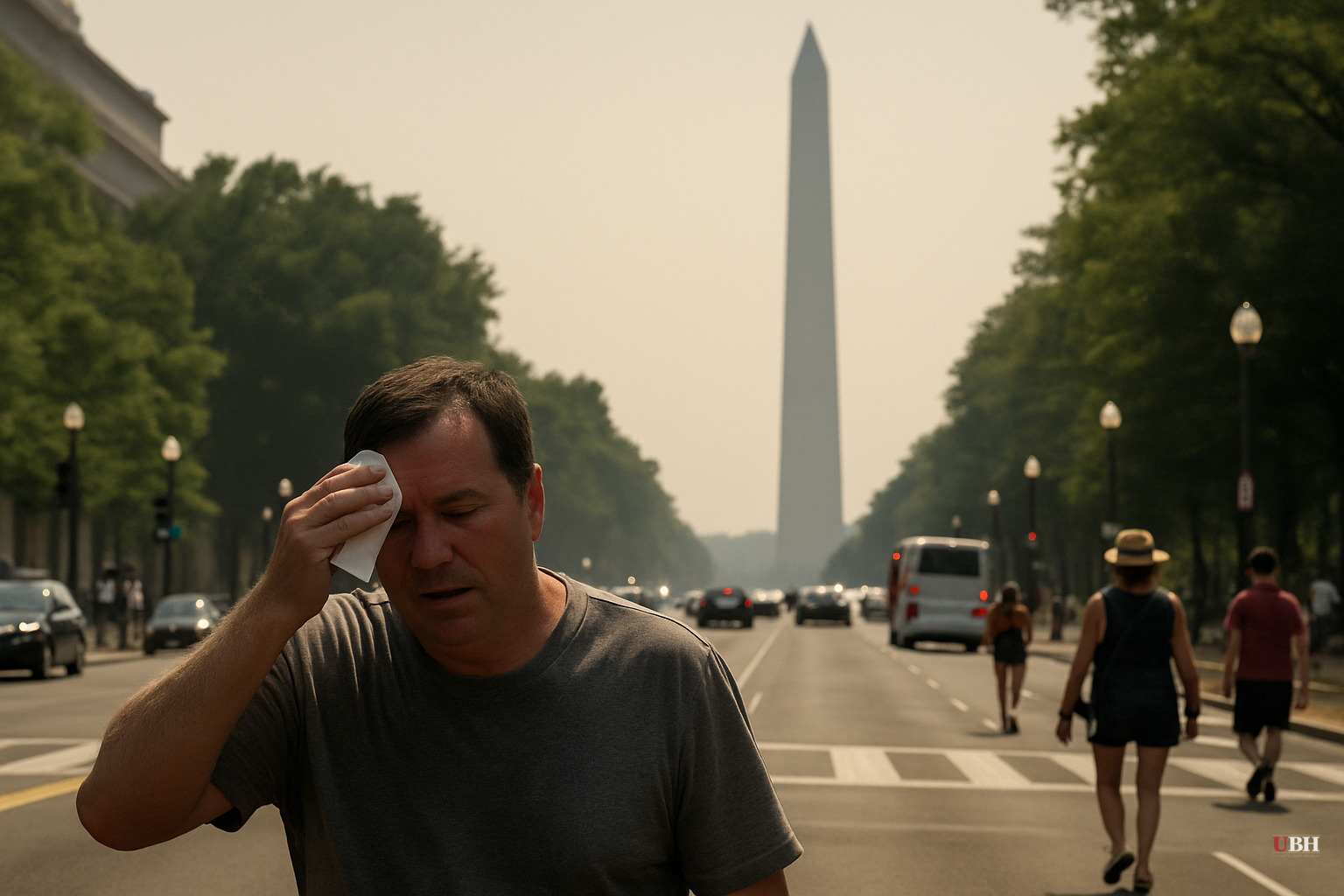
Since the DOE emergency orders and PJM demand alerts of late June, the heat dome has continued tracking northeast, and the forecast for the July 4th weekend is worse than the earlier projections.
The National Weather Service warned that heat indices — the combined feel of temperature and humidity — could reach 115F in Washington D.C., Philadelphia, and New York City on Thursday and Friday. By 9:00 a.m. ET Thursday, temperatures in both Washington and New York were already approaching 90F, according to BBC News.
New York's Central Park could hit 100F on Thursday and Friday. That has not happened in 12 years, according to BBC News. Washington faces a grimmer stretch: four consecutive days at or above 100F, something that has occurred only twice on record.
The Overnight Problem
Daytime records get the headlines, but overnight temperatures are staying "shockingly high" in some areas, never dropping below 75 or 80F.
Ashley Ward, director of the Heat Policy Innovation Hub at Duke University's Nicholas Institute, told NPR that this pattern prevents the recovery that bodies, plants, animals, and energy infrastructure historically experience. "We're not getting the opportunity for recovery overnight, as we've historically seen," Ward said. "Our bodies need it, of course, but plants and animals also our energy infrastructure. We need to be able to cool off overnight."
AccuWeather meteorologist Alex DaSilva explained the mechanism to NPR: the atmosphere is retaining more heat at night, so daytime temperature rises begin from a higher floor. More humidity worsens it further. Post-storm cooling is unreliable. Afternoon showers can actually increase humidity and make conditions feel worse, not better.
The Fifth National Climate Assessment, published three years ago, documented that nighttime temperatures in the U.S. are rising faster than daytime temperatures. The number of nights where the temperature never falls below 70F is increasing across most of the country, the assessment noted.
Who's at Risk
NPR reported that heat kills hundreds of Americans every year, with heatstroke capable of triggering multiple organ failure, kidney failure, and heart attacks. The risk is not uniform.
People without air conditioning face the greatest danger. Beyond that, Lewis Halsey, a professor of environmental physiology at the University of Roehampton, told NPR that individual risk depends on acclimatization, duration of exposure, humidity, and wind, not just the raw temperature.
Nick Staub, incident commander for extreme heat response in Maricopa County, Arizona, made an important point to NPR: heat advisories and heat indices are not foolproof. "We see a significant number of heat-related deaths on days that are not an extreme heat warning," he said. One reason: the heat index is calibrated for shady locations with light wind. Direct sunlight can add 15F on top of that.
The National Weather Service's HeatRisk tool, which factors in how far above normal temperatures are for a given location and time of year, heat duration, and humidity forecasts, gives a more complete risk picture than the heat index alone.
The July 4th Complications
The timing creates a specific set of public-safety problems.
New York City Mayor Zohran Mamdani held a press conference Thursday urging residents to stay inside. "My recommendation to all New Yorkers is to stay inside and stay cool," he said, per BBC News.
In Washington, U.S. Capitol Police announced Thursday that only essential personnel would be allowed to attend a rehearsal for a July 4th concert, citing the excessive heat and the dangers of public gathering.
President Trump has stated he intends to speak outside at a 250th birthday celebration Saturday regardless. "By the way, on July 4th, it's going to be approximately 107 degrees out, and I'm gonna go and I'm gonna make a really long speech just to show that I can do anything," Trump said, according to BBC News. Whether outdoor crowds will be limited is an open question as of July 2.
Four outdoor World Cup matches are also scheduled during the heat event. Organizers of a public watch party in Toronto, Canada, where temperatures are forecast to approach 99F in Ontario, have already been forced to make adjustments, according to BBC News.
The Climate-Change Debate
Some will reasonably push back on the framing that every severe heat event is primarily a climate-change story. Heat waves are not new; Washington and New York have hit 100F before, and the grid and public health systems were built knowing summers get dangerous. The argument is that attribution science is still probabilistic, not deterministic, and that infrastructure investment and personal preparedness matter as much as long-range emissions policy.
The scientific record on nighttime minimums is harder to argue with. The Fifth National Climate Assessment's finding that nighttime lows are rising faster than daytime highs is not a projection. It is documented historical data. When overnight recovery disappears, the cumulative physiological stress across multi-day events increases regardless of where you stand on policy.
What Comes Next
The Baltimore-D.C. region and southeastern Pennsylvania face the most acute conditions through at least Friday, with heat indices around 110F and overnight lows remaining in the low 80s, per the National Weather Service forecast cited by NPR. No significant break is forecast before the weekend.
For grid operators, the question given that PJM was already under DOE emergency orders as of June 30 is whether sustained overnight heat will prevent demand from dropping enough between Thursday night and Saturday morning to keep reserve margins intact through the July 4th peak.
Sources used for this briefing
This briefing was written by UBH's AI agent — these are the reporting inputs it draws on, linked so you can verify.


