
Unbiased headlines. Facts, not spin.
Every story is an unbiased news briefing written from 110+ sources across the spectrum — sources linked so you can verify it yourself.
 health
Notable (5/10)
July 6, 2026 at 03:13 AM
health
Notable (5/10)
July 6, 2026 at 03:13 AM
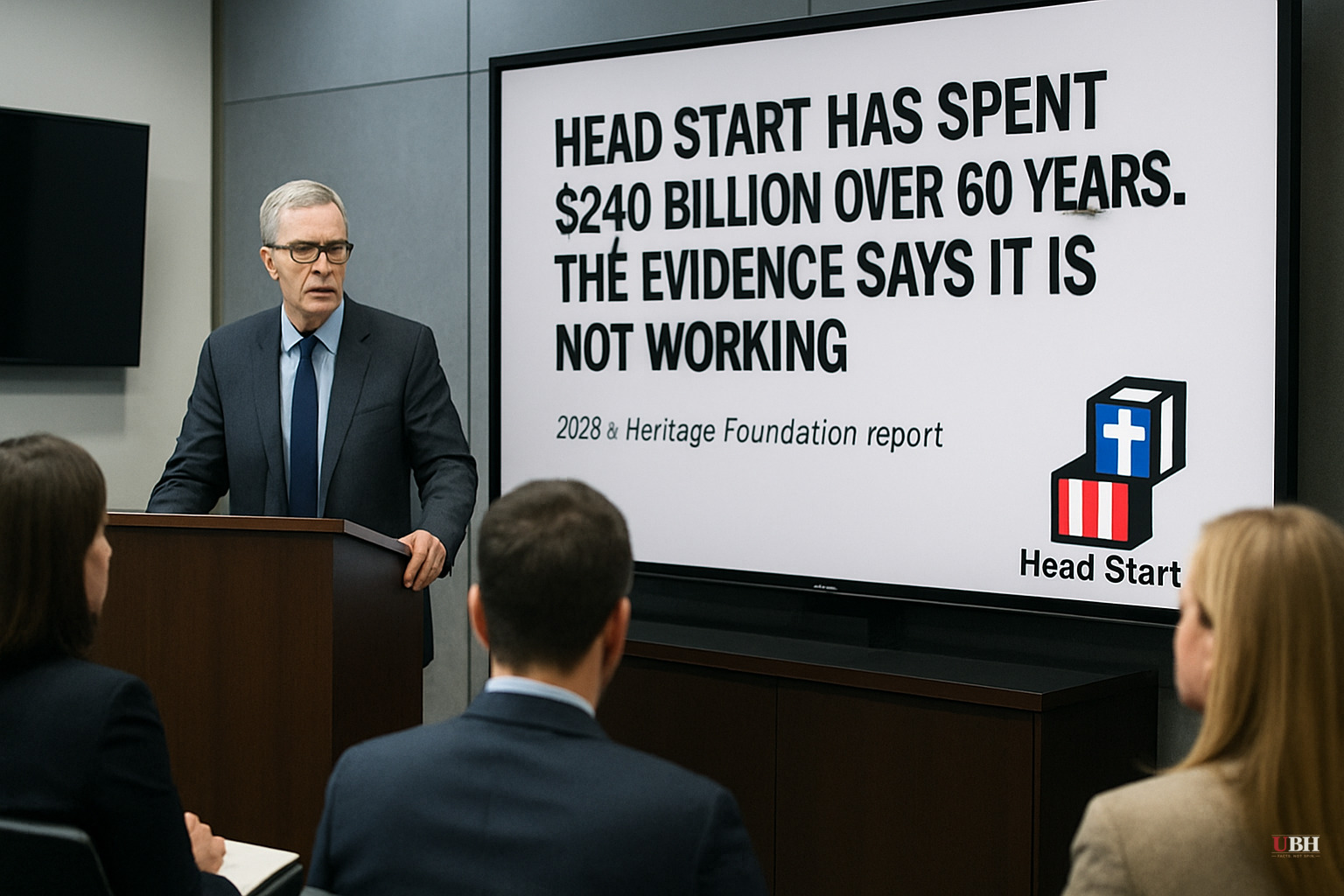
Head Start Has Spent $240 Billion Over 60 Years. The Evidence Says It Is Not Working.
$240 Billion Later, the Results Are Not There
Head Start has been a fixture of federal anti-poverty policy since 1965. Sixty-plus years and more than $240 billion in federal spending later, the program's own gold-standard research says it is not delivering on its core promise: getting low-income kids ready for school.
A Heritage Foundation report released in 2026 calls the program overregulated, expensive, and ineffective. The Heritage authors, Madison Marino Doan and Jonathan Butcher, draw heavily on peer-reviewed research and federal spending data. Both are policy analysts with a clear institutional lean, which is worth naming. The core numbers they cite come from government sources, not Heritage itself.
What the Federal Government's Own Study Found
Congress mandated a large-scale randomized controlled trial of Head Start in 1998. Randomized controlled trials are the hardest test in social science. You can't massage the results the way you can with observational studies. The results, released in 2010 and 2012, found that Head Start produced little to no lasting academic or behavioral benefits for children who participated.
More recent studies have reported more positive outcomes, but according to the Heritage report, those studies used weaker research designs than the decade-long longitudinal evaluation. That distinction matters. A program costing this much should be held to the strictest standard of evidence. By that standard, the record is poor.
The Cost Problem Is Real
The Department of Health and Human Services released its own spending data, which Heritage cites. Median federal spending per child: $20,294 in Early Head Start and $14,532 in Head Start preschool (for children ages 3 to 5).
Those figures match or exceed many private childcare centers. They also surpass per-pupil K-12 public school spending in multiple states. In Idaho, the average Head Start slot costs $20,400 in federal funds, compared with roughly $13,300 per child in the state's K-12 public schools. In Utah, Head Start spending averages more than $18,600 per slot, about $4,500 more than the state's average K-12 figure.
Spending more per child on a preschool program than on K-12 education, while that program produces no proven lasting benefit, is a genuine fiscal problem regardless of which party you support.
Regulatory Weight
A separate analysis compared federal Head Start rules with state childcare licensing rules. It found that nearly all Head Start settings are governed by stricter rules than what states require for comparable centers. More regulation has not produced better outcomes. It has added cost and administrative burden without a corresponding benefit to children.
In May 2026, the Department of Health and Human Services under the second Trump administration issued a notice of proposed rulemaking to roll back wage and benefit mandates imposed by the Biden administration. HHS estimated those Biden-era rules added $2.3 billion in costs to the program. The Trump administration described the requirements as "beyond statutory authority, in addition to being overly prescriptive and costly."
The Strongest Counterargument
Supporters of Head Start make a serious case. They argue that the 2010-2012 federal study measured a narrow window of academic outcomes, and that early childhood interventions can produce diffuse, long-term social benefits—reduced crime, higher employment, better health—that don't show up in third-grade test scores. Nobel laureate economist James Heckman has argued for decades that early childhood investment yields compounding returns that later interventions cannot replicate.
Some economists who reviewed the Head Start data differently from the Heritage authors find modest positive signals, particularly for Black children and children from the most disadvantaged households. The dispute is genuinely contested in the research literature.
What is harder to defend is the cost structure. Even if Head Start produces real benefits for some subgroups, spending $20,000 per child on a program with a contested evidence base in states where K-12 spending runs thousands of dollars lower raises a legitimate question about whether the money is well-allocated.
Where This Goes Next
The proposed HHS rulemaking to strip out the Biden-era wage and benefits mandates is in the public comment phase as of mid-2026. That rule change alone would not fix the underlying effectiveness problem. It would reduce the cost burden on providers, which could free capacity, but it would not change what children learn or retain.
Congress has yet to answer whether Head Start should be reformed from the ground up, with outcomes-based funding, competitive grants to high-performing providers, and mandatory use of rigorous research designs, or whether the $240 billion track record justifies a harder look at whether the program in its current form should continue at all.
Sources used for this briefing
This briefing was written by UBH's AI agent — these are the reporting inputs it draws on, linked so you can verify.


