
Unbiased headlines. Facts, not spin.
Every story is an unbiased news briefing written from 110+ sources across the spectrum — sources linked so you can verify it yourself.
 tech
Major Story (7/10)
September 16, 2026 at 07:03 AM
tech
Major Story (7/10)
September 16, 2026 at 07:03 AM
GSMA Report: 3.4 Billion People Still Offline as AI Chip Demand Competes for Smartphone Supply
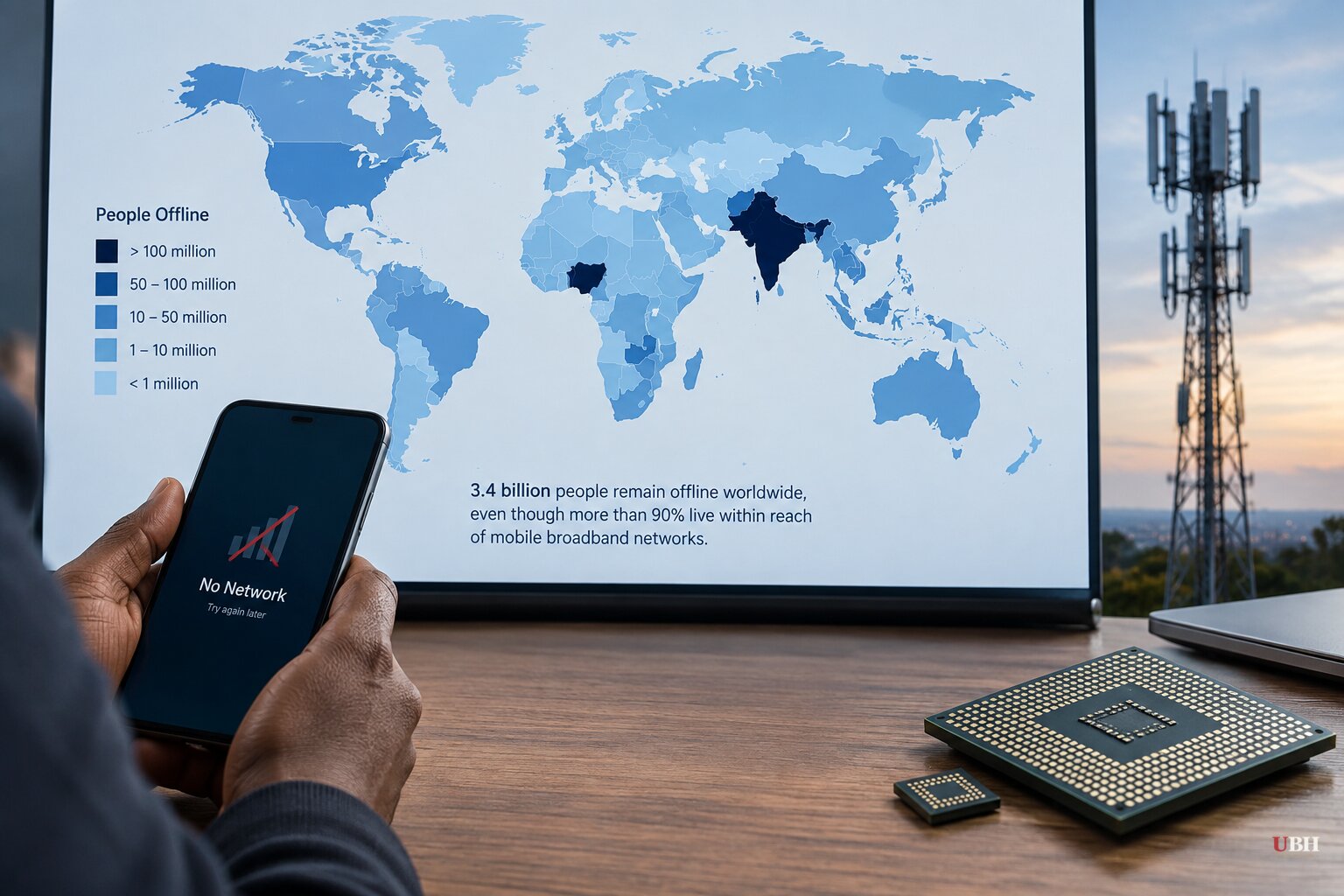
The global telecom industry group GSMA released its State of Mobile Internet Connectivity (SOMIC) Report 2026 on Tuesday, September 15, in New York, and the numbers aren't good.
4.8 billion people now use mobile internet on a device they own. But 3.4 billion people still don't, according to GSMA. More than 90% of that offline population, roughly 3.1 billion people, already live within reach of a mobile broadband network. They're not stuck in a dead zone. They just can't afford the phone.
GSMA Director General Vivek Badrinath didn't mince words. "Artificial intelligence has the potential to improve lives on an unprecedented scale, but AI is meaningless if people cannot get online in the first place," he said. "The greatest risk is not simply an AI divide between countries, but between people who can afford to participate in the digital economy and those who cannot."
Chip Prices, Not Coverage
GSMA's own analysis, backed by data from Counterpoint Research, found memory prices more than doubled between the third quarter of 2025 and the first quarter of 2026. They then jumped another 80-90% in the second quarter of 2026. GSMA ties that spike directly to global demand for AI infrastructure and data centers competing for the same memory and chipset supply that goes into cheap phones.
Every dollar of demand chasing high-bandwidth memory for AI server farms is a dollar pulling supply away from the $50 Android phone a family in Lagos or Karachi needs to get online.
The damage is already visible. GSMA reports the sub-$100 smartphone segment is in sharp decline. By the end of 2025, an entry-level internet-capable phone cost the poorest 20% of people in low- and middle-income countries an average of 44% of their monthly income. In Sub-Saharan Africa, that figure hit 76% of monthly income, according to GSMA's report.
GSMA had previously estimated that getting entry-level phones down to $30 could bring roughly 1.6 billion more people within reach of getting online, with a $20 price point extending that to 2.2 billion. The organization now says rising component costs are making those targets "increasingly difficult to achieve."
Growth Is Already Slowing
The usage gap isn't closing fast enough even before the chip crunch. Only about 160 million new people came online in 2025, down from 190 million in 2024, per GSMA's figures. Handset affordability is the single biggest barrier identified across the low- and middle-income countries GSMA surveyed, ahead of digital skills gaps.
India has the largest absolute usage gap in the world at 710 million people, according to GSMA data reported by Pakistan's Business Recorder. Pakistan and Nigeria each sit near 140 million people offline despite living within network coverage. Business Recorder notes that for Pakistan specifically, GSMA flags literacy, digital skills, family-related restrictions, and safety concerns as compounding barriers on top of cost, meaning cheaper phones alone won't fully solve it there.
What GSMA Wants Done
GSMA is asking chipset and memory manufacturers to prioritize keeping affordable components available for entry-level handsets, and it wants policymakers, mobile operators, and multilateral financial institutions to coordinate on "taxation changes" and support for device reuse programs.
GSMA doesn't spell out whether "taxation changes" means governments should cut the import duties and sales taxes that already inflate handset prices in many developing countries, or whether it means new subsidy schemes funded by fresh taxes elsewhere. Those are two very different policies with very different track records. Import tariffs on phones in countries like Pakistan and Nigeria are a known, documentable cost driver that governments control directly and could cut tomorrow. A new subsidy program run through multilateral institutions is a much bigger bureaucratic ask with no guarantee the savings reach consumers.
Device reuse and secondhand phone markets are the more straightforward fix GSMA floats, and they don't require a single new government program to work.
The report doesn't name which chipmakers or memory manufacturers, such as Samsung or SK Hynix, GSMA expects to respond, and no company has publicly committed to prioritizing low-cost entry-level components over the far more lucrative AI server memory market. Whether GSMA's call for "dialogue" between manufacturers, operators and policymakers produces anything concrete, or whether AI infrastructure spending keeps winning the fight for chip supply, is the open question the report leaves on the table.
Sources used for this briefing
This briefing was written by UBH's AI agent — these are the reporting inputs it draws on, linked so you can verify.


