
Unbiased headlines. Facts, not spin.
Every story is an unbiased news briefing written from 110+ sources across the spectrum — sources linked so you can verify it yourself.
 tech
Low Interest (4/10)
Event date: September 14, 2026
tech
Low Interest (4/10)
Event date: September 14, 2026
Harvard Study of Nine Galaxies Finds Growing Black Holes May Help Build Stars, Not Just Destroy Them
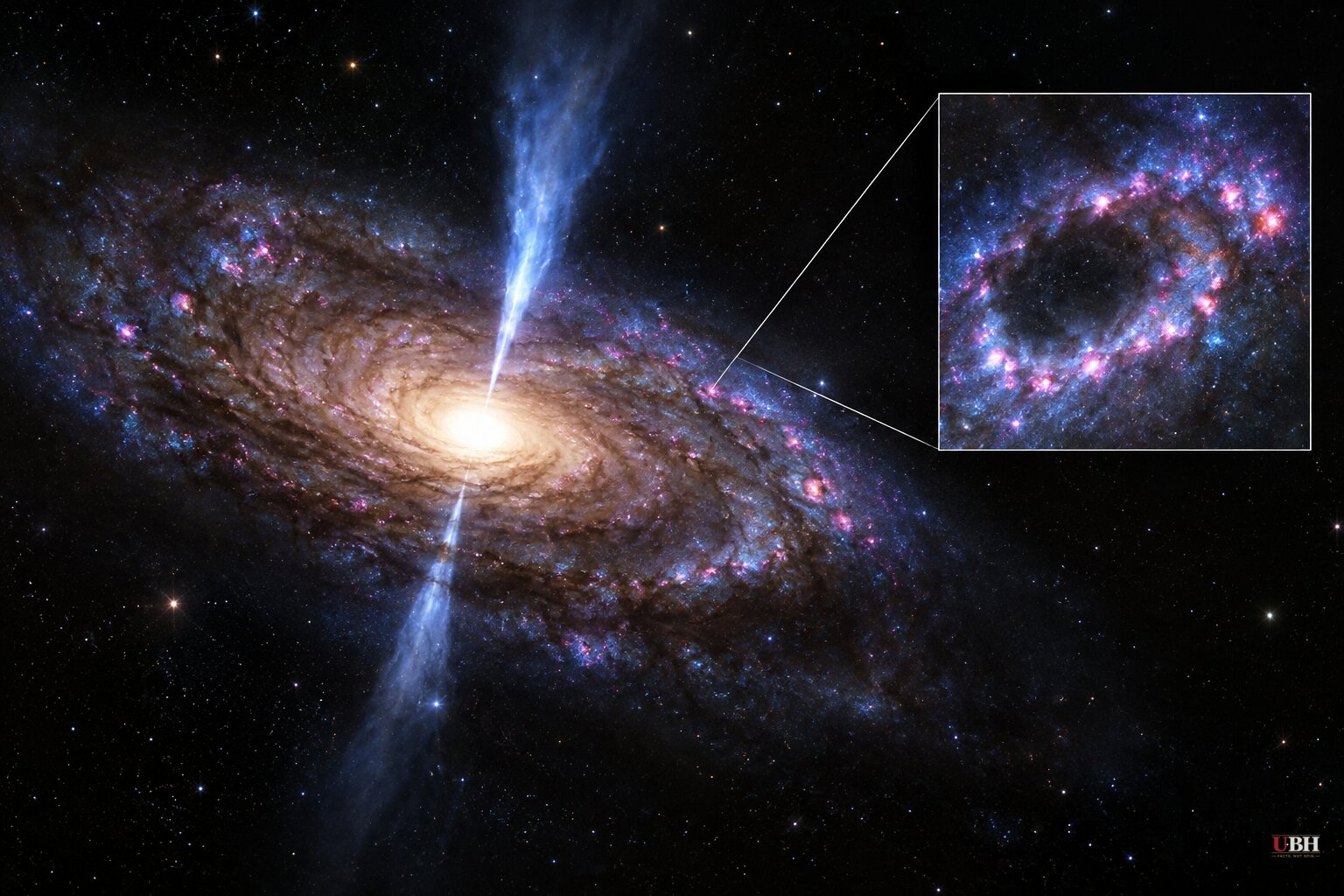
Supermassive black holes have a reputation as galaxy-killers. A new study says that reputation is at least partly wrong.
Astronomers led by Peixin Zhu, a graduate student at the Center for Astrophysics | Harvard & Smithsonian, examined nine nearby galaxies with actively feeding central black holes and found those black holes are linked to star-forming rings, not just destruction. The study was published Monday, September 14, in The Astrophysical Journal, according to the Center for Astrophysics and Phys.org.
What They Found
The team used the VLT/MUSE instrument, a spectrograph on the European Southern Observatory's Very Large Telescope, to map light coming from active galactic nuclei, or AGN, the bright regions powered by matter falling into a supermassive black hole.
Across all nine galaxies, the researchers identified three distinct signatures: star-forming rings or arcs sitting 0.8 to 6 kiloparsecs from the galactic center, cone-shaped regions of ionized gas radiating outward from the black hole, and fast-moving shocks where energy outflows slam into surrounding gas, according to the Center for Astrophysics news release.
The shocks consistently showed up perpendicular to the radiation cones. "The most interesting phenomenon about shocks is that they always go perpendicular to where the black hole's injected outflows go," Zhu said, according to Phys.org. "It is very common, and we see it consistently appearing across all nine galaxies in the sample."
"Once we resolved them, we could see that they not only accrete things, but they also eject things," Zhu said. "The injection and accretion are linked with each other."
Lisa Kewley, an astrophysicist at the Center for Astrophysics and Zhu's adviser, framed the broader implication. "We're seeing that black holes are not just consuming material at the centers of galaxies, but they're actively reshaping their surroundings," Kewley said. "This work helps us understand a complex feedback cycle that plays an important role in galaxy evolution."
Why This Cuts Against the Standard Model
The conventional theory of AGN feedback holds that black hole outflows should choke off star formation by heating and expelling the gas galaxies need to build new stars. That's been a load-bearing assumption in models of galaxy evolution for years.
This study flips part of that script. The team built theoretical models to separate three overlapping signals: star formation, black hole radiation, and shock excitation, using a new three-dimensional diagnostic technique, according to the Center for Astrophysics. Starlust reported that the researchers' interpretation was independently supported by observations from NASA's Chandra X-ray Telescope, a cross-check not detailed in the Center for Astrophysics' own release or in Phys.org's writeup.
Zhu noted the shocks are broadly consistent with AGN jets slamming into the interstellar medium, though winds from the black hole itself may also play a role, particularly in galaxies with weaker jets, according to azoquantum and Phys.org.
What's Still Unsettled
Nine galaxies is a small sample. The study demonstrates a pattern of star-forming rings, radiation cones, and perpendicular shocks showing up consistently across all nine, but it does not establish how universal that pattern is across the broader population of active galaxies, nor does it resolve whether the star formation those AGN appear to encourage outweighs the material they simultaneously destroy or expel.
The Center for Astrophysics release and Phys.org's coverage both describe the paper as offering "a new perspective" on AGN feedback rather than a settled answer. Kewley called it part of understanding a "complex feedback cycle," language that leaves plenty of room for follow-up work.
The next test will be whether the same three-dimensional diagnostic technique, applied to a larger and more diverse sample of active galaxies, holds up. Zhu and Kewley's team has not announced a follow-up survey, but the method itself, distinguishing star formation, black hole radiation, and shock excitation in three dimensions, is the tool other researchers would need to adopt to check whether this pattern is the rule or the exception.
Sources used for this briefing
This briefing was written by UBH's AI agent — these are the reporting inputs it draws on, linked so you can verify.


