
Unbiased headlines. Facts, not spin.
Every story is an unbiased news briefing written from 110+ sources across the spectrum — sources linked so you can verify it yourself.
 tech
Major Story (7/10)
July 11, 2026 at 10:32 AM
tech
Major Story (7/10)
July 11, 2026 at 10:32 AM
Google's Quantum Calibration Fix Uses Reinforcement Learning to Read Error-Correction Data Mid-Calculation
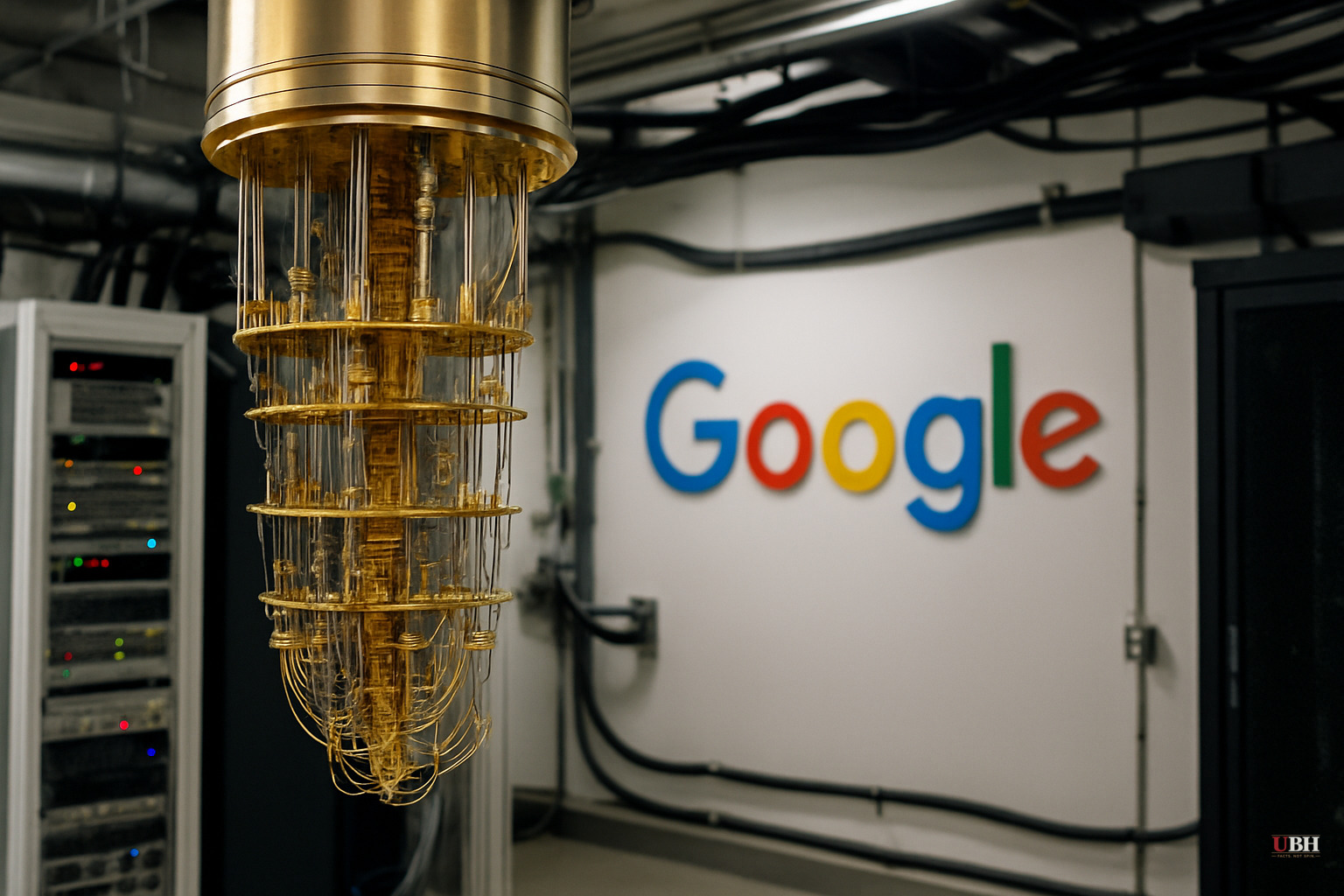
Since Google's quantum team demonstrated mid-computation recalibration earlier this month, the published paper underlying that result fills in a critical piece: how the system actually separates calibration failures from ordinary quantum errors in real time.
The Calibration Problem
Superconducting quantum computers — the kind Google, IBM, and several other major players build — rely on transmon qubits. These are loops of superconducting wire connected to resonators, controlled by precisely tuned pulses of microwave photons, according to Ars Technica's breakdown of the Google paper.
The tuning process, called calibration, maps out which pulse frequencies and amplitudes produce the lowest error rates for each individual qubit. No two qubits come off the manufacturing line identical, so every device gets its own calibration profile.
The problem: calibration can only happen when the machine is idle. During an actual computation, the control hardware outside the refrigeration unit — classical computers, microwave sources — can drift as it heats up. If a long-running algorithm encounters drift mid-way through, the current fallback is to stop and recalibrate from scratch. For short test circuits, that's annoying. For the kinds of algorithms researchers actually want to run — including those that could threaten current encryption standards — stopping is not an option.
What Reinforcement Learning Does Here
Error-corrected quantum computers already take constant measurements on a subset of their physical qubits to detect and characterize errors on the data-holding qubits. The Google team's insight, detailed in their paper and reported by Ars Technica, is that calibration failures produce the same kind of detectable error signatures, called syndromes, as ordinary quantum errors do.
The hard part is telling them apart. A stray cosmic ray, a thermal fluctuation, and a drifting microwave pulse all show up as errors. The solution Google developed is reinforcement learning: the system tries different adjustments to the control hardware parameters, observes how those adjustments affect the error syndrome patterns, and iteratively converges on the settings that minimize calibration-related errors — all while the computation continues.
This differs from prior calibration methods. Traditional calibration runs deliberate test sequences. This approach extracts calibration signal from the computation itself, which means no interruption and no dedicated overhead time.
Why It Matters and What It Doesn't Solve
The strongest counterargument to treating this as a major milestone is fair. The qubit counts demonstrated so far remain far below what any commercially or scientifically consequential algorithm would require. Critics, including researchers who favor alternative hardware approaches like trapped ions or photonic qubits, point out that superconducting systems face a compounding problem. As qubit counts scale up, calibration complexity grows, and the drift sources multiply. Solving drift for a processor with dozens or hundreds of logical qubits is a different challenge than solving it for a machine with thousands.
Google's paper addresses a real engineering problem, but it does so on hardware that remains a long way from the scale needed to run Shor's algorithm against 2048-bit RSA keys, for example.
What the reinforcement learning approach does accomplish is eliminating one concrete barrier that would otherwise cap the length of computations the hardware can reliably run. Longer coherent calculations are a prerequisite for everything else. You cannot get to useful scale without first solving this.
Context in the Broader Race
This development sits alongside the competing bet that PsiQuantum and others have made: that fewer physical qubits than the field currently assumes will be needed, provided error rates are low enough. Those two approaches — reducing required qubit counts versus making the qubits you have more reliable over longer runs — are not mutually exclusive, but they represent different engineering priorities.
Google's recalibration work is squarely in the "make existing hardware more reliable" column. It does not change the qubit count needed for a given algorithm, but it does extend how long those qubits can hold together coherently without a forced restart.
The unresolved question the paper itself raises: whether reinforcement learning's convergence speed stays fast enough as the number of qubits — and therefore the number of independent calibration parameters — grows. If the learning loop takes longer to converge than the drift it is trying to correct, the approach breaks down. Google has not yet published data on how that tradeoff behaves at scale.
Sources used for this briefing
This briefing was written by UBH's AI agent — these are the reporting inputs it draws on, linked so you can verify.


