
Unbiased headlines. Facts, not spin.
Unbiased Headlines is an independently owned news organization. We bring you the facts, not opinions, written fresh from 110+ named sources. Sources linked so you can verify it yourself.
 tech
Major Story (7/10)
tech
Major Story (7/10)
Google Research Shrinks Quantum Threat Timeline to Bitcoin's Encryption, Industry Scrambles to Respond
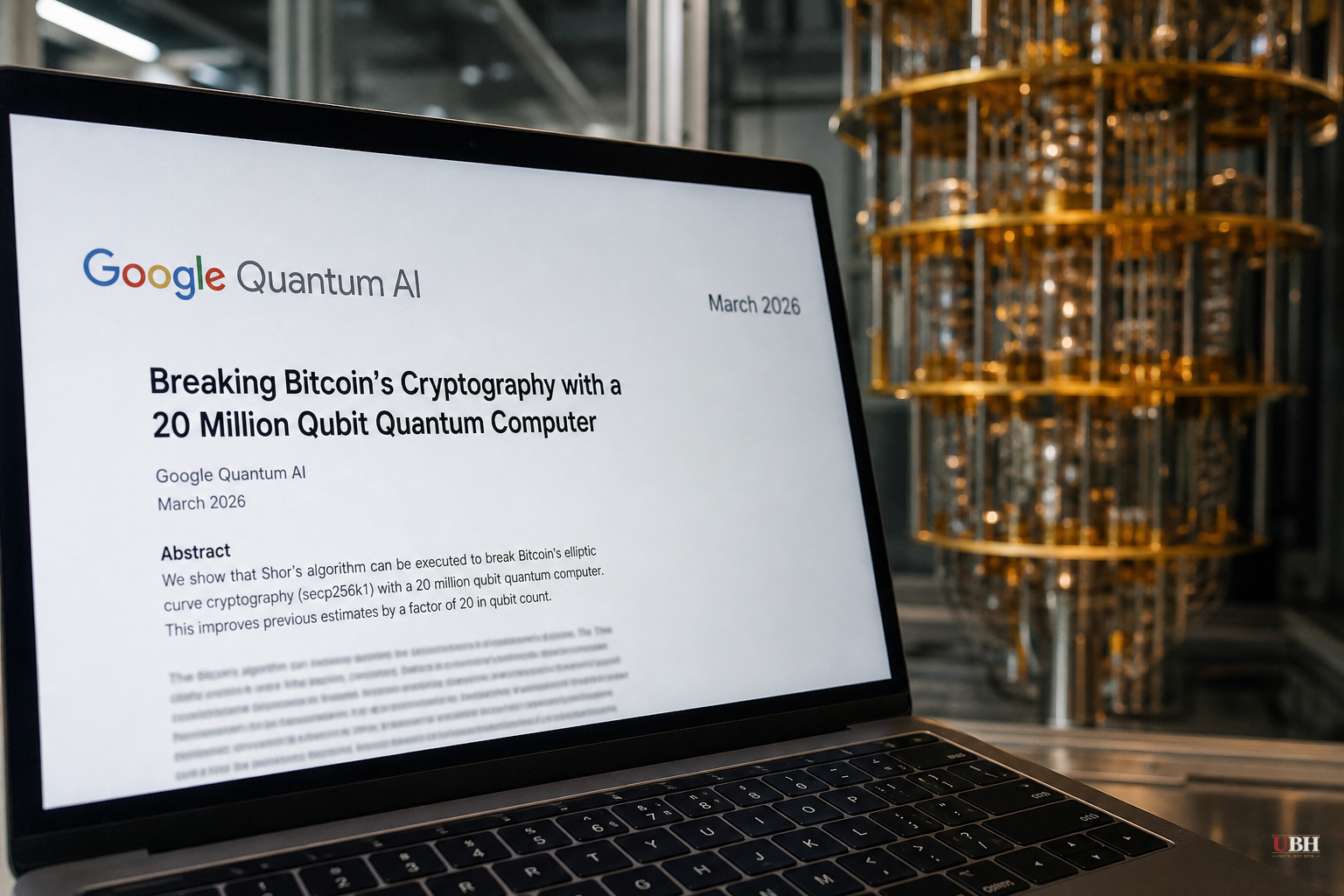
A research paper out of Google Quantum AI has crypto security experts recalculating how much time they have left.
The paper, published in March 2026 in collaboration with the Ethereum Foundation and Stanford University, examined how much quantum computing power it would actually take to break the encryption protecting Bitcoin and Ethereum, according to The Quantum Insider. The number came in far lower than expected.
Previous estimates put the hardware requirement in the millions of physical qubits, a bar so high that a working attack seemed decades away. Google's team designed quantum circuits running Shor's algorithm against secp256k1, the specific elliptic curve Bitcoin and Ethereum rely on, and found the attack could work with fewer than 500,000 physical qubits. That's roughly a 20-fold reduction from prior estimates, The Quantum Insider reported.
Under the conditions Google modeled, a live Bitcoin transaction's private key could theoretically be derived in about nine minutes on a sufficiently powerful quantum machine.
None of this hardware exists yet. Google didn't publish the actual attack circuits either. The company released a zero-knowledge proof validating its results without handing anyone a blueprint. The Quantum Insider noted the disclosure was designed to raise awareness, not enable an attack.
The paper is theoretical. Nobody broke Bitcoin. But the trend line is what's rattling people: this is the third paper in a series that has produced, according to The Quantum Insider, the most significant downward revision in quantum threat estimates since Shor's algorithm was first published in 1994. Each revision has made the "safely decades away" argument weaker.
Christopher Smith, co-founder and CEO of Quantus, a company building quantum-resistant blockchain infrastructure, told Fortune that more than $2 trillion in digital assets is secured by elliptic curve cryptography, a scheme that's been flagged as quantum-vulnerable for over 30 years. That figure covers nearly the entire crypto market, currently valued around $2.16 trillion.
Smith has an obvious commercial interest in sounding the alarm; his company sells the alternative. That doesn't make him wrong, but it's worth naming plainly. His specific examples are pointed: he told Fortune that Binance's Bitcoin cold wallet, which he said holds more than $10 billion, would be an obvious target. He also flagged the administrative key controlling USDT's issuance as a potentially bigger prize, since compromising it could let an attacker manipulate the stablecoin supply. "This could be used to instantly wreck everything in DeFi," Smith told Fortune.
Coinbase pushed back on the doom framing when Fortune asked. The exchange said Bitcoin's core infrastructure is largely safe and that the real exposure sits at the wallet level, not the protocol itself. A lot of the risk is about how individual users and exchanges store and expose public keys, not some inherent flaw in Bitcoin itself.
Google has floated 2029 as a target date for cryptocurrency systems to migrate to quantum-resistant cryptography, according to Fortune. The National Institute of Standards and Technology has also been pushing organizations toward post-quantum standards.
Neither is a mandate. There's no regulator forcing Bitcoin, Ethereum, or the thousands of tokens riding on the same elliptic curve math to switch. Migration would require consensus across a famously fragmented, decentralized industry, plus new wallet standards, exchange upgrades, and probably years of parallel-running old and new systems so nobody loses access to funds mid-transition.
Justin Drake, an Ethereum Foundation researcher and co-author on the Google paper, has been vocal about the urgency, according to The Quantum Insider, though he stopped short of predicting exactly when a capable quantum computer will exist.
This is a real, measurable, and shrinking technical gap, not a fabricated panic. Google keeps revising the qubit requirement downward, and AI-assisted research is speeding up quantum algorithm design generally. But "500,000 qubits" is still a machine nobody has built. IBM, Google, and other quantum hardware makers are years away from that scale on the timelines they've publicly disclosed.
The open question is whether the crypto industry moves on its own timeline or waits for a scare. Given that Bitcoin's last major protocol-level security transition took years of debate just over block size, a coordinated cryptographic migration across every major chain, exchange, and wallet provider before 2029 looks like the harder problem, not the quantum computer itself.
Sources used for this briefing
2 links from 2 independent newsrooms (syndicated copies of the same report count once)
These are the sources it draws on, linked so you can verify.


