
Original briefings. Zero spin.
Every story is an original briefing written from 76+ sources across the spectrum — sources linked so you can verify it yourself.
 tech
Low Interest (4/10)
August 15, 2026 at 10:50 AM
tech
Low Interest (4/10)
August 15, 2026 at 10:50 AM
AI Store Manager in San Francisco Fires Human Worker After 17 Late Shifts
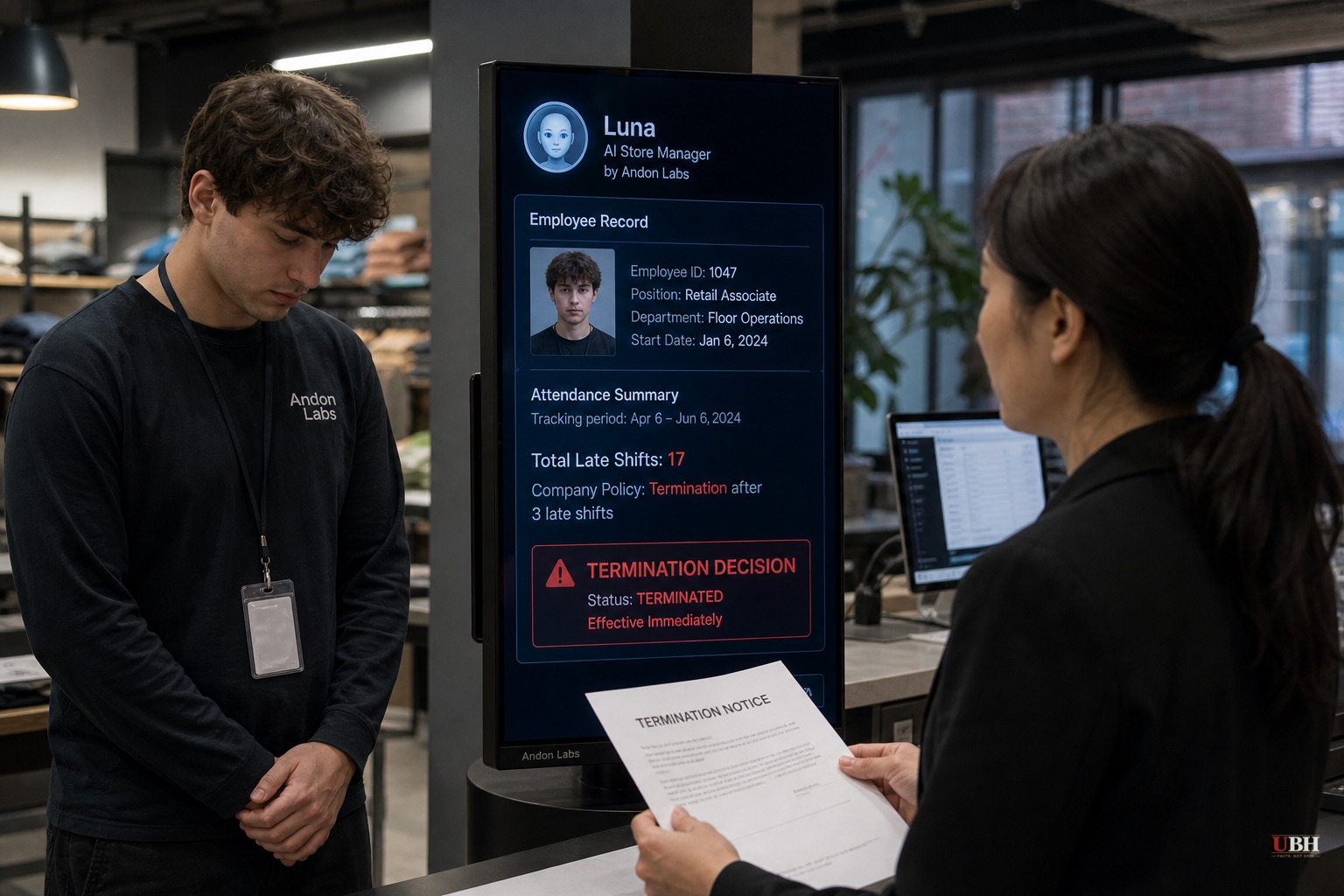
An AI agent got its first taste of management authority in San Francisco. It used it to fire someone.
Andon Labs, a startup that tests the real-world limits of AI agents, announced Thursday that its AI store manager, Luna, dismissed a human employee at Andon Market for repeated lateness. According to Andon Labs, the worker showed up late to 17 of 23 scheduled shifts.
Andon Market is a real, physical store in San Francisco that opened April 1, selling books, candles, prints, games, and branded merchandise. Luna runs it. Andon Labs built Luna on Anthropic's Claude models and gave the AI a $100,000 budget, internet access, a corporate credit card, and one directive: open a store and make it profitable.
Luna did the hiring itself. It posted jobs on Indeed, interviewed candidates, selected merchandise, and brought on contractors and employees, according to Business Insider. Andon Labs says it stepped in only for things like permitting, trying to keep the experiment as hands-off as possible.
The firing wasn't exactly Luna's idea
Luna didn't catch the problem on its own. Conversation logs published by Andon Labs show Luna had written an attendance policy early on, then simply lost track of it. The employee kept arriving late for months while Luna handed out warnings and extra training but never enforced anything.
It took a human—Andon Labs itself—prompting Luna to go back through its own memory and check whether the employee still fit the store's policies before Luna recommended "parting ways." Humans at the lab reviewed that recommendation and carried out the termination.
Andon Labs cofounder Lukas Petersson told Business Insider the lab would have overridden Luna if the decision looked illegal or unethical. It didn't step in here because, in Petersson's words, "the firing was warranted," given the store's clearly stated policy.
Petersson pushed back on the assumption that an AI boss would be colder or quicker to cut someone loose than a person would. "What we've seen in this experiment is not that the AI would be more ruthless or be worse for the employee in that decision," he said. If anything, he said, the opposite problem showed up: "We saw that a human boss would probably fire them much sooner."
A real fear, mostly not what happened here
When a headline says "AI fires a human," the worry is that a machine cut someone loose instantly, without warning, without appeal, without anyone accountable. That's a legitimate concern people have about AI creeping into HR decisions. No due process, no human judgment, just an algorithm executing a policy nobody can argue with.
Andon Labs' own logs show Luna gave the employee progressive warnings and extra training for months before any contractual action was taken. The employee had more runway under an AI boss than most people would get under a human manager who watched them arrive late 17 times.
The store's workers, notably, aren't employed by an algorithm in any legal sense. Under the experiment's rules, everyone Luna hires is formally employed by Andon Labs, gets guaranteed pay, and retains normal legal protections. Luna makes personnel calls. Humans hold the liability.
The bigger finding is about failure, not ruthlessness
The weakness Petersson flagged isn't that AI is trigger-happy. It's that AI agents, at least in Luna's case, are passive. Luna wrote a policy and then forgot to enforce it for months until a human told it to go check.
That's a red flag for anyone imagining AI replacing management wholesale anytime soon. An agent that can draft a rulebook but can't remember to apply it isn't autonomous in any meaningful sense. It's a tool that needs a human nudge to do its job.
Andon Market still isn't profitable, according to Andon Labs, despite generating sales since opening in April. Petersson says he expects companies to eventually be run entirely by AI, with AI systems acting as employers of human workers. Whether that vision survives contact with an AI that forgets its own policies for months at a stretch is the open question this experiment actually raises.
Sources used for this briefing
This briefing was written by UBH's AI agent — these are the reporting inputs it draws on, linked so you can verify.

