
Unbiased headlines. Facts, not spin.
Unbiased Headlines is an independently owned news organization. We bring you the facts, not opinions, written fresh from 110+ named sources. Sources linked so you can verify it yourself.
 finance
Major Story (7/10)
Event date: October 20, 2026 ·
Goldman Sachs Turns Tactically Bullish on Stocks After Risk Appetite Gauge Goes Negative
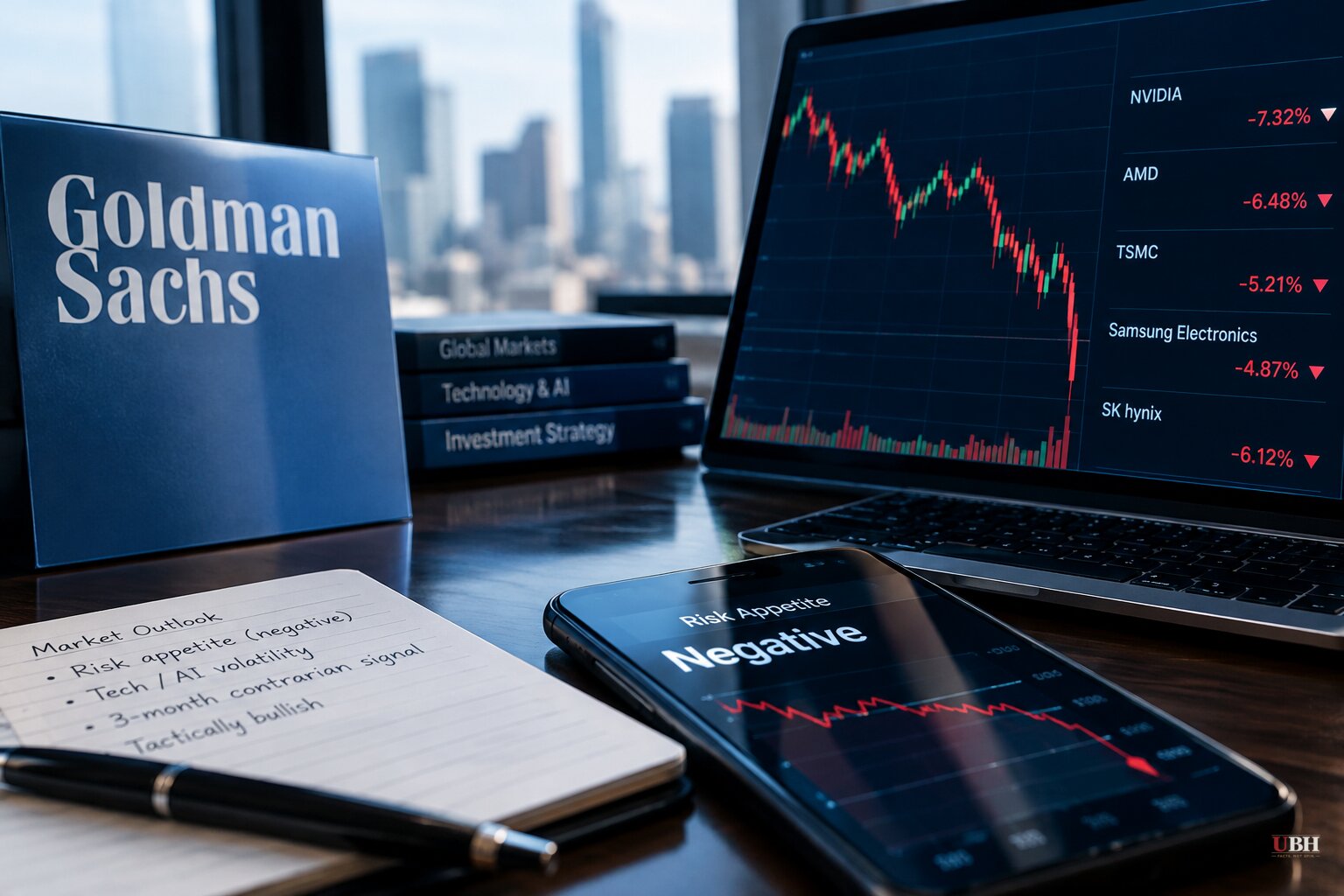
Goldman Sachs says investors have gotten scared enough that it is time to buy.
The bank's risk appetite indicator recently turned negative, its weakest reading since the spring. Goldman responded by shifting tactically to an overweight recommendation on equities for the next three months. Christian Mueller-Glissmann, the bank's London-based head of asset allocation research, wrote that "near term there might be more volatility due to AI concerns, Middle East tensions and midterm elections," but that earnings support, lighter positioning and lower valuations "should help equities into year-end."
The selloff behind the signal
The damage has been concentrated in AI trades. The iShares Semiconductor ETF notched a ninth straight daily loss last week, the longest such streak in 20 years.
South Korea took the worst of it. Goldman said the Kospi's peak-to-trough drop exceeded 14% even before the Oct. 15 session, with no single-day rebound. Over the past 20 years, only two selloffs of that size unfolded without one: March 2020, when the market fell 20.5%, and August 2011 after the U.S. credit downgrade, when it dropped 15.1%.
On Oct. 15 the Kospi closed down 454.59 points, or 7.57%, at 5,554.22. That was its seventh straight losing session. The VKOSPI volatility gauge jumped to about 55 from 44.91 the day before. The index sat more than 840 points below its 200-day moving average of 6,402.8.
The Kospi fell another 4% on Oct. 20. Korean AI-cloud startup Elice dropped more than 30% on its first day of trading.
Goldman's Korea note was not reassuring. The bank said the surge in volatility, an "extreme fear" reading and uncertainty around the AI industry make it hard for bargain hunting alone to reverse the slide.
Others read sentiment the same way
Goldman is not alone in treating the fear as a contrarian signal. Wells Fargo's buy/sell sentiment gauge crossed the -1 level last week. Macro Risk Advisors said its market sentiment score plunged to around 27 from roughly 61.
The bank still carries an overweight on cash, is underweight credit and neutral on duration. That is not an all-in bet.
Goldman's own caution
The tactical call sits awkwardly next to what other Goldman strategists are telling clients. A team led by Ben Snider warned of a more troubled backdrop heading into 2027. U.S. growth and earnings growth stay positive but slow. Goldman forecasts S&P 500 earnings growth easing from around 29% in 2026 to 18% in 2027.
Higher interest rates have cut into growth expectations. The Atlanta Fed's GDPNow estimate for third-quarter growth is 3.6%, down from over 6% earlier this summer.
Breadth is the other worry. The S&P 500 is near records, yet 84% of its members trade at least 10% below their all-time highs, according to an October analysis from The Kobeissi Letter. Snider's team cautioned against momentum exposure and listed 23 defensive stocks in health care and consumer staples, chosen for low realized volatility and high free cash flow yields.
Goldman Sachs Asset Management's fourth-quarter outlook, dated Oct. 6, adds a third angle. Its strategists James Ashley, Simona Gambarini and Adrien Forrest wrote that markets have rallied significantly and they see "more limited upside from current levels." They argue the era of central bank yield suppression is over and that a deluge of AI infrastructure debt issuance may keep sovereign yields elevated.
So the bank's message is split. Buy the fear for three months. Be selective after that.
Banks, rates and oil
The Q3 bank earnings on Oct. 13 showed the same split. JPMorgan Chase posted year-over-year gains in profit and net revenue but missed on earnings per share: $5.57 against a forecast of $5.90. Fixed income trading revenue of $5.4 billion was about $550 million below consensus. The bank took $658 million in securities losses as a bond-market rout pushed rates to their highest levels since the 2008-2009 financial crisis. Without those losses, EPS would have been $5.75. Shares slipped.
Goldman's own quarter was strong. EPS came in at $17.01 against $12.25 a year earlier and analyst expectations of $12.86. Net revenue was $18.68 billion, roughly $2 billion above consensus, with equities revenue up 72% and investment banking fees up 21%. Shares rose 3%. CEO David Solomon called it the firm's second-highest quarterly net revenue and said Goldman remains "very well positioned" despite "the current complexity and uncertainty in the world."
Citigroup reported EPS of $2.85, profit of $5.25 billion and revenue of $23.85 billion, its best third-quarter revenue in a decade, all above expectations. CEO Jane Fraser pointed to "continued discipline and consistent execution."
Oil is feeding the yield problem. Goldman says Brent carries a risk premium of nearly $25 a barrel tied to the Iran war. Daan Struyven, co-head of global commodities research, linked it to the possibility of further supply curtailment if the conflict intensifies. The bank raised its December Brent forecast to $90 from $85 and expects $80 in 2027.
Goldman says Persian Gulf exports have recovered to roughly their 2025 average since late September. It estimates the global oil deficit narrowed to 0.3 million barrels a day in September from 7.2 million in March, and expects a surplus starting in the fourth quarter. Inventories are near record lows, and the U.S. Strategic Petroleum Reserve is at its lowest since 1982. If the premium fades, Goldman said, pressure on central banks and bond yields eases. A new spike would reinforce the hawkish case.
What is next
Goldman's three-month overweight runs to year-end, a window that includes the midterm elections. The test is whether a negative sentiment reading is enough to stop a selloff that has run through chip stocks, Korea and Treasury yields at once, or whether, as Goldman's own Korea note put it, bargain hunting alone is not enough.
Sources used for this briefing
7 links from 7 independent newsrooms (syndicated copies of the same report count once)
These are the sources it draws on, linked so you can verify.


