
Unbiased headlines. Facts, not spin.
Unbiased Headlines is an independently owned news organization. We bring you the facts, not opinions, written fresh from 110+ named sources. Sources linked so you can verify it yourself.
 finance
Major Story (7/10)
S&P 500 Near Records as Its 15 Largest Stocks Hold 46.7% of Index Value
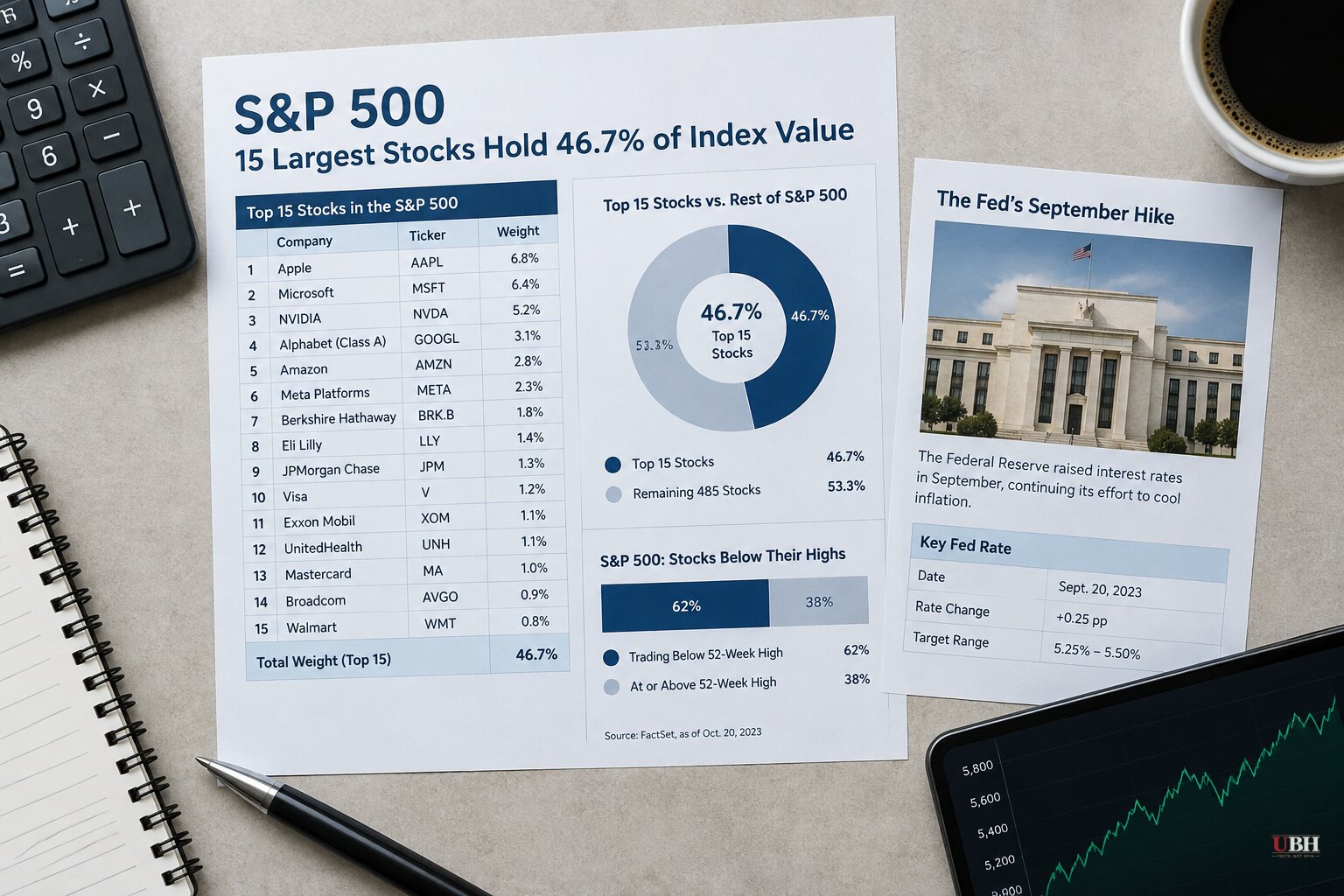
The S&P 500 sits near record territory, and a small group of companies is doing nearly all the lifting.
One count puts the 15 largest stocks at a record 46.7% of the index's total market value as of mid-to-late October. The top 10 alone made up 39.03% in an Oct. 10 snapshot from Slickcharts, which counted Alphabet's two share classes as separate lines. Nvidia led at 7.78%, then Apple at 6.91% and Microsoft at 5.59%.
Nvidia's market value was about $5.2 trillion as of Oct. 20, followed by Apple near $5 trillion and Alphabet above $4.1 trillion. Nearly half of today's top 15 were not in the top 15 in 2022.
How narrow the rally is
The index closed at a record 7,819 on Oct. 6, its first record since mid-August and its first close above 7,800. Tech did the work. It was the only sector to post gains over the prior month, while real estate, financials and materials each fell more than 4.5% as the 10-year Treasury yield climbed to its highest level since 2002.
The Kobeissi Letter's analysis finds that ten companies generated roughly 70% of the S&P 500's gain since the March 30 low. Nvidia alone accounts for about 13% of it. Micron, Apple, Microsoft, AMD and Alphabet were also major contributors.
The same analysis found 84% of S&P 500 members at least 10% below their all-time highs. It put 59% down 20% or more, and 17% down more than 50%.
Bloomberg's analysis shows the gap another way. Over three months, the ten biggest S&P 500 stocks gained 7.06% while the equal-weight index lost 1.49%. That is an 8.55-point spread, among the most extreme megacap leads in Bloomberg's records.
As of Oct. 12, the index was up just over 14% for the year. At least 200 of its 500 members were down on the year, the median member was up 4%, and more than 10 points of the index's 14% gain came from a handful of tech names. Only 21% of members were trading above their 50-day moving average that day, per commentator Peter Earle.
Burry's 2000 comparison
Michael Burry, the investor who bet against subprime mortgages, posted a Substack analysis built on a different yardstick. His "bear market ratio" tracks the share of S&P 500 stocks at least 20% below their 10-year highs. It stood at 55% on Oct. 6, up from 47% when the index hit a record on Aug. 13.
Burry found only one other time in four decades when the index hit a record with most members in that condition: 2000. Just 15 stocks closed at new highs on Oct. 6, and 97 were within 10% of a high. At the March 2000 peak the figures were 15 and 87.
He stops short of saying the two periods match. His "Fresh Drawdown Ratio" was 27% in October versus 53% at the March 2000 peak, and the median S&P 500 stock was 22% below its high versus 31% then. But he warned that "if the market keeps going like it is, it could surpass 2000 within months."
The bullish reading
Not everyone treats the split as a warning. The Kobeissi Letter calls it a rare "bull-bear market" and argues it "may actually represent an opportunity rather than a warning." Its case: if oil and inflation ease, the Fed could become less restrictive, which would remove part of the discount weighing on the other 480-odd stocks and let the rally broaden past the megacaps.
There is also earnings support for the leaders. Marvell raised its multiyear revenue forecast on Oct. 6 on AI demand and its shares rose 5.8%. AMD CEO Lisa Su told reporters in Taipei the company plans to ramp chip supply next year. Hyperscalers' heavy AI capital spending feeds chip suppliers' order books, and both sides' valuations rise with it.
The flip side is that the whole chain leans on one theme. If hyperscalers trim capital budgets or investors cool on high-growth stocks, several of the biggest index weights would move at once, and anyone holding a plain S&P 500 fund holds all of them.
The macro backdrop
The conditions for a broadening are not in place yet. At the start of the year, markets expected at least three Fed rate cuts. Instead the Fed raised rates in September, and current pricing implies three more increases by June 2027, a swing of about 175 basis points in the expected path.
Brent crude hit $106 a barrel, diesel is up more than 80% from its January lows, and inflation runs close to double the Fed's target, per the Kobeissi Letter. CNN reported lingering uncertainty over the war with Iran and turmoil in global bond markets as of the Oct. 6 record.
The open question is which gives first: the rate and oil pressure squeezing the other 480-odd stocks, or the AI spending propping up the top 15. Third-quarter earnings from the biggest names will show whether capital budgets are holding.
Sources used for this briefing
7 links from 7 independent newsrooms (syndicated copies of the same report count once)
These are the sources it draws on, linked so you can verify.


