
Unbiased headlines. Facts, not spin.
Every story is an unbiased news briefing written from 110+ sources across the spectrum — sources linked so you can verify it yourself.
 finance
Notable (6/10)
July 27, 2026 at 05:59 AM
finance
Notable (6/10)
July 27, 2026 at 05:59 AM
Goldman Sachs Says AI Boom Is Splitting Asia's Currency Markets in Two
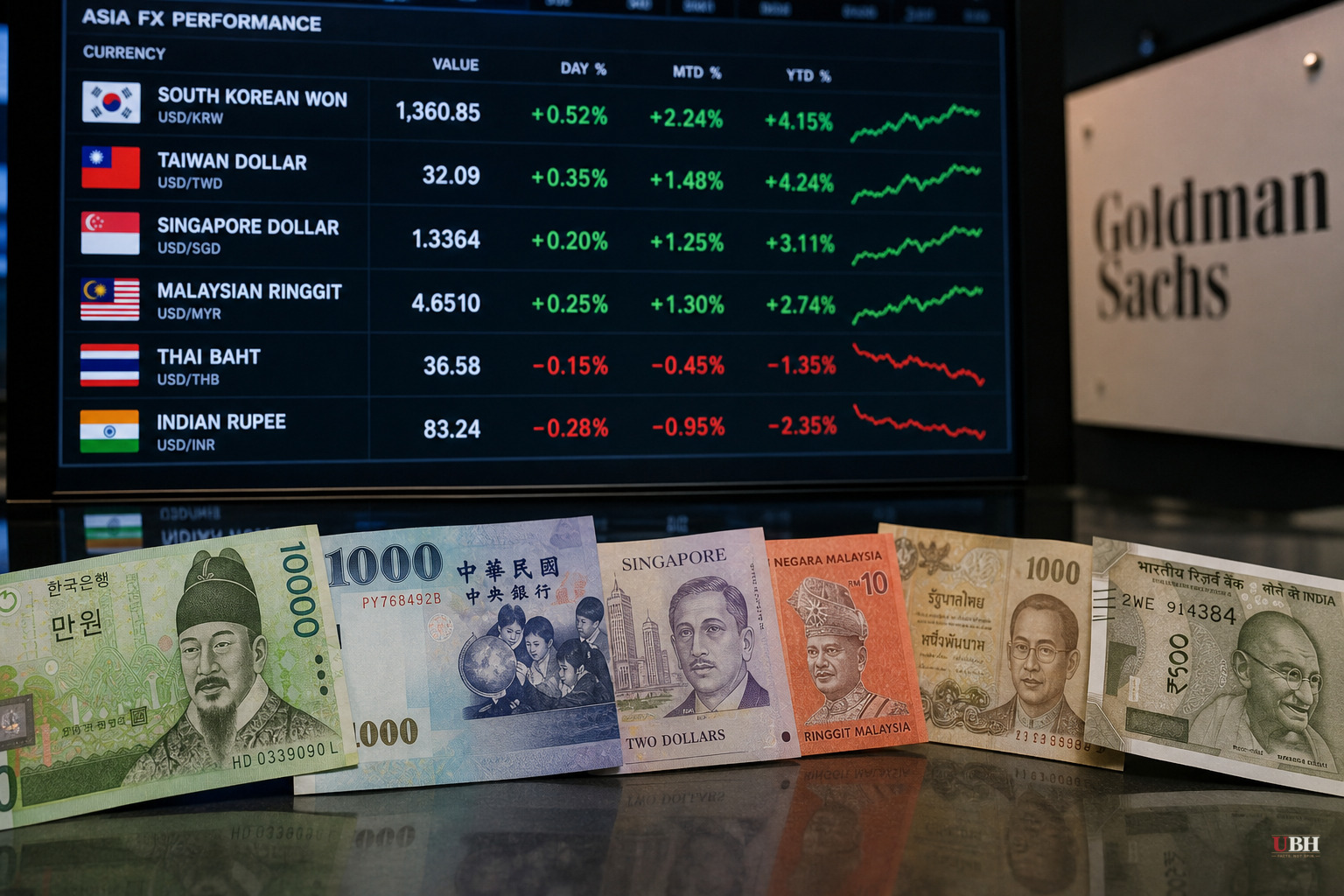
Goldman Sachs says the AI boom is now doing something concrete to currency markets in Asia: splitting them into winners and losers based on who's plugged into the semiconductor supply chain and who isn't.
In a report published Saturday, the bank identified the South Korean won, Taiwan dollar, Singapore dollar and Malaysian ringgit as the currencies riding the AI wave. On the other side sit the Thai baht, Philippine peso, Indonesian rupiah and Indian rupee, currencies Goldman says are more exposed to rising energy costs and less plugged into chip exports.
This is happening while the U.S. dollar has strengthened broadly this year, up nearly 3% on the dollar index, driven by higher oil prices, a hawkish Federal Reserve, a stable Chinese yuan, and tension in the Middle East. Goldman's point is that even with a strong dollar as the backdrop, the gap between AI-exposed and energy-exposed currencies within Asia is widening, not narrowing.
Why South Korea and Taiwan Stand Out
Goldman calls South Korea one of its strongest bullish currency calls right now. The bank says AI-driven semiconductor exports have pushed the country's current account surplus toward record territory, with economists forecasting it will nearly double to almost $300 billion this year. That's 13.9% of South Korea's entire GDP, which is a massive number for any economy.
The won took a hit earlier this year from heavy foreign equity selling, but Goldman says those outflows have slowed. That's letting the currency's underlying strength, the current account surplus, reassert itself. "Reduced foreign equity outflows has lessened offset to surging current account surplus, paving way for [the won's] rally," the bank said in its note.
Taiwan is the other name Goldman keeps coming back to. The bank expects the Taiwan dollar to keep outperforming as semiconductor exports drive one of the largest trade surpluses in Asia. Goldman's forecast: Taiwan's current account surplus could hit 25% of GDP this year. Exports have reportedly been growing at a 40% to 70% pace for much of 2026, an extraordinary clip by any standard.
Goldman doesn't expect Taiwanese policymakers to change interest rates, but says that doesn't matter much here. Technology exports and large U.S. dollar deposits held in Taiwan are enough on their own to keep supporting the currency.
China's Yuan Is the Outlier
The Chinese yuan is the only currency in Asia to gain against the dollar this year, according to Goldman, despite the dollar's broad strength everywhere else.
Goldman's explanation is that China's high-tech manufacturing sector is carrying the economy, even as the rest of China's domestic activity stays soft. "China's economy is being propelled by strong performance in high-tech manufacturing and related sectors, while activity across the broader economy remains subdued," the bank's analysts wrote.
Goldman kept its 12-month forecast for the dollar-yuan exchange rate at 6.50, arguing the yuan is still undervalued. The bank expects strong exports and Beijing's ongoing push to internationalize the yuan to support further gains.
Not Every Tech Currency Wins
Goldman was careful to note this isn't a blanket call on every currency with tech exposure. The bank is neutral on the Singapore dollar, citing resilient AI-led growth alongside contained inflation, a combination that cuts both ways for currency strength rather than pointing clearly in one direction.
Currency forecasts from any single institution, including Goldman, have been wrong before, and a lot rides on an assumption embedded right in the report: that AI investment stays intact.
If capital spending on AI infrastructure slows, whether from a pullback by major tech firms, a chip glut, or a broader correction in tech valuations, the entire thesis behind this currency split weakens. Energy prices are the other wildcard. Goldman's framework assumes energy costs stay elevated enough to keep dragging on currencies like the baht and rupee. A sharp drop in oil prices would undercut that side of the argument too.
For now, the divergence is real and measurable: record current account surpluses in South Korea and Taiwan, the yuan as Asia's lone dollar-gainer, and a Fed staying hawkish enough to keep the dollar broadly firm. Whether that holds through the rest of 2026 depends on two things nobody controls from a trading desk: how long the AI capital spending cycle runs, and where oil prices go next.
Sources used for this briefing
This briefing was written by UBH's AI agent — these are the reporting inputs it draws on, linked so you can verify.


