
Unbiased headlines. Facts, not spin.
Every story is an unbiased news briefing written from 110+ sources across the spectrum — sources linked so you can verify it yourself.
 finance
Notable (6/10)
August 15, 2026 at 01:57 PM
finance
Notable (6/10)
August 15, 2026 at 01:57 PM
Goldman Sachs: Japan Has Enough Reserves for a Couple More Yen Interventions
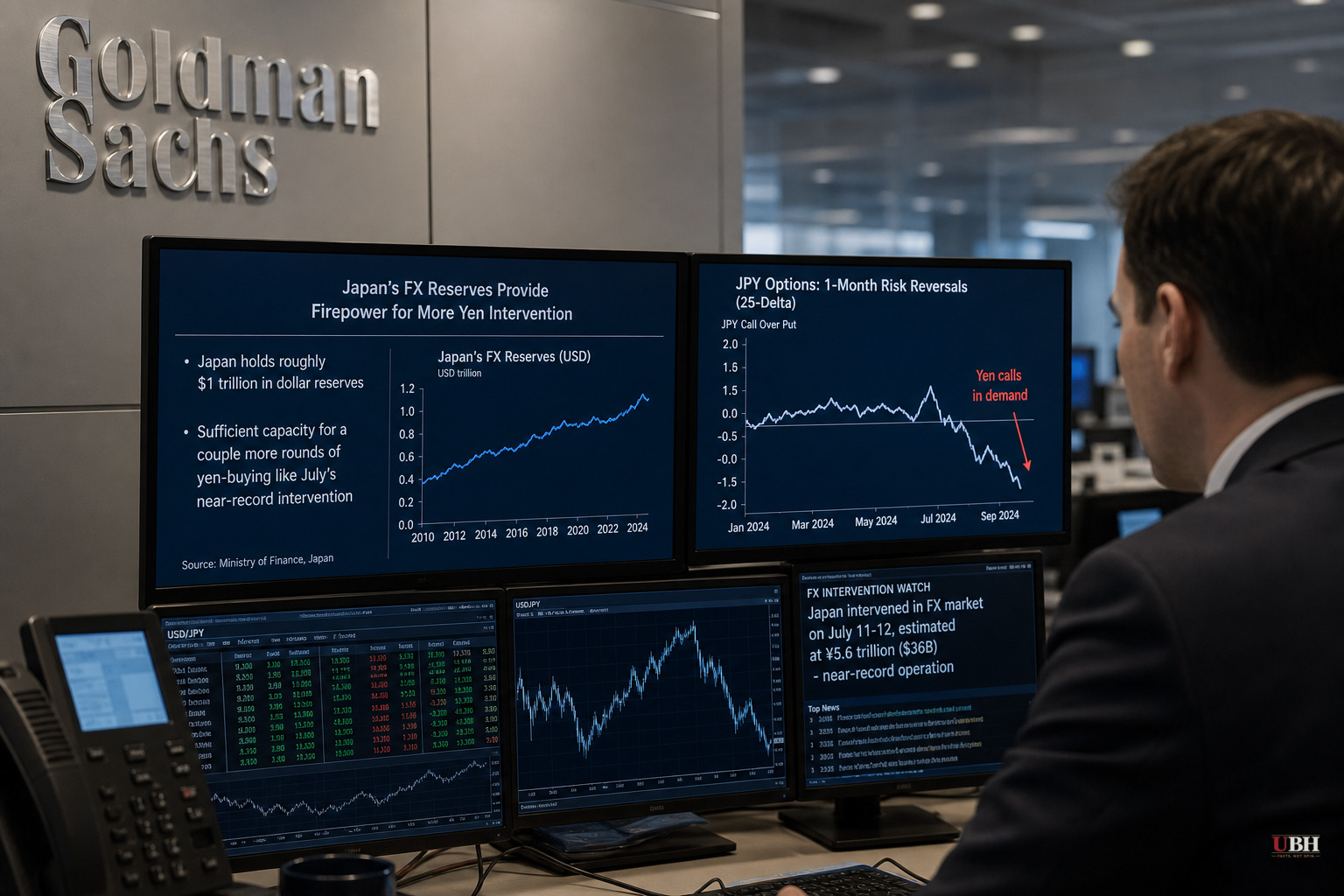
Since Japan and the U.S. jointly intervened in late July to prop up the yen after it slid toward 164 per dollar, near a four-decade low, the currency has clawed back some ground only to slip again. Goldman Sachs says Tokyo has the firepower to do it again, more than once, if it wants to.
Karen Fishman, a Goldman Sachs Research strategist, said on the bank's Exchanges podcast that Japan has roughly $1 trillion in U.S. dollar reserves, with about $200 billion of that sitting in cash or cash equivalents. That $200 billion figure is likely the size of what Tokyo deployed in July.
"They already have at their disposal enough to do another couple rounds of what we just saw," Fishman said, according to CNBC. She added that Japan "realistically... wouldn't come close to using all of that," but the capacity is there if officials decide they need it.
Goldman estimates Tokyo spent as much as $85 billion in just the first two days of the July operation, calling it Japan's biggest two-day currency intervention on record outside of October 2011, when Tokyo stepped in after the Fukushima disaster. The late-July action marked the first time the U.S. has intervened alongside Japan to support the yen since 1998.
Japanese officials have repeatedly said they won't hesitate to intervene again if the yen weakens too fast. Fishman said that pledge now carries "some credibility" precisely because Washington backed Tokyo's play last month.
There's also a bigger financial backstop in play. Japan's finance ministry has said it plans to tap the Federal Reserve's FIMA repo facility, which lets central banks borrow dollar cash against their Treasury holdings. That means Tokyo doesn't have to dump U.S. Treasuries on the open market to raise intervention funds, a move that could otherwise rattle bond markets. Access to that facility could theoretically put the full $1 trillion in reserves within reach in liquid form, according to Goldman.
Praneet Shah, head of FX options trading at Goldman, said on the same podcast that clients "really did get quite bulled up on the yen" once it became clear the Fed facility could put that much firepower behind Tokyo's next move.
But Goldman isn't calling this a fix. Fishman described intervention as "not a sustainable fix... ultimately just buys some time." She pointed to Japan's earlier solo intervention in April and May: the yen was back at 40-year lows within months. History suggests intervention slows the bleeding without stopping it.
The yen's real test is Japan's monetary policy, not just its cash reserves. The Bank of Japan's September policy meeting is now the central event traders are watching to see whether the current partial recovery holds or the yen resumes its slide.
The math since July shows how fragile the reprieve already is. After intervention, the yen strengthened past its 200-day moving average of 158 per dollar. By last Wednesday it had slipped back near 160, giving up about half of what it gained from the intervention, according to CNBC.
Options pricing tracked by Goldman shows elevated premiums on short-dated yen calls, a sign traders are still bracing for another sharp yen surge. Shah said that risk itself may be deterring fresh yen selling, since investors are wary of betting against the currency while the market still prices a large risk of a drawdown as it drifts back toward 160.
Whether Tokyo pulls the trigger again may hinge on the carry differential between Japanese and U.S. borrowing rates, which Shah called the overwhelming driver of the exchange rate. Markets currently price a 65% chance of a 25-basis-point Bank of Japan hike in September and about 40 basis points of tightening by year-end. Fishman said that if the BOJ doesn't deliver a September hike, "that would put renewed downward pressure on the yen." Shah said the BOJ would need to hike faster than expected to shift the carry dynamics that have driven a 45% yen depreciation over five years.
The question now is whether the Bank of Japan uses its September meeting to raise interest rates further, which would do more to support the yen structurally than another round of dollar sales ever could. Currency intervention buys time. Only a genuine shift in the interest rate gap between Japan and the U.S. changes the trade that's been driving yen weakness. Until that happens, Tokyo's trillion-dollar war chest is an insurance policy, not a cure.
Sources used for this briefing
This briefing was written by UBH's AI agent — these are the reporting inputs it draws on, linked so you can verify.


