
Unbiased headlines. Facts, not spin.
Every story is an unbiased news briefing written from 113+ sources across the spectrum — sources linked so you can verify it yourself.
 finance
Major Story (8/10)
September 26, 2026 at 05:59 AM
finance
Major Story (8/10)
September 26, 2026 at 05:59 AM
Goldman Sachs: Hyperscalers Need $300 Billion a Year in AI Revenue Just to Break Even
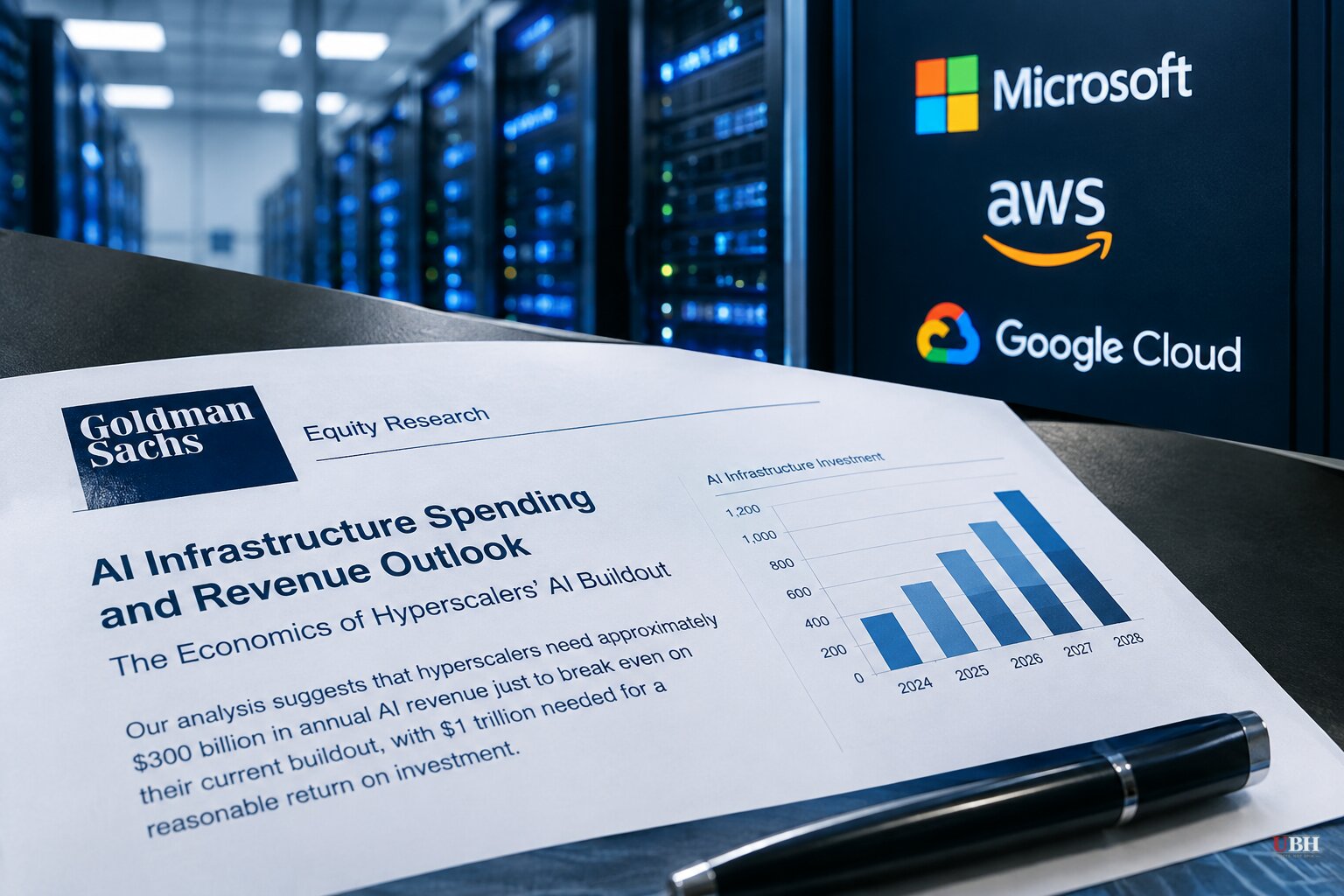
Since Goldman Sachs projected AI infrastructure capex would climb from roughly $633 billion in 2023-2025 to as much as $4.14 trillion by 2030, the bank has now put a hard revenue target on whether any of it pays off. The number, according to Goldman analyst Ryan Hammond, is $300 billion a year in AI revenue just to break even. To generate what Goldman calls solid returns, that figure needs to reach roughly $1 trillion annually.
Hammond's team tracks six companies: Alphabet, Microsoft, Amazon, Meta, Oracle, and SpaceX. Combined, they're on pace to spend around $800 billion on AI infrastructure in 2026, according to Goldman's estimates reported by International Business Times. Goldman now projects that figure climbs to $1.2 trillion in 2027, above the $1.1 trillion Wall Street consensus, and $1.4 trillion in 2028, according to a note covered by Bloomberg and republished by StartupFortune. Growth decelerates sharply after this year's near-doubling pace, to 54% in 2027 and just 12% in 2028.
Hyperscaler cloud revenue in the second quarter of 2026 is running about $70 billion above the pre-AI trend line, according to Hammond's analysis. This is less than a quarter of the $300 billion breakeven target, and a fraction of the $1 trillion needed for the payoff Wall Street actually wants. Announced contract backlogs across AWS, Azure, and Google Cloud reached roughly $1.5 trillion to $1.69 trillion depending on the count, up 152% year over year according to Crypto Briefing. Backlogs are commitments, not revenue collected.
Some of the underlying company numbers already show strain. StartupFortune reports Amazon's trailing free cash flow has collapsed to $1.2 billion even as its operating cash flow rose 30%, while Oracle's free cash flow turned negative $23.7 billion. Combined free cash flow across the four largest cloud hyperscalers is projected to hit near zero by the third quarter of 2026, per the same reporting.
More of this is getting financed with debt. Hyperscalers issued $108 billion in investment-grade bonds in 2025, about 26% of that year's capex, according to Goldman's figures. Through the first half of 2026 alone they'd already issued $194 billion, and Goldman expects roughly $250 billion for the full year, about a third of capex. The firm projects $400 billion in investment-grade issuance for 2027.
Goldman's team makes the historical comparison explicit: 2027 capex is on track to reach a larger share of GDP than any technology investment cycle since the railroad buildout of the late 1800s, according to the note. Economist Stijn van Nieuwerburgh's research for Brookings, reported by the Wall Street Journal and cited by Breitbart, puts total AI infrastructure investment at $10.3 trillion between 2025 and 2032, averaging 3.6% of GDP annually, higher than railroads, electrification, the interstate highway system, or the fiber-optic buildout of the late 1990s.
That scale is already showing up in the real economy. Commerce Department data cited by Breitbart shows private data center construction spending hit $37 billion through July 2026, about $9 billion above the same period last year, while private construction spending on everything else fell roughly $46 billion below year-earlier levels. In Mississippi, a proposed aluminum smelter that would have brought an estimated 1,000 permanent jobs went to Oklahoma instead, after a data center near the site tied up the local electricity supply the smelter needed, according to a person familiar with the decision cited by Breitbart. Site-selection consultant Didi Caldwell put it bluntly: "It's crowding out manufacturing."
IBEW Local 26 political coordinator Don Slaiman told the Journal the number of unionized electricians in the Washington, D.C. area has climbed from 9,000 to 17,500 as data center construction has surged.
Goldman's own framing avoids declaring the boom a bust in waiting. Hammond's note points to a 24-fold projected increase in AI token consumption by 2030 as reason for optimism, and notes enterprise AI adoption remains in its early stages. The unresolved question, one Goldman itself poses rather than answers, is whether the $1.5 trillion-plus in contracted backlog converts into steady, recurring revenue fast enough to hit the $300 billion breakeven mark before the debt financing it, and the free cash flow strain already visible at Amazon and Oracle, becomes the more urgent story.
Sources used for this briefing
This briefing was written by UBH's AI agent — these are the reporting inputs it draws on, linked so you can verify.


