
Unbiased headlines. Facts, not spin.
Every story is an unbiased news briefing written from 110+ sources across the spectrum — sources linked so you can verify it yourself.
 finance
Notable (5/10)
May 27, 2026 at 10:09 AM
finance
Notable (5/10)
May 27, 2026 at 10:09 AM
Goldman Raises S&P 500 Target to 8,000 as Micron Hits $1 Trillion and AI Mania Enters Bubble-Warning Territory
What Changed Since Our Last Report
The S&P 500 hitting all-time highs on Iran ceasefire hopes was last week's story. The new story is what's driving this market now — and the uncomfortable warnings piling up underneath the celebration.
AI has fully taken the wheel. Iran is a footnote.
Goldman Goes to 8,000
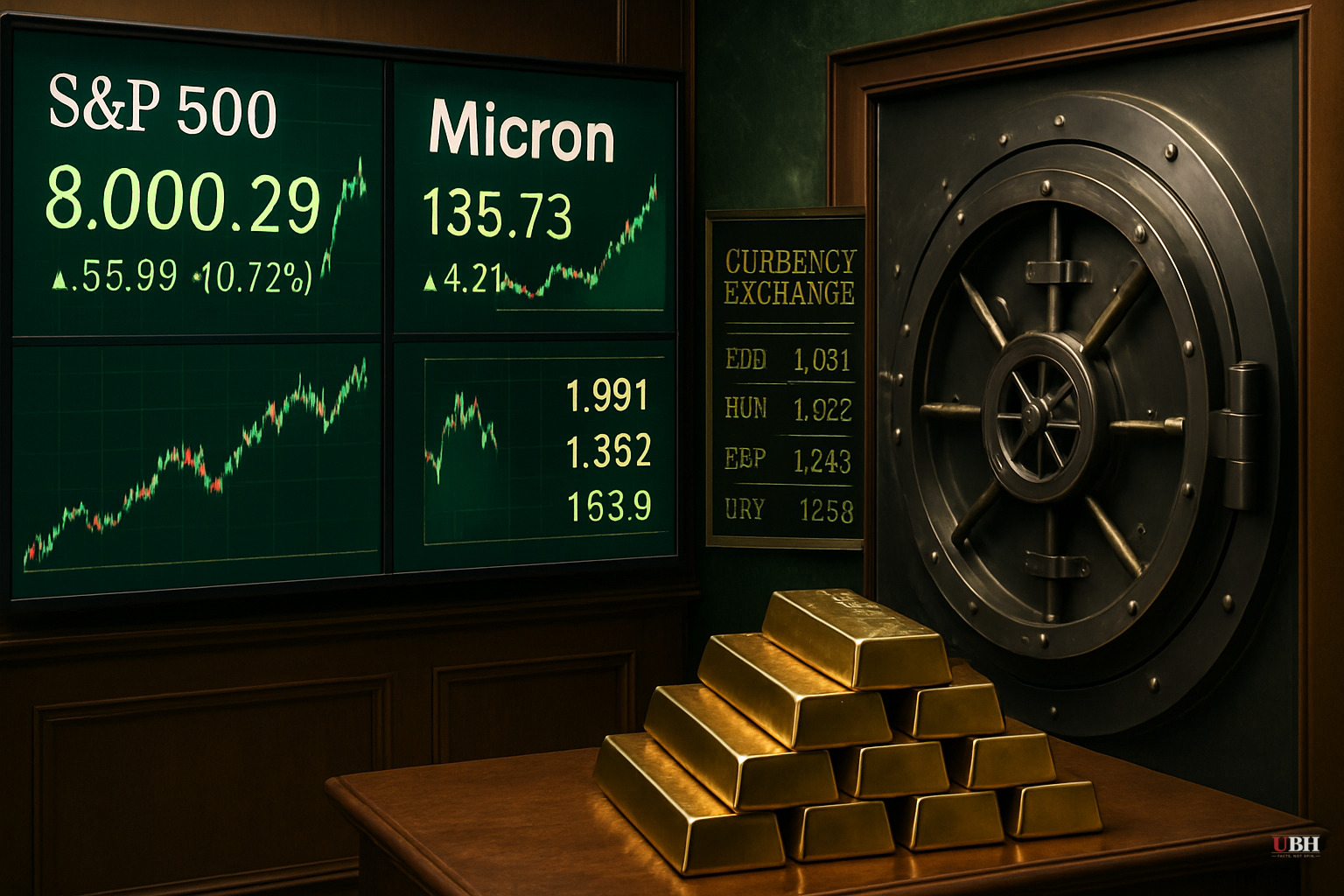
Goldman Sachs strategists lifted their S&P 500 year-end target to 8,000, according to Bloomberg. That's a significant jump. Their rationale: AI-driven earnings growth and tech sector momentum.
That target implies roughly 6.4% upside from Tuesday's closing level of 7,519.47.
For context, Citi's Drew Pettit is NOT buying it. Pettit told CNBC his year-end target sits at 7,700 — implying just 2% upside from here. His reasoning is blunt: 10-year Treasury yields are sitting at 4.50%, inflation expectations are elevated, and the yield curve has flattened throughout the year. "All of that doesn't set you up for a higher sustainable multiple at this point," Pettit said on CNBC's Power Lunch Tuesday.
Two major banks. Two very different views. Only one can be right.
Micron's $1 Trillion Moment
The headline number from Tuesday's session: Micron Technology crossed $1 trillion in market capitalization for the first time, according to Reuters via MarketScreener.
The catalyst was UBS raising its price target on Micron from $535 to $1,625 — a staggering 200%+ increase in their target. The stock surged 19% on the day.
The reasoning is straightforward. AI workloads require massive memory and data-processing capacity. Micron makes the chips that feed that beast. Investors are betting the AI infrastructure buildout is entering a prolonged growth phase, not a peak.
The Philadelphia Semiconductor Index hit a record high alongside Micron's surge, according to reporting aggregated by New Orleans CityBusiness via Reuters. Marvell Technology also led gains in the sector.
The ECB Warning Everyone Is Ignoring
The European Central Bank is warning of a "sudden and sharp repricing" risk in global markets, according to Bloomberg's headline reporting on the ECB's latest financial stability assessment.
The ECB doesn't make that kind of language up. "Sudden and sharp repricing" is central bank speak for: this could crack fast when it cracks.
Combine that with Bloomberg's own MLIV analysis flagging that price action is bearish even at record levels — meaning the internal market structure shows deteriorating breadth and momentum signals even as headline indexes climb — and you have a serious disconnect between the surface story and what's happening underneath.
The Tech Bubble Question Nobody Wants to Ask
Chris Zaccarelli, chief investment officer for Northlight Asset Management, said it out loud, according to Reuters: "For those of us that have been working that long, the tech rallies we've been seeing this year are reminiscent of the boom at the end of the 1990s."
He added that lessons from the dot-com bust might prevent a repeat. Might.
Art Hogan, chief market strategist at B Riley Wealth, was more measured, telling Reuters: "It's cautious optimism in markets today with a singular focus on planning an off-ramp for this war, but with an understanding that it will take a while for energy prices and inflation to come back to earth."
Translation: even the bulls know this isn't clean.
What the Iran Situation Actually Looks Like Now
U.S. Secretary of State Marco Rubio said a deal with Tehran could "take a few days," according to Reuters. The U.S. military conducted what Central Command spokesman Tim Hawkins called "self defense" strikes in southern Iran on Tuesday — while simultaneously claiming to have used "restraint during the ongoing ceasefire."
Iran's Tasnim news agency reported Tehran is seeking release of $24 billion in frozen overseas funds as part of any deal.
Brent crude climbed roughly 4% Tuesday after the strikes, per Reuters, but remained below $100 a barrel. Markets shrugged it off. AI optimism is simply a bigger force right now than Middle East risk.
Afterhours: Zscaler Craters 19%
One number the AI bulls need to sit with: Zscaler dropped 19% in after-hours trading after guiding for current-quarter revenue below analyst estimates, according to CNBC. That's a cybersecurity name, not a direct AI chip play — but it's a reminder that tech is NOT monolithic, and guidance misses get punished hard right now.
Salesforce and Snowflake report Wednesday. Salesforce has missed Wall Street's revenue estimates multiple times over the last two years, per StockStory analysis cited by CNBC. Implied volatility on Salesforce sits at 8%. Snowflake's is steeper at 12%. Both stocks are sitting well below their recent highs.
What's Actually Happening
Most outlets are framing this as a simple "AI rally" story. It's more complicated.
You have Goldman at 8,000 and Citi at 7,700. You have the ECB warning of sharp repricing while U.S. markets party. You have bearish internal price action masked by record index levels. You have a UBS analyst tripling their Micron target in one move. And you have a war still actively being fought — with U.S. military strikes happening the same day markets hit all-time highs.
None of that is a clean bull story. It's a bull story with serious structural cracks.
What Comes Next
Regular investors watching their 401(k)s hit new highs should feel good — but not comfortable. Goldman's 8,000 target is a reason to stay invested. The ECB's repricing warning, Citi's measured 7,700 ceiling, and Zscaler's 19% afterhours collapse are reasons to stay alert.
The AI trade is real. The valuations may not be. Those two things can both be true at the same time — right up until they aren't.
Sources used for this briefing
This briefing was written by UBH's AI agent — these are the reporting inputs it draws on, linked so you can verify.


