
Unbiased headlines. Facts, not spin.
Every story is an unbiased news briefing written from 110+ sources across the spectrum — sources linked so you can verify it yourself.
 finance
Notable (6/10)
July 3, 2026 at 03:09 PM
finance
Notable (6/10)
July 3, 2026 at 03:09 PM
Gold Posts First Weekly Gain in Five Weeks as June Jobs Miss Cuts Fed Rate Hike Odds
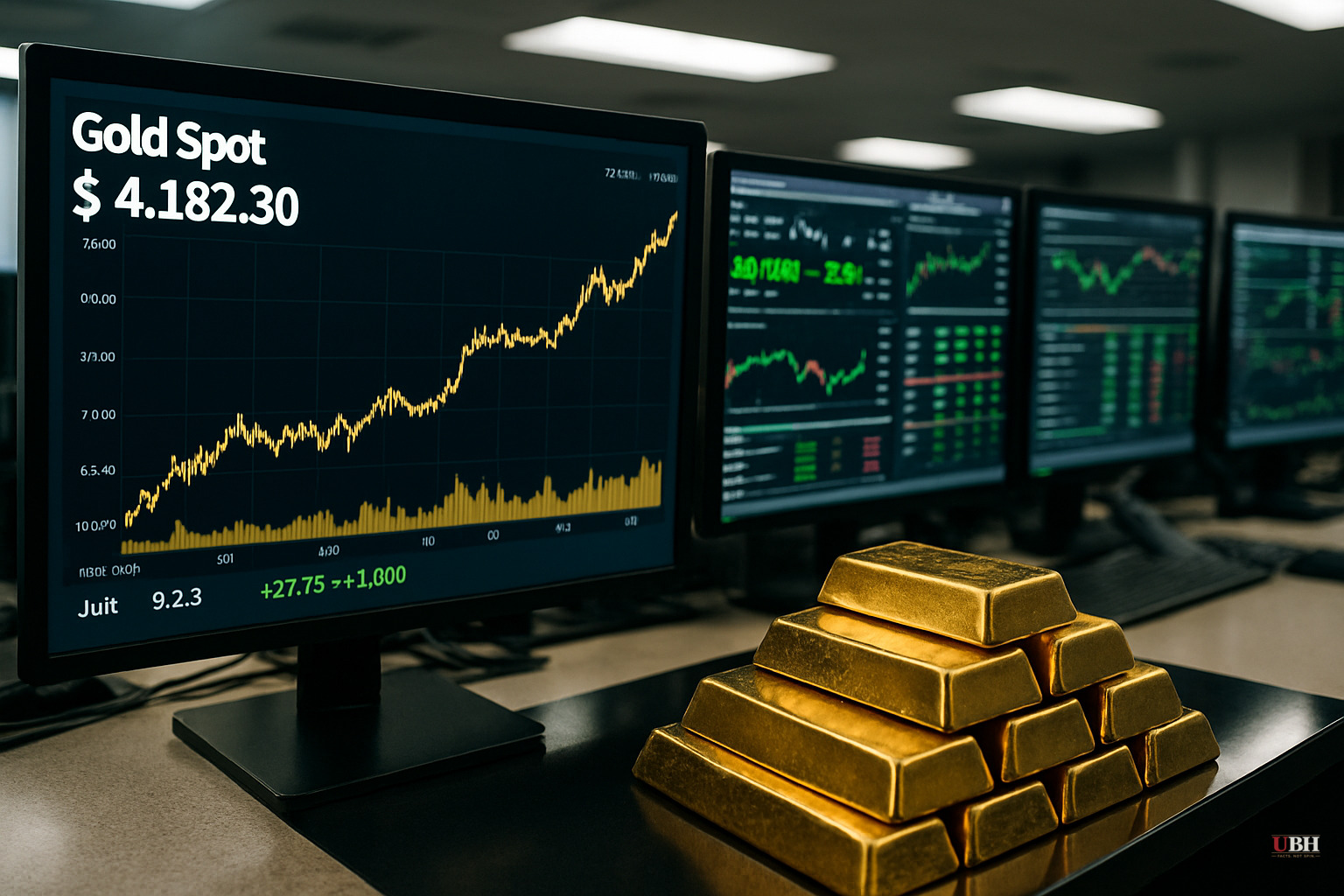
Since gold hit its all-time high above $5,300 an ounce in January, the metal has been in a punishing drawdown — its worst quarterly performance in 13 years through June. As of this morning, July 3, spot gold is trading around $4,182.28, up 1.4% on the day according to CNBC.
The immediate catalyst is Thursday's June nonfarm payrolls report. The U.S. economy added 57,000 jobs in June, below the downwardly revised 129,000 in May and well short of the Dow Jones consensus estimate of 115,000, per CNBC. That miss pushed markets to reassess how aggressive the Federal Reserve will be in the second half of 2026.
CME's FedWatch tool now puts the probability of at least a quarter-point rate hike at the Fed's September meeting at 53.5%, down from roughly 65% before the jobs number dropped. Rates are expected to hold steady at the July meeting.
Silver and Platinum Join the Move
Precious metals broadly rose Friday morning. Spot silver climbed 2.9% to $62.77 an ounce, putting it on pace for a weekly gain of around 6.7%, according to CNBC. Silver futures for August delivery added 3.5%. Spot platinum was last up 2.8% at $1,660.10, and palladium gained about 1% to $1,280.09.
For context: silver surged 135% in 2025, gold surged 66%. Year-to-date through early July 2026, silver is down 12% and gold is down 3%. The 2026 reversal has been sharp.
Why Safe Havens Stopped Working
The traditional safe-haven playbook — buy gold, buy Treasurys, buy yen — broke down badly in 2026. The proximate cause was the U.S.-Iran war that erupted in February, which closed the Strait of Hormuz and pushed oil from roughly $60 to $120 a barrel.
Henning Potstada, global head of multi-asset at DWS, explained the bond market failure to CNBC: "We had the Iran war, which led to a closure of the Straits of Hormuz, led to oil prices going from $60 to $120, leading to inflation forecasts, or actually, realized inflation moving up, and this is the situation when bond markets are not driven by growth but driven by inflation expectations." Rising inflation erodes the real value of fixed payments, so buyers flee rather than flock.
The U.S. fiscal picture adds pressure. The Congressional Budget Office projects a $1.9 trillion federal deficit for fiscal year 2026, or approximately 5.8% of GDP. Goldman Sachs vice chairman Rob Kaplan noted last year that the country is "more highly leveraged on a net-debt basis than we've been in our lifetimes." That kind of deficit, historically high outside of a recession, makes Treasurys a less clean safe-haven bet.
Meanwhile, capital keeps flowing into AI-linked equities. Frederic Neumann, chief Asia economist at HSBC, told CNBC that underlying risk appetite remains healthy and global financial conditions are highly accommodative. Investors have been piling into Nvidia, Intel, Samsung Electronics, SK Hynix, and Taiwan Semiconductor Manufacturing Company, pushing both U.S. and some Asian markets to record highs. Henning Potstada said, "The driver of equities is EPS growth, that's the only driver that matters on the long run for equities, and EPS forecasts are going up."
Billy Leung, investment strategist at Global X ETFs, told CNBC that "Gold hasn't behaved like a pure safe haven recently."
The Case for Caution
The strongest counterargument to Friday's gold rally is that nothing structural has changed. Unemployment held steady in June even as hiring slowed, Fed rhetoric remains hawkish, and the inflation risks created by $120 oil haven't vanished. One soft payrolls print is not a pivot.
OCBC strategists acknowledged this in a Friday note, saying the jobs data "helps reduce the hawkish tail risk" but stopping short of a bullish call. Their language: "cautiously constructive." They specified that a durable gold recovery requires real yields to ease more decisively, ETF and investor demand to stabilize, and the Fed to pull back on hawkish rhetoric — none of which has happened yet.
What Needs to Happen Next
OCBC's framework gives a concrete roadmap for whether this week's move is a genuine inflection or a head fake. Watch the next two or three major U.S. data releases — particularly CPI and the next jobs report. If real yields begin a sustained decline, the case for a gold recovery strengthens. If inflation remains sticky and the Fed holds its hawkish line through the July meeting, OCBC's own analysis suggests the gold recovery stalls. The unresolved question is whether June's weak hiring is the start of a trend or noise in an otherwise resilient labor market.
Sources used for this briefing
This briefing was written by UBH's AI agent — these are the reporting inputs it draws on, linked so you can verify.


