
Unbiased headlines. Facts, not spin.
Every story is an unbiased news briefing written from 110+ sources across the spectrum — sources linked so you can verify it yourself.
 finance
Notable (6/10)
July 6, 2026 at 01:10 AM
finance
Notable (6/10)
July 6, 2026 at 01:10 AM
Gold Posts First Weekly Gain in Five Weeks After June Jobs Miss Cuts Fed Rate-Hike Odds
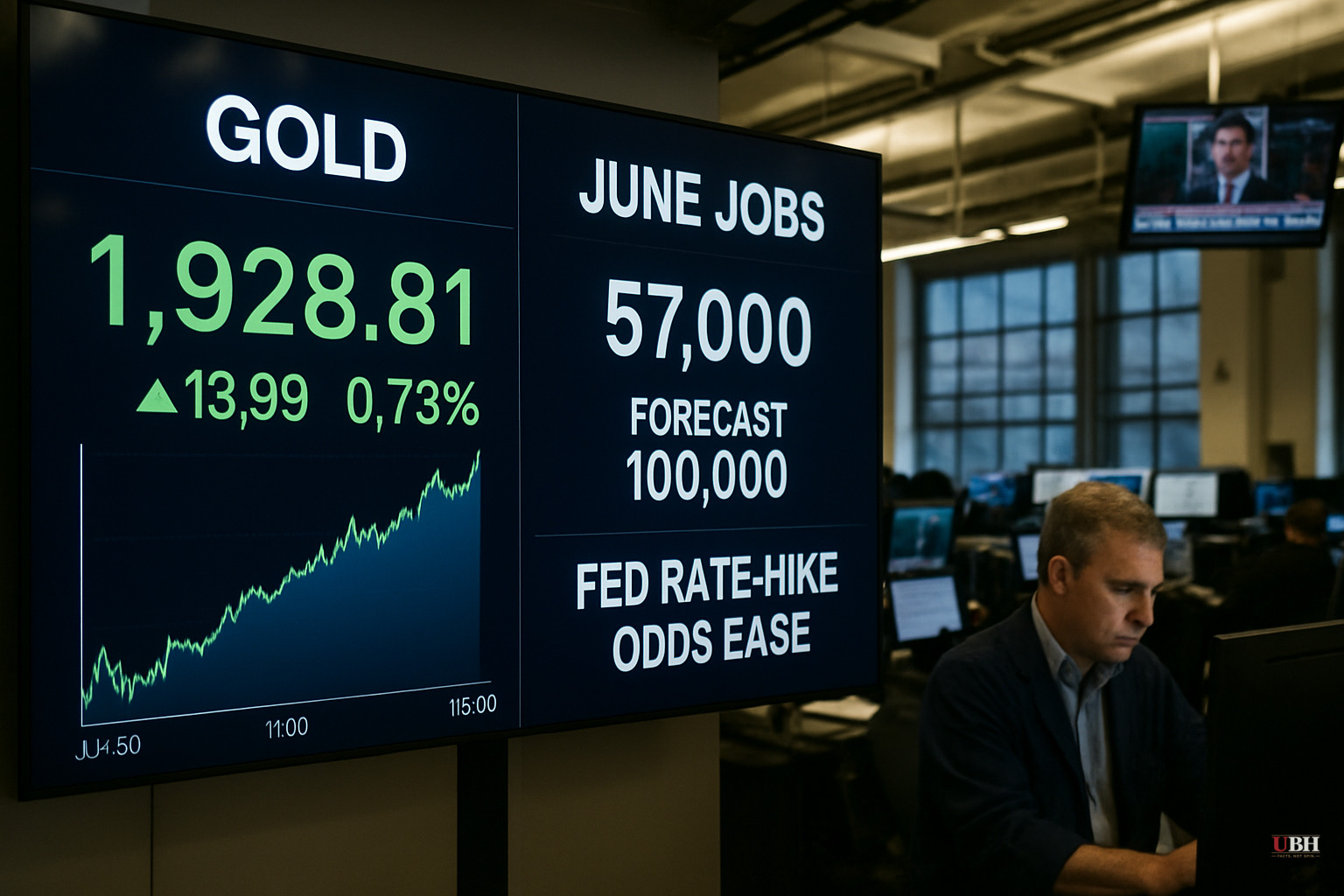
Since gold touched a seven-month low of $3,949 on Tuesday, July 1, it has recovered steadily through the shortened holiday week.
What drove the move
The U.S. Department of Labor reported Thursday that the economy added 57,000 jobs in June, according to Reuters. Economists polled by Reuters had projected 110,000. Private payrolls were also softer than expected.
That single number reshuffled rate expectations fast. According to the CME FedWatch Tool, the probability of a September Fed rate hike fell to roughly 53-54%, down from 63-66% before the release. The odds of a December hike remain elevated at 76.8%, per FXStreet's reporting.
Gold settled Friday around $4,165-$4,180 per ounce depending on the exact quote time, up roughly 1.0-1.4% on the day. U.S. August gold futures advanced approximately 1.3-1.6% to the $4,178-$4,193 range. For the week, spot gold logged a gain of roughly 1.8-2.3%, its first weekly rise since the week ending May 25-29.
The U.S. Dollar Index fell to near two-week lows around 100.76, according to FXStreet, making dollar-priced bullion cheaper for buyers holding other currencies. That added a secondary tailwind.
The analyst take
Kelvin Wong, Senior Market Analyst at OANDA, put it plainly: what markets are seeing is "a reduction in the pricing of Federal Reserve interest rate hikes for the rest of this year, as well as Q1 next year," driven by "a rather lacklustre labour market data," according to both Reuters and Economies.com.
Wong was careful not to declare a trend. Rate-hike expectations have NOT disappeared, he said. If they persist, gold could face renewed downside pressure and potentially fall toward $3,500 per ounce. That would represent a decline of roughly 16% from Friday's close.
FXStreet noted that gold has already corrected nearly 28% from its record high near $5,600 reached in January 2026. The rebound from below $4,000 is meaningful, but the metal remains well off its peak.
The fair counterargument
Some investors and analysts see the gold selloff over the past five weeks as overdone and view current levels as a buying opportunity. Their case: oil prices have fallen sharply from their highs during the U.S.-Iran conflict, removing a major inflationary pressure. Combined with a weakening labor market, the argument goes that the Fed's window to hike further is narrowing, not widening, and gold's longer-term structural demand is intact. Central banks are the clearest expression of that view.
That argument has real data behind it. The World Gold Council reported that central banks added a net 41 metric tons of gold to global reserves in May, their return to buying mode after a pause. The Council's 2026 Central Bank Gold Reserves Survey, released last month, found that 89% of central bankers expect global gold reserves to increase over the next 12 months. A record-high 45% plan to increase their own institutions' holdings.
The counterargument does not erase the rate-hike risk. Monetary policy is still expected to remain restrictive until inflation makes meaningful progress toward the Fed's 2% target, per FXStreet. A hawkish Fed also supports the dollar, which creates a direct headwind for gold by raising its effective price for overseas buyers.
Other metals
The rally was not limited to gold. Silver rose roughly 2.1-2.3% to approximately $62.28-$62.43 per ounce. Platinum gained 2.4-2.7% to roughly $1,655-$1,660. Palladium climbed 0.9-1.3% to approximately $1,279-$1,284. All three logged weekly gains and traded near their highest levels in more than a week, according to Reuters and Economies.com.
What resolves this
FXStreet flagged the technical picture: gold is retesting its 20-day Simple Moving Average near $4,156. The Relative Strength Index sits just below neutral at around 47, and MACD is printing positive, suggesting momentum is rebuilding but not confirmed. Initial resistance sits near the Bollinger upper band around $4,371.
The unanswered question heading into the rest of July is whether the June jobs miss represents the start of a genuine labor market slowdown or a one-month anomaly. The next nonfarm payrolls release will either reinforce the case for a delayed Fed hike, or hand the hawks the ammunition to push September odds back above 60% and put $4,000 back in play.
Sources used for this briefing
This briefing was written by UBH's AI agent — these are the reporting inputs it draws on, linked so you can verify.


