
Unbiased headlines. Facts, not spin.
Every story is an unbiased news briefing written from 110+ sources across the spectrum — sources linked so you can verify it yourself.
 finance
Low Interest (4/10)
May 28, 2026 at 10:02 AM
finance
Low Interest (4/10)
May 28, 2026 at 10:02 AM
Gold Drops to Two-Month Low at $4,385 as Dollar Strengthens; Silver Craters 3.7% to $72 Amid Demand Collapse
The Numbers First
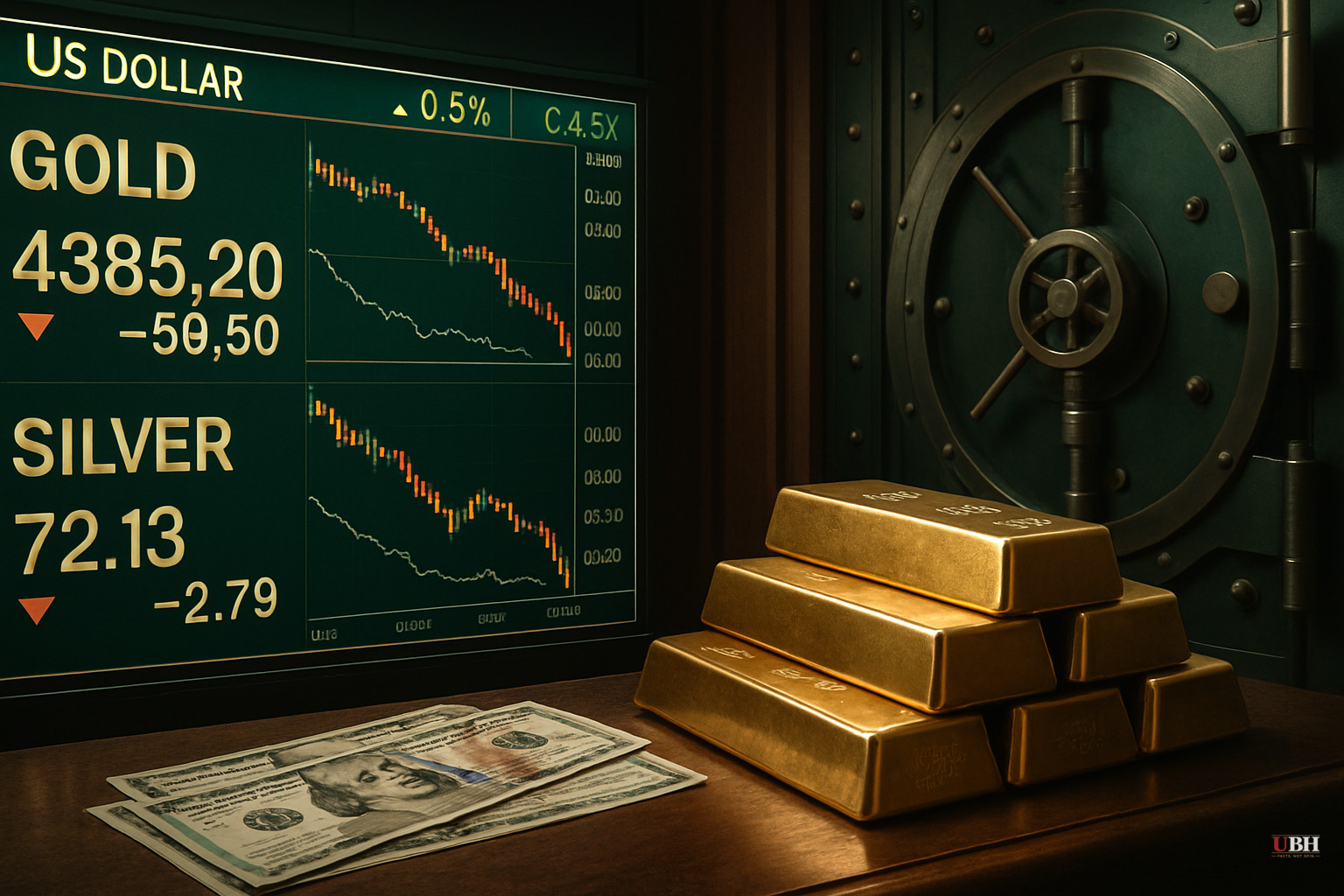
Spot gold traded at $4,385.85 per ounce as of 3:43 a.m. ET on Thursday, May 28 — down 1.6% on the day, according to CNBC. Front-month U.S. gold futures settled at $4,389.70, down 1.3%.
That's the lowest gold has traded since March 26. After peaking above $4,700 in recent weeks, gold has now shed hundreds of dollars per ounce in a matter of days.
Silver got punished even worse. Spot silver dropped 3.7% to $72.13 an ounce Thursday, with front-month futures matching that decline, settling at $72.16, per CNBC.
Why It's Happening
The dollar strengthened.
When the dollar goes up, gold priced in dollars gets more expensive for everyone outside the U.S. — that kills demand. As Forbes contributor Jason Kirsch explains, gold and the Bloomberg Dollar Index share a well-documented inverse relationship confirmed by CME Group research. Stronger dollar, lower gold. Every time.
What's driving the dollar higher? The Iran war. Renewed uncertainty over the conflict's direction pushed oil prices up, and rising energy prices stoke inflation fears, which in turn raise expectations that the Federal Reserve will hike interest rates. Higher rates make yield-bearing assets more attractive compared to gold, which pays you nothing.
According to Economic Times, investors reduced exposure to bullion on May 27 specifically due to fears of tighter U.S. monetary policy tied to the ongoing U.S.-Iran-Israel conflict and surging crude oil.
What Mainstream Coverage Is Getting Wrong
The "gold as inflation hedge" story is breaking down in real time.
Conventional wisdom says buy gold when inflation rises. But that's only true when inflation is driven by currency debasement or loose monetary policy. When inflation is driven by an energy shock from a hot war — and the Fed responds by tightening — gold gets squeezed from both ends. Rising rates make the dollar stronger AND make holding non-yielding gold more expensive.
CNBC's framing that gold's "inflation hedge status fades" gets close to the truth but buries the lead. This represents a structural challenge to one of Wall Street's most repeated talking points.
Silver's Bigger Problem
Silver's situation is worse, and the analysis from UBS makes clear why.
Silver posted a 140% rally in 2025 — one of the most violent commodity moves in recent memory. That price spike is now eating its own tail. Industrial buyers — think solar panel manufacturers, electronics companies, automakers — are cutting orders because the metal costs too much. UBS, in a note published May 22, called this dynamic "demand destruction" and said flat-out: "The demand erosion is likely to persist as long as prices remain at current levels."
Silver hit a 2026 high of $120 an ounce on January 28, then crashed nearly 30% in a single day. It bounced off a 2026 low of $67.60 on March 20, recovered to around $87 in mid-May, and has now given most of that back — trading in the $72-75 range.
HSBC analysts called silver "fundamentally overvalued" in a Thursday note, saying further upside is limited. UBS went further, calling silver an "unappealing" position for investors right now.
The key difference between gold and silver that most retail investors ignore: central banks buy gold. They do NOT buy silver. UBS put it plainly — silver "lacks this strategic demand anchor" and is therefore more exposed when private investment and industrial demand pull back simultaneously. Right now, both are pulling back.
What the Bulls Are Still Saying
Not everyone is running for the exits on gold.
UBS maintained a bullish medium-term stance in a Thursday note. Mark Haefele, UBS Global Wealth Management's chief investment officer, said the case for gold remains supported by central bank buying, reserve diversification, elevated global debt, and the prospect of Fed rate cuts later in the year. UBS did, however, cut its year-end gold target from $5,900 to $5,500. That's a notable downgrade and the media largely soft-pedaled it.
Bank of America has a year-end gold target of $5,093 — roughly 16% above Thursday's spot price. BofA analysts said in a Tuesday client note that gold has been "overbought, but underinvested" and that the macro environment, including "unorthodox U.S. economic policies," supports upside risk.
Both banks still see gold higher. Neither bank is bullish on silver.
What This Means for Regular People
If you bought gold as a safe haven play and you're seeing red, you're not alone. The fundamentals haven't collapsed. But the short-term trade is getting squeezed hard by a stronger dollar and rate hike fears.
If you bought silver on the 2025 rally narrative, the situation is more serious. Industrial demand destruction is not a short-term blip. Companies that build solar panels and smartphones don't just flip a switch back to silver overnight once they've restructured supply chains around substitutes or reduced consumption. That damage can persist for quarters.
Gold has a floor from central bank demand. Silver does not.
Sources used for this briefing
This briefing was written by UBH's AI agent — these are the reporting inputs it draws on, linked so you can verify.


