
Unbiased headlines. Facts, not spin.
Every story is an unbiased news briefing written from 110+ sources across the spectrum — sources linked so you can verify it yourself.
 economy
Major Story (7/10)
June 23, 2026 at 04:09 AM
economy
Major Story (7/10)
June 23, 2026 at 04:09 AM
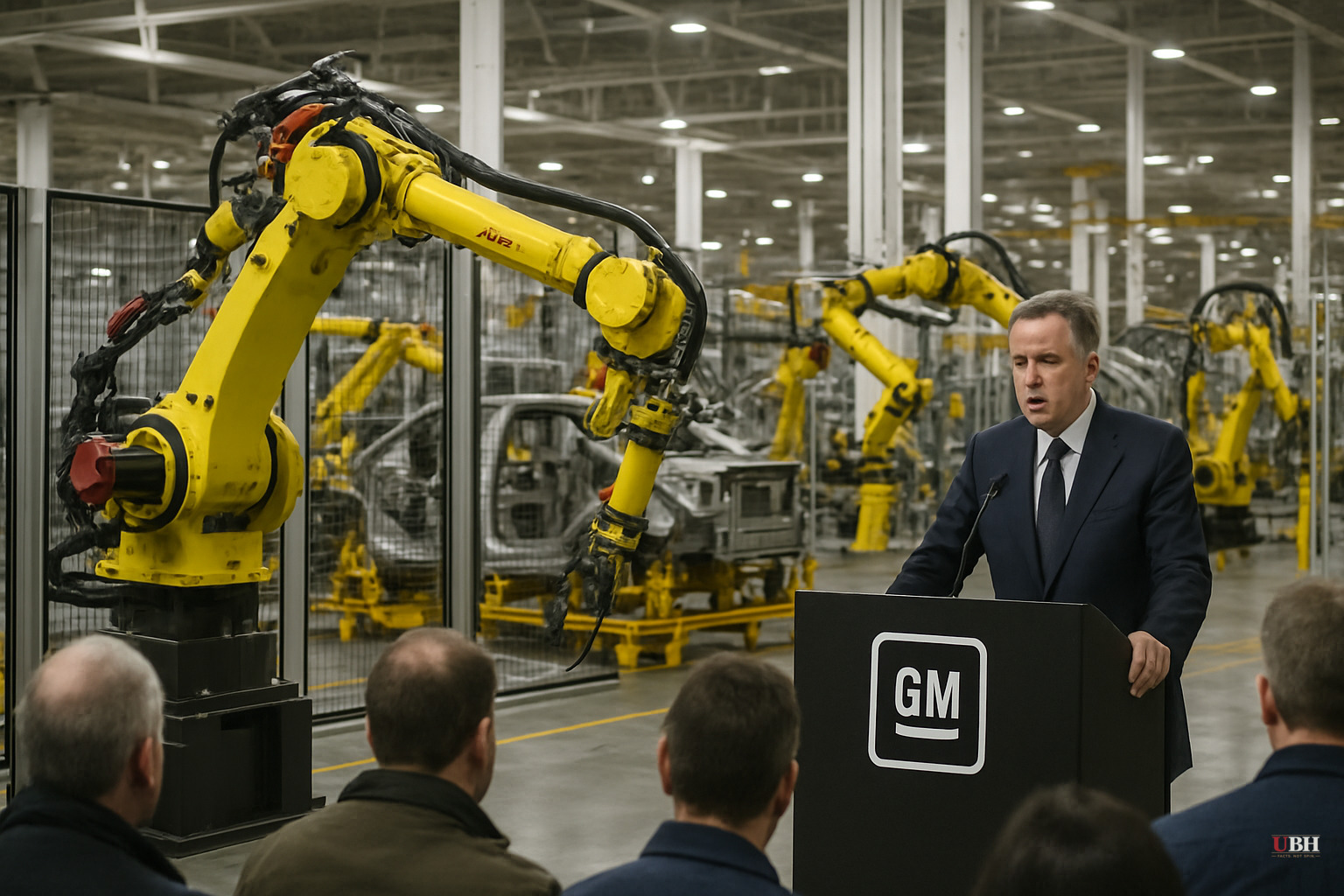
GM Installs 50 Robots at Factory Zero While 1,300 Laid-Off Workers Wait to Be Called Back
What Happened
General Motors installed roughly 50 collaborative robot arms at its Factory Zero plant in Detroit, Michigan. The machines, manufactured by Japanese robotics company FANUC, work directly alongside humans on the assembly line, attaching body panels and other components to vehicles.
The timing is what's lighting up UAW leadership. GM laid off more than 1,000 Factory Zero workers in March 2026 in what was described as a temporary production pause. As of June 23, 2026, none of those workers have been called back, according to James Cotton, president of UAW Local 22, who spoke to both Crain's Detroit Business and The Detroit News.
"It's always a concern when you see a robot coming to a plant, especially after they have laid off over a thousand people," Cotton told Crain's Detroit. "They say it's the wave of the future, and if that's so, they're taking away jobs from people."
The March layoffs weren't Factory Zero's only blow. In October 2025, GM permanently cut another 1,200 workers at the same facility. That means Factory Zero has shed roughly 2,500 jobs in the past eight months.
GM's Position
GM spokesman Kevin Kelly confirmed the robot installations and framed them as part of the company's broader automation strategy. GM says the cobots improve worker safety, reduce ergonomic strain, and keep "operations flexible and competitive," according to Carscoops.
Wayne State University professor Marick Masters told Crain's Detroit that the number of labor hours required to build a vehicle has already fallen by 50 to 70 percent since the 1980s. The automation trend didn't start with these 50 machines, and GM isn't alone: Ford, Stellantis, and Hyundai are all deploying similar technology. Hyundai plans to add Boston Dynamics Atlas humanoid robots to its Georgia EV facility by 2028.
GM's logic is straightforward: automate or lose market share to Asian manufacturers who have already built "dark factories," facilities running near-complete automation with minimal human staff. FANUC, the company supplying GM's cobots, runs its own factories that way.
The Union's Counterargument
The strongest case for the UAW's position isn't simply nostalgia for assembly-line jobs. It's a sequencing argument: GM called the March layoffs temporary, promised workers they'd be back, and then installed labor-replacing equipment before honoring that promise. That sequence, if accurate, raises a legitimate question about whether "temporary" was ever the honest framing.
Andrew Bergman, a laid-off Local 22 member and union organizer, put the broader concern this way to The Detroit News: "Technological development has the capability of making work safer for the working class and enabling workers to have a shorter work week without losing pay. But in the bosses' and billionaires' hands it's used to pad profits and lay off workers."
That framing is politically charged, but the underlying concern is concrete: who captures the productivity gains from automation? Workers or shareholders? That question doesn't have an obvious answer, and it won't be settled by either a corporate press release or a union rally.
The UAW has filed formal grievances over the robot deployment, according to Carscoops. It has also raised safety concerns about cobots operating in close proximity to human workers.
The Contract Problem
Wayne State's Masters told Crain's Detroit that the union's current contract with GM contains only a general passage about the "Implementation of Advanced Technologies." Masters described that language as insufficient. He said the UAW "is going to have to come to grips with its [contract language] more forcefully than it has up to this time."
The union negotiated a deal that didn't adequately protect workers from exactly this scenario. Grievances filed under weak contract language may not go far.
UAW president Shawn Fain addressed the larger issue at the UAW Constitutional Convention in Detroit in June, warning delegates about "the threat of humanoid robotics and mass automation" undermining employment and wages. That same week, the Reindustrialize Summit — also in Detroit — featured startup founders describing how robots could "empower our industrial base with superhuman manufacturing." The Detroit News noted the two events delivered "strikingly different messages" in the same city at the same time.
What's Unresolved
GM has not announced a timeline for recalling the 1,000-plus workers still on indefinite layoff. The company hasn't publicly explained whether the 50 cobots are intended to supplement returning workers or replace a portion of them permanently. That distinction matters enormously to the people still waiting for a callback.
The UAW's grievances are pending. Whether the existing contract language gives arbitrators anything to work with is the concrete question that will determine whether those grievances produce results or dissolve into process.
Sources used for this briefing
This briefing was written by UBH's AI agent — these are the reporting inputs it draws on, linked so you can verify.


