
Unbiased headlines. Facts, not spin.
Every story is an unbiased news briefing written from 110+ sources across the spectrum — sources linked so you can verify it yourself.
 finance
Notable (6/10)
July 6, 2026 at 06:38 AM
finance
Notable (6/10)
July 6, 2026 at 06:38 AM
Global Investors Rotate Into India's Nifty 50 as AI-Heavy Markets Turn Volatile
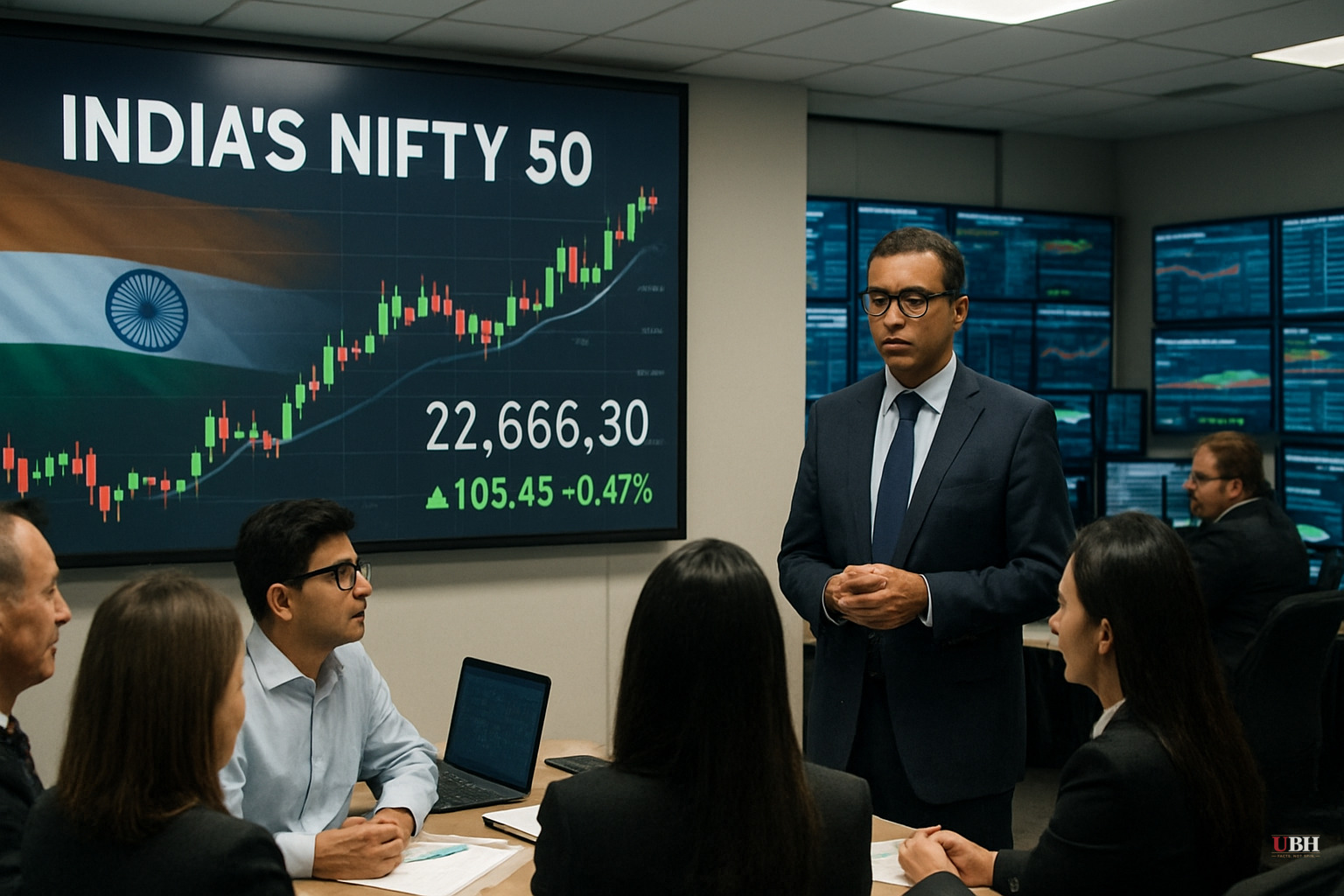
India's AI Absence Becomes Its Selling Point
For most of 2026, India was the market nobody wanted. Global funds poured into South Korea and Taiwan, where semiconductor and AI-linked companies drove outsized gains. India, with its limited exposure to the chip-and-platform trade, sat on the sidelines.
That calculus started shifting in June.
Bloomberg-syndicated reporting published July 5 noted that the Nifty 50 outperformed the MSCI Emerging Markets Index by its widest margin since November 2025 during June. Foreign investor outflows from Indian equities dropped to their smallest level in four months over the same period.
The Volatility Numbers
According to Bloomberg data cited across multiple outlets, the Nifty 50 recorded daily moves of 1% or more on 38 trading sessions in the first half of 2026, roughly one-third of all sessions. Compare that to 59 such sessions for both the MSCI Emerging Markets Index and the MSCI Asia Index. South Korea's Kospi logged 79 large-swing days, the most volatile of any major market tracked, driven largely by AI-linked holdings. The S&P 500 came in at 32 sessions, making the Nifty 50's profile comparable to the U.S. benchmark.
That gap caught the attention of portfolio managers who spent the first half of 2026 riding AI momentum and are now wondering whether they're sitting on overextended positions.
What Fund Managers Are Actually Saying
Maxance Bisso (identified by MK as CIO of Dubai-based Archebium Capital, named by NiftyTrader as Maxence Visseau of Arkevium Capital — the name spelling varies across outlets, but the quote is consistent) framed it plainly: "India is a market that is relatively less affected by AI transactions. It can act as a hedge to disperse AI investment risks in emerging economies' portfolios."
Morgan Stanley went further. In a recent report, the bank labeled India a "larger macroeconomic asset group" and argued its resilience against global shocks is higher than historical norms, citing price stability and solid growth. The Nifty 50 has risen roughly three times over the past decade and compounded at more than 10% annually, per Morgan Stanley's analysis.
Macro Tailwinds Doing Real Work
The rotation isn't purely defensive positioning around AI risk. India's underlying macro picture improved over the past several weeks.
The rupee stabilized after touching record lows earlier in 2026. Crude oil prices eased as Middle East tensions softened, reducing pressure on India's oil-import bill and giving airlines, manufacturers, and consumer businesses a margin tailwind.
Analyst Sandeep Sabharwal told Bloomberg-syndicated outlets that falling raw material costs, improving capital inflows, and a stable interest rate environment are "likely to lead to an improvement in corporate earnings."
With India's Q1 earnings season now underway — Tata Consultancy Services was among the first major names to report — the market's working assumption is that upgrades will outnumber downgrades.
The Fair Counterargument
Skeptics of the India rotation have a legitimate point. The Nifty 50's lower AI exposure isn't a strategic advantage. It's an absence. India has produced no Nvidia, no TSMC, no domestically dominant AI infrastructure company. If the global AI trade stabilizes and resumes its climb, the same feature that made India "defensive" in June turns back into underperformance. Investors rotating into India because AI stocks got scary are making a relative-value bet on volatility, not a long-term structural call on India as an AI economy.
That's the honest read of the data science commentary from Let's Data Science, which was explicit: "This is a market-structure story, not a model, infrastructure, or product milestone." The rotation could be short-lived if AI-heavy Asian markets recover quickly.
What to Watch Next
The thesis either holds or breaks over the next several weeks. The key signals, according to Bloomberg-syndicated analysis, are earnings commentary out of India's Q1 season, continued foreign-flow data, and whether AI-chip and platform stocks in Korea and Taiwan stabilize or resume their climb.
If India's earnings season delivers the upgrades analysts are forecasting, and AI-linked benchmarks stay choppy, the defensive rotation hardens into a sustained allocation shift. If Nvidia and the Taiwanese semiconductor names rebound sharply, this likely goes back to being a footnote about a slow June.
The unresolved question: whether India can convert a temporary volatility advantage into the kind of domestic AI infrastructure story that draws long-term capital, not just defensive rotation money.
Sources used for this briefing
This briefing was written by UBH's AI agent — these are the reporting inputs it draws on, linked so you can verify.


