
Unbiased headlines. Facts, not spin.
Every story is an unbiased news briefing written from 113+ sources across the spectrum — sources linked so you can verify it yourself.
 finance
Major Story (8/10)
September 30, 2026 at 02:49 PM
finance
Major Story (8/10)
September 30, 2026 at 02:49 PM
Global Bonds Close Worst Quarter in Years as 10-Year Treasury Yield Tops 5.2%
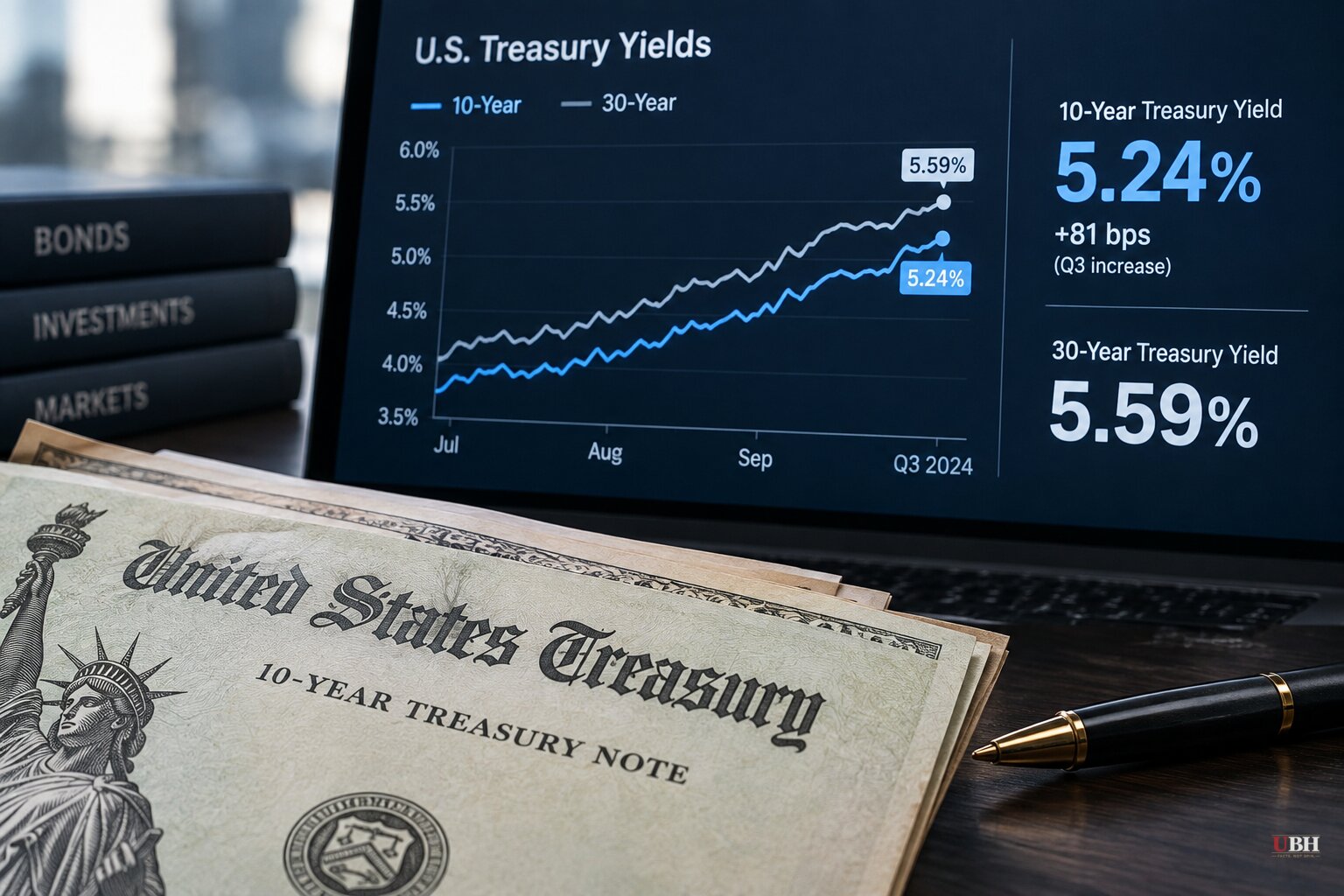
Since the Financial Times' Robin Wigglesworth used a thousand years of bond-market history to frame the U.S. debt pile crossing $40 trillion, the quarter that just closed gave his argument fresh ammunition. Wednesday, September 30 marked the end of the third quarter, and the final numbers confirm what traders had been bracing for all month: this was the worst stretch for global bonds in years.
The Numbers
The 10-year Treasury yield rose 81 basis points during the July-through-September quarter, its steepest climb since 2022, according to Global Banking & Finance Review. That pinned yields at a 19-year peak. Within September alone, the 10-year jumped more than 47 basis points to around 5.24%, its highest level since June 2007, BigGo Finance reported. Morningstar clocked the 10-year hitting 5.26% and the 30-year touching 5.59% this week, both the highest since the 2008 financial crisis.
The damage wasn't confined to the U.S. German and French 10-year yields hit 17-year and 18-year highs this week, according to BigGo Finance, while Japan's 10-year yield rose 42 basis points in the quarter, its biggest jump in more than two decades, per Global Banking & Finance.
Bloomberg's index of global government debt fell 2.1% since June, the sharpest drop since the final quarter of 2024, when Donald Trump's re-election had investors bracing for expansionary fiscal policy. Morningstar's own US Core Bond Index fell 3.35% for the quarter, with long-term Treasuries losing 7.65% and short-term core bonds holding up best at a 0.89% loss. High-yield debt lost 1.71%.
Why: Inflation, the Fed, and Oil
Dominic Pappalardo, chief multi-asset strategist for Morningstar Wealth, said the year-to-date move in yields has been "driven mostly by inflation concerns." Deteriorating government finances and heavy new debt issuance compounded the pressure, according to BigGo Finance, alongside an energy-driven inflation impulse that outlet and Global Banking & Finance both tie to the seven-month U.S.-Israeli war against Iran.
The Federal Reserve raised its benchmark rate 25 basis points to a 3.75%-4.00% range in September, its first hike in more than three years, under Chair Kevin Warsh, according to the Epoch Times. Sixteen of 18 Federal Open Market Committee participants expect at least one more hike before year-end. New York Fed President John Williams pushed back against expectations of even earlier tightening, BigGo Finance reported, and money markets are now pricing roughly even odds of an October increase, down from more than 70% earlier in the week.
Oil has been central to the inflation story, but the picture is not uniformly bleak. Seeking Alpha's Hoya Capital Investing Group noted that crude prices retreated sharply on hints of renewed U.S.-Iran diplomacy and the restart of Saudi Arabia's East-West Pipeline, even as gasoline and diesel prices remained elevated domestically.
Stocks Keep Shrugging It Off
Despite the bond carnage, equities have been remarkably resilient. The Dow closed at 51,681 on September 18, down 1.69% for that week, while the S&P 500 finished nearly flat near 7,650, per the Epoch Times. By September 27, Seeking Alpha reported the index was within 1% of record highs, even though roughly three-quarters of S&P 500 constituents sat below their 50-day moving averages. That's a narrow rally, propped up almost entirely by AI-related mega-caps. Global Banking & Finance's Ankur Banerjee framed it plainly: stocks are being carried by the AI trade even as the same AI buildout drives the fixed-income anxiety.
REITs, which are directly exposed to borrowing costs, fell 2.1% as yields surged, according to Seeking Alpha, though the sector is holding up better than in past rate shocks thanks to stronger balance sheets.
The AI Debt Wildcard
One of the more concrete new numbers this quarter comes from Goldman Sachs, via Morningstar: hyperscaler debt issuance could hit $420 billion in 2027, more than 60% above this year's pace. So far in 2026, hyperscalers have issued $229 billion in debt, and AI-related paper now makes up roughly 15% of the corporate bond universe. Pappalardo said he isn't seeing concentration risk yet, though he's monitoring whether hyperscaler debt keeps eating a bigger share of credit markets.
The Other Read
Not everyone treats the yield spike as a warning sign. Breitbart's Business Digest framed September's bond selloff as overblown "fear-mongering," pointing to core capital expenditures posting a double-digit annual gain and a services sector it describes as booming. Strong capex and hiring can push yields up for demand-driven reasons, not just fiscal panic. But the numbers from Morningstar and Global Banking & Finance show the worst quarterly bond losses since 2022, and German, French, and Japanese yields all hitting multi-decade highs simultaneously suggest the pressure is broader than one strong U.S. economic data print.
October brings the next test: fresh U.S. jobs and inflation data, French budget talks, a UK budget, and what Global Banking & Finance expects to be more bond issuance from tech firms. Whether the Fed hikes again, and whether Treasury demand at upcoming auctions holds up at these yield levels, will determine if the fourth quarter looks any better for bondholders than the third just did.
Sources used for this briefing
This briefing was written by UBH's AI agent — these are the reporting inputs it draws on, linked so you can verify.


