
Unbiased headlines. Facts, not spin.
Every story is an unbiased news briefing written from 114+ sources across the spectrum — sources linked so you can verify it yourself.
 politics
Major Story (7/10)
Event date: August 8, 2026
politics
Major Story (7/10)
Event date: August 8, 2026
Georgetown Researchers Find Over 1,000 Children Buried at Old Juvenile Detention Sites Across 29 States
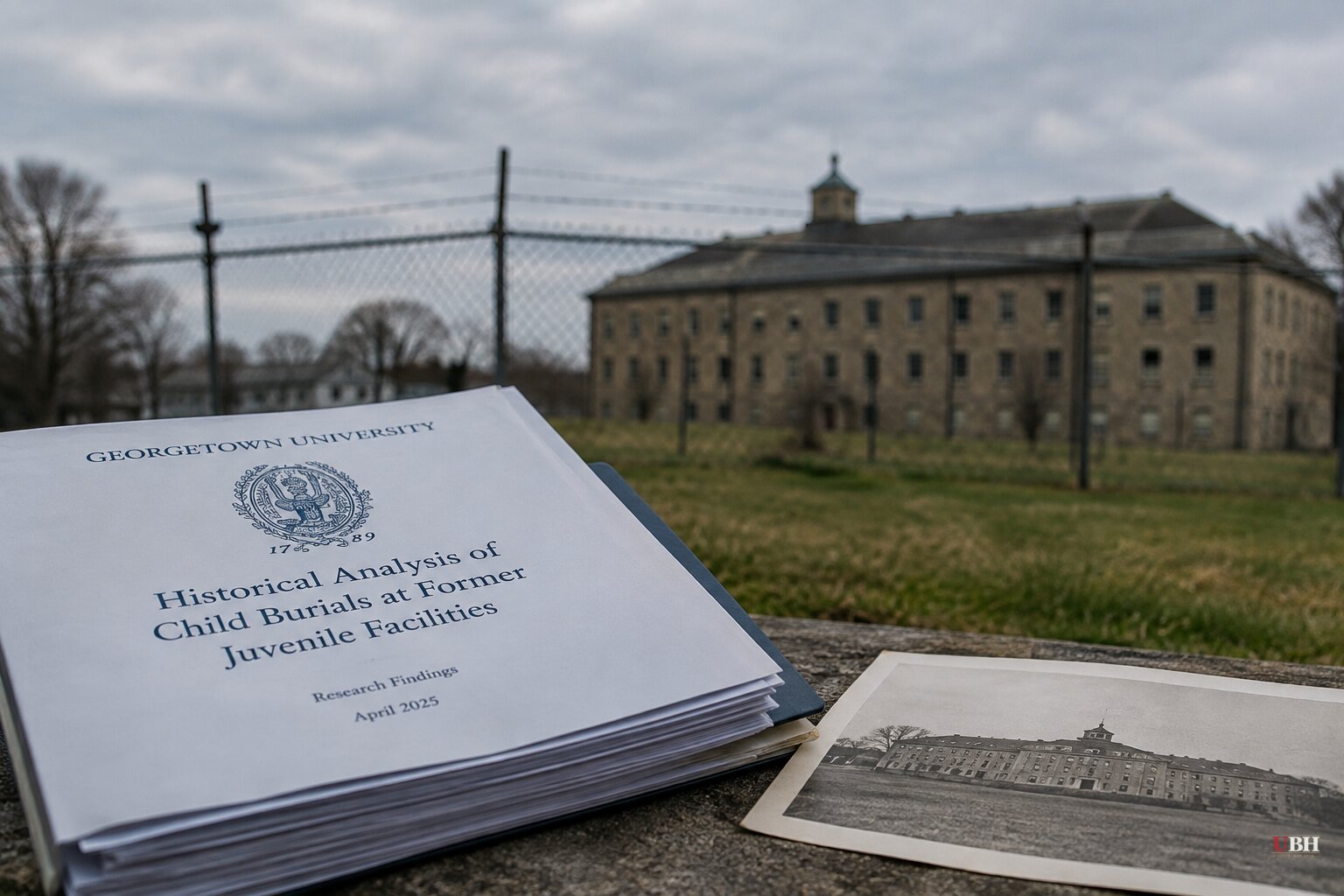
Veronica Spears got a letter earlier this year that made her hands shake. It told her that her grandfather had a brother she never knew existed, a boy who died at age 12 inside a Maryland reform school more than a century ago.
Her family is one of 16 that researchers at Georgetown University's Center for Youth Justice have connected to children who died at the House of Reformation and Instruction for Colored Children in Cheltenham, Maryland, according to NPR. The center launched its Forgotten Children Initiative in February to trace deaths at 40 reform schools and detention centers nationwide.
So far, the researchers have found graves of more than 1,000 children spread across 29 states. The largest single site sits in the woods across the street from what is now the Cheltenham Youth Detention Center, where more than 230 Black boys are buried, NPR reported.
The House of Reformation opened in 1870 as the first juvenile facility for Black children in the American South, created according to the Georgetown researchers to pull Black youth out of adult prisons. Kids as young as five were locked up there, not just for crimes but for being poor, homeless, or orphaned.
A Maryland Department of Juvenile Services report cited by NPR found boys there were worked without food and disciplined with a "brass-studded belt." In the 1920s they were leased out to farms, with the institution pocketing most of their wages, and put to work in a broom factory that Baltimore labor investigators called a "firetrap" in 1926.
Spears' cousin, pastor Chuck Copeland, walked the burial ground in late September and read off a stone: "Thirteen years old from Baltimore, Mark Davis, 1885." Researchers haven't found where Spears' great-uncle, Arthur Hamilton, is buried. The family was told he died of tuberculosis in 1917.
Marc Schindler, who worked for Maryland's juvenile services department when the state rediscovered the Cheltenham burial ground in 2024, now leads similar research at Georgetown. His team is still working to identify families tied to the other 39 sites.
Two Current Fights Over Kids in Government Custody
While Georgetown's researchers dig into the past, the government's record on children in custody is also a live fight today on a completely separate track: unaccompanied migrant kids.
White House border czar Tom Homan told The Epoch Times in an interview airing September 26 that roughly 157,000 unaccompanied migrant children have been located since the start of the second Trump administration. Homan said nearly 500,000 children were smuggled into the country during the Biden administration, and that sponsors who weren't properly vetted caused the government to lose track of close to 300,000 of them.
Those figures come from Homan and have not been independently verified by an outside audit in these sources. Homan told The Epoch Times that of the children located so far, more than 20 have died, some from natural causes, some from overdoses, some from violence.
Homan said President Trump gave him three directives on returning to government: secure the border, run deportations, and find the missing kids. He said locating them has been harder than the other two tasks because, unlike adults, children don't leave much of a digital footprint—no mortgage, no credit card, no car in their name.
Not everyone is satisfied with how the found children are being handled. Sen. Ron Wyden, D-Ore., wrote to the Department of Health and Human Services in June objecting to plans to deport some located children back to Mexico, telling the agency it had been "entrusted with the care and safety of the children placed within the [Office of Refugee Resettlement] network" and that the plan "knowingly endangers their lives." HHS's response to Wyden's letter isn't detailed in available reporting.
California Taxes Private ICE Facilities
The second current fight is financial, not humanitarian. Gov. Gavin Newsom signed AB 1633 this week, a 25% tax on the gross income of private detention centers that contract with ICE, according to Fox News. "If we can't kick out private facilities, we'll go after their profits," Newsom said in a press release. The tax takes effect July 1, 2028, and money raised goes to a state Due Process for All Fund for immigration legal services.
Hans von Spakovsky, a senior fellow at the conservative-leaning Advancing American Freedom, told Fox News Digital the law has one real purpose: making sure no private contractor in California will lease space to ICE. He said the likely federal response is to convert existing federal properties, warehouses or office space, into detention sites that California can't tax.
That's a fair read of the bill's stated intent from Newsom's own press release, and Spakovsky's prediction about federal workarounds is a reasonable forecast rather than a settled fact. Whether ICE actually shifts operations onto untaxed federal land in California, or whether the eight private facilities currently operating there scale back first, hasn't happened yet and isn't addressed in current reporting.
What's Unresolved
The Cheltenham burial ground raises a question nobody has answered yet: how many of the roughly 1,000 identified graves, and the dozens more sites Georgetown hasn't finished cataloguing, involve children whose deaths were never properly explained to their families.
On the immigration side, the open number is the gap between Homan's 157,000 located and the nearly 300,000 he says went missing under the prior administration. No source here accounts for where the rest stand, found, still missing, or never located at all.
Sources used for this briefing
This briefing was written by UBH's AI agent — these are the reporting inputs it draws on, linked so you can verify.


