
Unbiased headlines. Facts, not spin.
Every story is an unbiased news briefing written from 110+ sources across the spectrum — sources linked so you can verify it yourself.
 politics
Notable (5/10)
June 15, 2026 at 06:31 AM
politics
Notable (5/10)
June 15, 2026 at 06:31 AM
Geneva Riots Leave Burned Tesla, Smashed Windows, and Injured Officers as G7 Leaders Meet in Évian
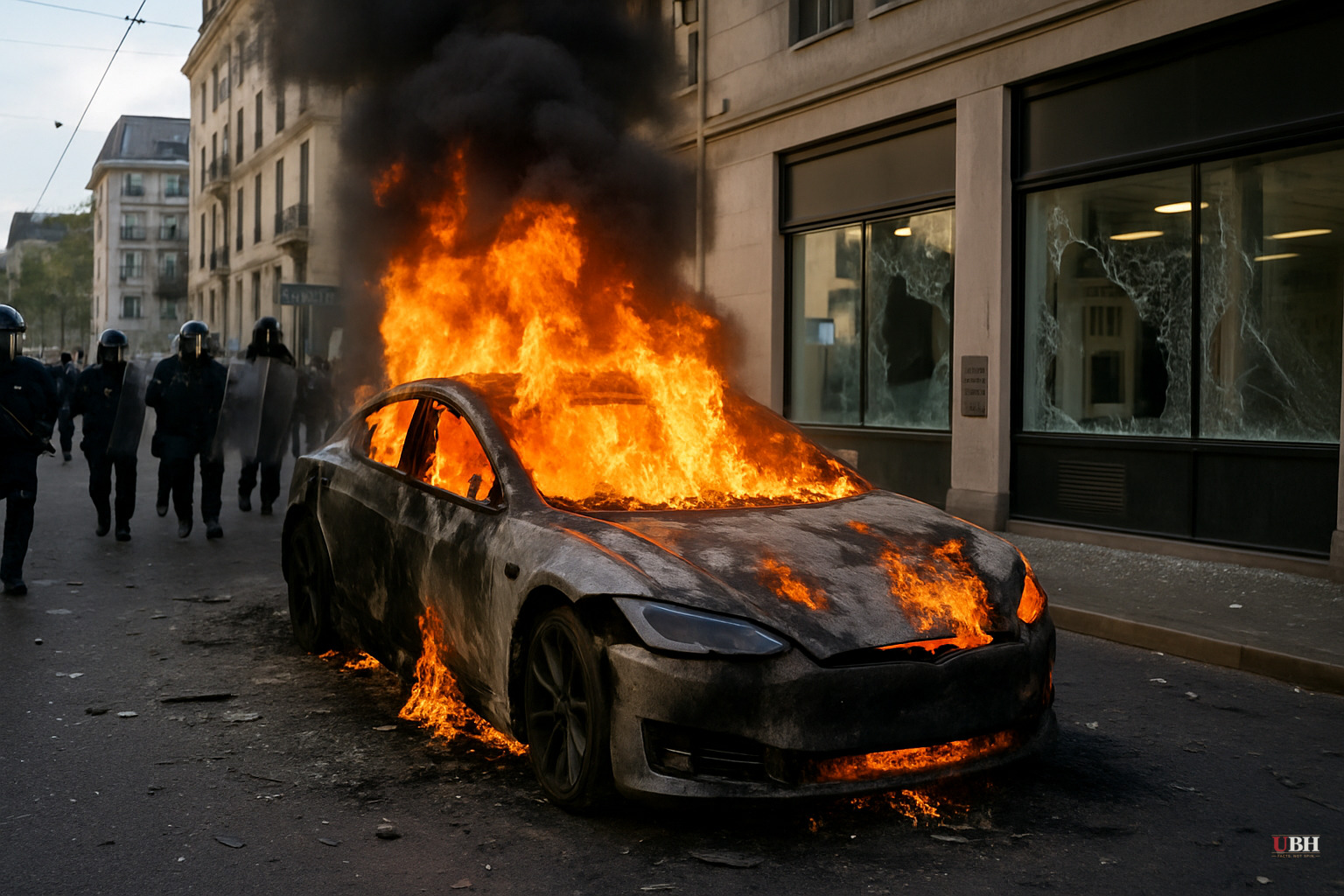
Since our coverage of the tens of thousands expected in Geneva on the eve of the summit, Sunday's protest delivered on the worst-case scenario: a full-scale riot in the streets of one of Europe's wealthiest cities.
What Happened on the Ground
Around 5 p.m. local time on Sunday, June 14, a protest that had drawn an estimated 50,000 people to Geneva turned violent, according to the Swiss German-language daily Blick. A Tesla was set on fire and destroyed. A nearby bank had its windows smashed with hammers. Rioters armed with iron bars, bicycles, and wooden sticks attacked police officers on the street.
Some demonstrators broke into a construction site and raided it for building materials and tools to use as weapons and projectiles. Swiss authorities responded with water cannons and tear gas to push back the most aggressive elements of the crowd.
The 7,000 police officers deployed in Geneva — a number reported by Breitbart News — were not enough to prevent property destruction, though they did contain the violence from escalating further.
Why Geneva, Not Évian
The summit itself is taking place in Évian, France, roughly 50 kilometers from Geneva. The French government barred demonstrations on its territory for the duration of the June 15-17 summit, effectively pushing all protest activity across the border into Switzerland. Geneva absorbed the crowd that France refused to host.
That decision kept world leaders physically insulated from the unrest. It did NOT keep Swiss shopkeepers and residents insulated. Many businesses in the Geneva area had boarded up their windows before Sunday in anticipation of exactly this kind of damage, according to Breitbart's reporting.
Who Was in the Streets
Breitbart characterized the protesters as uniformly "far-left," and the crowd did include anti-capitalists, black bloc activists, and anarchists. But the Swiss newspaper Neue Zürcher Zeitung, cited in that same report, described a broader coalition: radical feminists, communists, trade unionists, and pro-Palestine activists. These are not identical constituencies with a unified platform. Lumping them all into one label oversimplifies the makeup of a 50,000-person crowd.
The people who torched a car and swung iron bars at police officers are not a rhetorical category. They did specific, documented damage, and those acts stand on their own regardless of the broader political composition of the march.
The Strongest Case for the Protesters
Fairly stated: the majority of the 50,000 who came to Geneva were there peacefully. G7 summits concentrate decision-making power over the global economy, trade policy, debt relief, and climate agreements in the hands of seven governments representing a fraction of the world's population. Critics argue that the process is opaque, that affected nations have no seat at the table, and that protest — even disruptive protest — is one of the few levers available to people outside that system. Many who marched Sunday had no interest in burning anything.
That case does not cover the rioters. A protester exercising political speech and a rioter swinging an iron bar at a police officer are not the same person doing the same thing, and conflating the two in either direction either to discredit the whole march or to excuse the violence misrepresents what actually occurred.
Historical Pattern, Not an Anomaly
This is not a new phenomenon. The 2001 Genoa G8 summit saw around 100 police officers injured in riots; 23-year-old protester Carlo Giuliani was shot and killed by police during that unrest. A previous Évian summit in 2003 saw hundreds of black bloc activists block roads, set cars on fire, use Molotov cocktails, and ransack shops, according to Breitbart's historical recap. The pattern is well-established enough that Geneva merchants were boarding up storefronts days in advance.
What Happens Next
The G7 summit in Évian runs through June 17. As of Monday morning, the agenda includes trade policy, AI governance, and relations with China. Whether Sunday's violence in Geneva has any material effect on those discussions is genuinely unclear. Historically, G7 protest riots generate headlines for 48 hours and then disappear from the negotiating table entirely. The open question is whether Swiss authorities will file charges against identified rioters, and how many of the documented assaults on police officers result in prosecutions.
Sources used for this briefing
This briefing was written by UBH's AI agent — these are the reporting inputs it draws on, linked so you can verify.


