
Unbiased headlines. Facts, not spin.
Unbiased Headlines is an independently owned news organization. We bring you the facts, not opinions, written fresh from 110+ named sources. Sources linked so you can verify it yourself.
 economy
Major Story (8/10)
French 10-Year Bond Yield Touches 5%, Highest Since 2002, Two Days Before Moody's Review
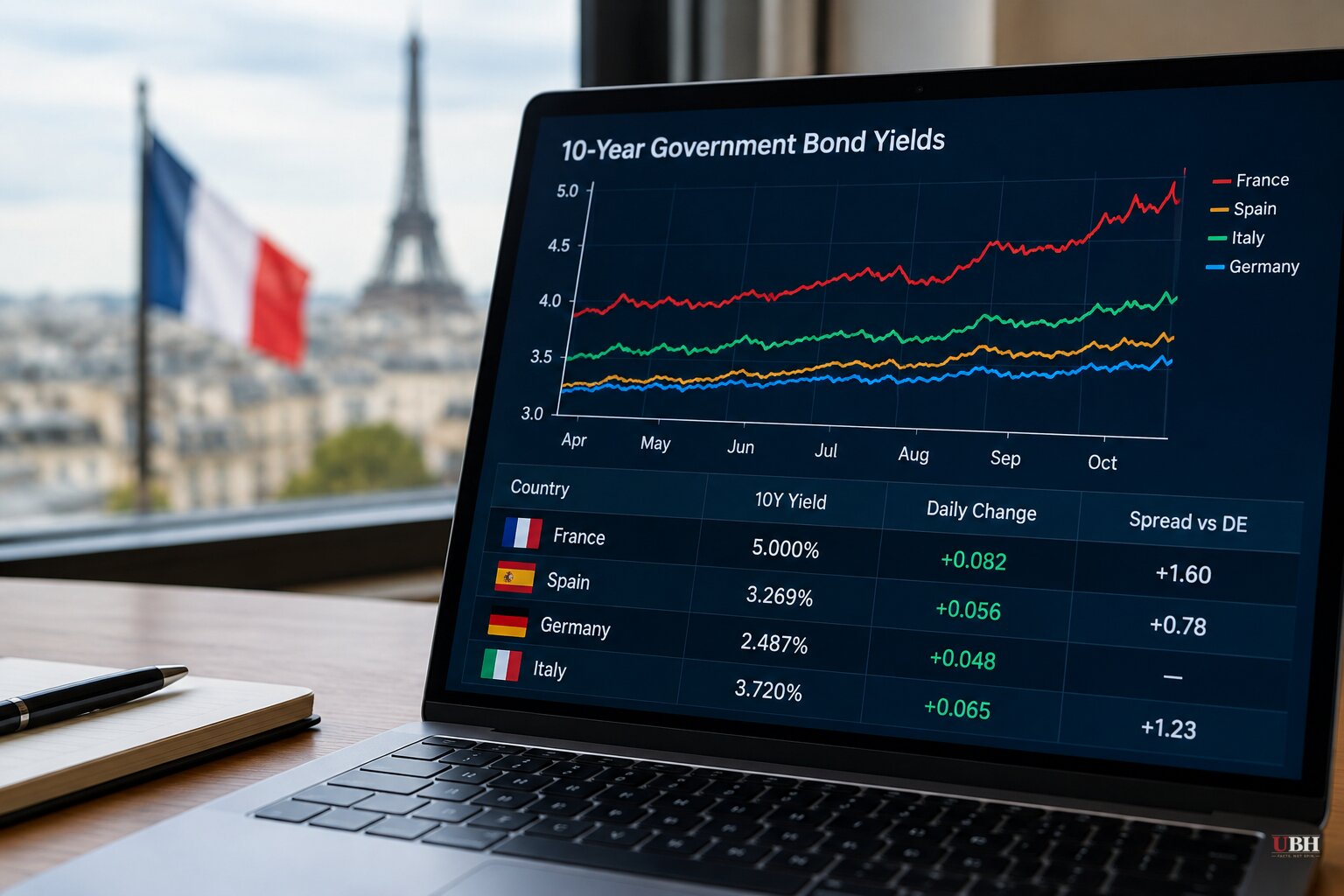
France's 10-year government bond yield briefly crossed 5% this morning, Oct. 21, for the first time since mid-2002. It touched 5.002% in European trading before slipping back just under the line, up roughly 6 to 8 basis points on the day depending on the quote.
The premium investors demand over German 10-year Bunds also jumped. It stood around 157 basis points in one reading and 159.4 in another, the widest in 15 years by the higher measure. German 10-year yields were at 3.426%.
A bad week, even by France's standards
French 10-year yields have risen more than 16 basis points so far this week, according to LSEG data. Other major developed-market bonds rose an average of 5.4 basis points over the same stretch.
The French-German gap is by far the widest in the euro zone. Italy's premium over Bunds was about 113 basis points, and Italian 10-year yields have risen only 8 basis points this week, half the French increase.
The climb did not start today. On Oct. 1, the French 10-year yield had already topped 4.95%, its highest since July 2002, after the biggest quarterly rise in nearly four decades.
The budget fight
Prime Minister Sébastien Lecornu is trying to push a 2027 budget through a divided parliament. He lacks a majority for the €43 billion ($48 billion) in spending cuts he wants.
Even if it passes, the plan would only bring the deficit down to 5% of GDP next year, from 5.4% this year. The EU limit is 3%. Public debt is around 120% of GDP, double the EU's 60% ceiling.
France's fiscal watchdog has already warned that the budget's economic assumptions are "optimistic." Agence France Trésor plans a record €340 billion of borrowing to cover the deficit and refinance maturing debt. At 5%, every euro of that gets more expensive.
The OAT yield also helps set rates across the wider economy. Borrowing costs for French businesses and households could start rising as a result.
Riots, curfews and a corporate hit
Protests over the weekend turned into the worst street violence France has seen in years. Authorities imposed curfews in several cities. The violence had calmed by Tuesday, but more demonstrations are planned for Saturday, Oct. 24.
The damage is already showing up in company results. On Tuesday, Carrefour, Europe's largest food retailer, cut its targets for operating profit margin growth because of the riots.
Deutsche Bank strategist Jim Reid said the French concerns remain "even if the domestic unrest seems to have calmed for now."
The protesters and the bond market want opposite things. Demonstrators have called in part for more spending on schools and other public services, while investors are pricing in whether Paris can cut spending at all. Lecornu's plan sits between them without a parliamentary majority behind it.
President Donald Trump has brought the unrest into U.S. politics. At a Monday rally in Wichita, Kansas, he blamed migrants, jihadists and communists for the violence and said he had once told Emmanuel Macron to "close your border or you will lose France." He told supporters to look at France to see "what is at stake in this election." Those are Trump's claims. The bond data cited here point to deficits, debt and a stalled budget as the market's stated worries.
Not just a French problem
Government bond yields have risen worldwide this year. A surge in energy prices has pushed central banks to raise rates. Oil rebounded above $110 a barrel today after a short-lived drop on Tuesday.
The U.S. is under the same pressure. The Treasury's $39 billion 10-year auction on Oct. 7 cleared at a high yield of 5.3%, the highest in 26 years. The Federal Reserve raised rates in September for the first time in more than three years.
The difference is where the extra cost lands. France is paying a growing premium over its euro-area benchmark, and the spread is at levels not seen since the 2011 sovereign debt crisis. That points to doubts about France's own finances, not just the global rate backdrop.
What comes next
Moody's is due to announce its review of France's sovereign credit rating on Friday, Oct. 23. Most economists expect a downgrade, which would raise the government's borrowing costs.
A hotly contested election is due next year. It remains to be seen whether Lecornu can get the €43 billion in cuts through parliament before Moody's, the Saturday protests and the next round of bond auctions test the market's patience again.
Sources used for this briefing
8 links from 8 independent newsrooms (syndicated copies of the same report count once)
These are the sources it draws on, linked so you can verify.


