
Unbiased headlines. Facts, not spin.
Every story is an unbiased news briefing written from 110+ sources across the spectrum — sources linked so you can verify it yourself.
 tech
Major Story (8/10)
July 7, 2026 at 09:29 AM
tech
Major Story (8/10)
July 7, 2026 at 09:29 AM
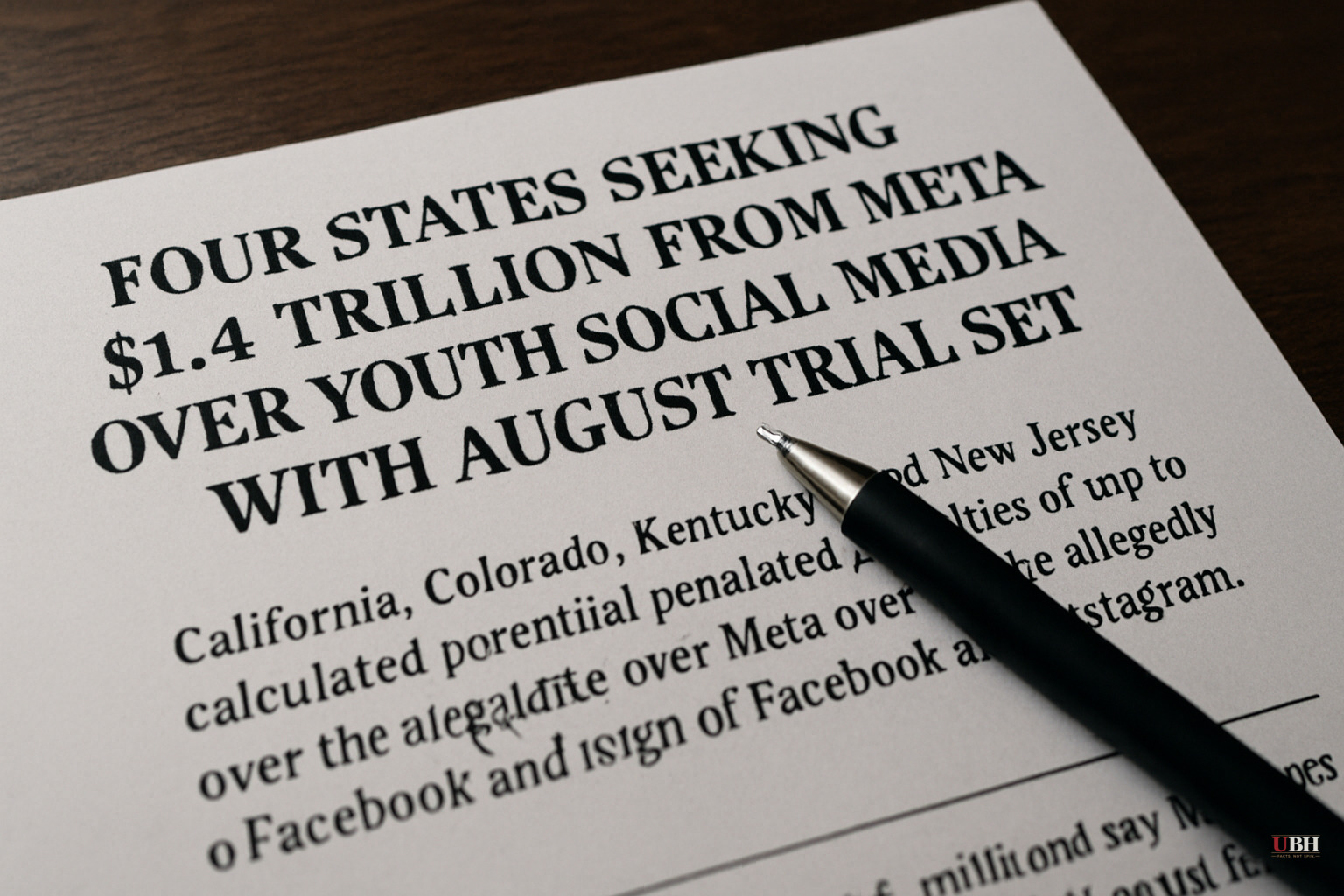
Four States Seeking $1.4 Trillion from Meta Over Youth Social Media Harm, with August Trial Set
The Number
$1.4 trillion. That figure, disclosed by Meta in a court filing in response to a request from state attorneys general, represents the maximum penalty four states believe they can seek under their own consumer protection laws, according to Reuters.
The states — California, Colorado, Kentucky, and New Jersey — calculated it by estimating the number of young users affected by Meta's platforms and multiplying that count by per-violation fines set in state law. Meta disclosed the number but immediately called it indefensible. "A sanction of that size has no analog in the history of consumer protection enforcement," the company's lawyers wrote.
For context: Meta's market capitalization as of this writing is approximately $1.5 trillion. A $1.4 trillion judgment would effectively erase the company.
What the States Are Alleging
The four states accuse Meta of deliberately engineering Facebook and Instagram to be addictive to young users, and of misleading the public about the safety of those platforms. A court hearing on the penalty methodology took place last month.
Separate from those four, 29 additional states have filed suits primarily alleging that Meta violated the federal Children's Online Privacy Protection Act (COPPA) by collecting data from children without the required parental consent.
All of those cases will be addressed by U.S. District Judge Yvonne Gonzalez Rogers at a trial scheduled for August. A further 14 states have claims based on local laws that will be heard at a separate trial in February 2027.
Meta's Defense
Meta's strongest argument is definitional. The company has maintained that "social media addiction" is not a recognized psychiatric condition, and Instagram head Adam Mosseri compared the phenomenon to being "addicted" to a Netflix show.
The American Psychiatric Association confirmed to Engadget that social media addiction is NOT currently listed as a diagnosis in the DSM-5-TR, the field's official diagnostic manual. But the APA added a qualifier: the absence of a formal diagnosis "does not mean it doesn't exist."
The lack of a DSM classification matters legally and scientifically. It means there is no standardized clinical threshold for harm, no agreed-upon diagnostic criteria, and no established causal chain that a court can simply adopt off the shelf. Meta's lawyers will press that gap hard.
What Juries Have Already Decided
The "no proof" defense is getting harder to sustain in court. A jury recently awarded New Mexico $375 million after finding that Meta misled consumers in that state, according to Engadget. In a separate matter, Meta and other social networks paid $27 million to settle a Kentucky school district lawsuit over similar claims.
Those are not findings against Meta for social media addiction per se. They are findings on the narrower question of whether Meta misled the public. But they establish a track record that state attorneys general will use to argue the August trial should go the same way.
The Strongest Concern Worth Taking Seriously
Critics of these lawsuits — and there are serious ones outside of Meta's PR department — argue that $1.4 trillion in penalties for a single company sets a precedent that could give states effectively unlimited leverage over any technology platform. If you multiply a large user base by a per-violation fine and call every user a victim, you can threaten any tech company with extinction-level liability. That's a legitimate structural concern about how consumer protection law is being applied, separate from whether Meta behaved badly.
The counterpoint is equally serious: if documented evidence shows that a company knew its product harmed children and hid that knowledge, the fact that the resulting liability is enormous is a function of the scale of the conduct, not a malfunction in the legal system.
A company can have done something genuinely harmful and the penalty calculation can be constitutionally disproportionate. Courts have tools to reduce excessive damages — the Eighth Amendment's excessive fines clause and due process proportionality review being the primary ones — and Meta will almost certainly invoke both if the August trial produces anything close to the headline number.
What's Actually at Stake in August
No one expects a $1.4 trillion judgment to survive appellate review intact. Judge Gonzalez Rogers will have to navigate whether the states' methodology for counting violations — one per affected young user — is legally sound, or whether it inflates the penalty beyond what the statutes actually authorize.
The COPPA claims from the 29 additional states add a separate layer. COPPA is federal law with its own penalty structure, and a finding that Meta collected children's data without parental consent would be a more straightforward legal violation than the addiction theory.
The August trial date has not changed as of July 7, 2026. Whether Judge Gonzalez Rogers issues preliminary rulings on the penalty methodology before then is the open question that will determine whether Meta walks into that courtroom facing $1.4 trillion or a significantly smaller but still enormous number.
Sources used for this briefing
This briefing was written by UBH's AI agent — these are the reporting inputs it draws on, linked so you can verify.


