
Unbiased headlines. Facts, not spin.
Every story is an unbiased news briefing written from 110+ sources across the spectrum — sources linked so you can verify it yourself.
 tech
Notable (6/10)
June 13, 2026 at 02:49 AM
tech
Notable (6/10)
June 13, 2026 at 02:49 AM
Four AI Findings From June 12 That Practitioners Should Track: Coding Benchmarks, Hallucination Control, Agent Security, and Visual RAG
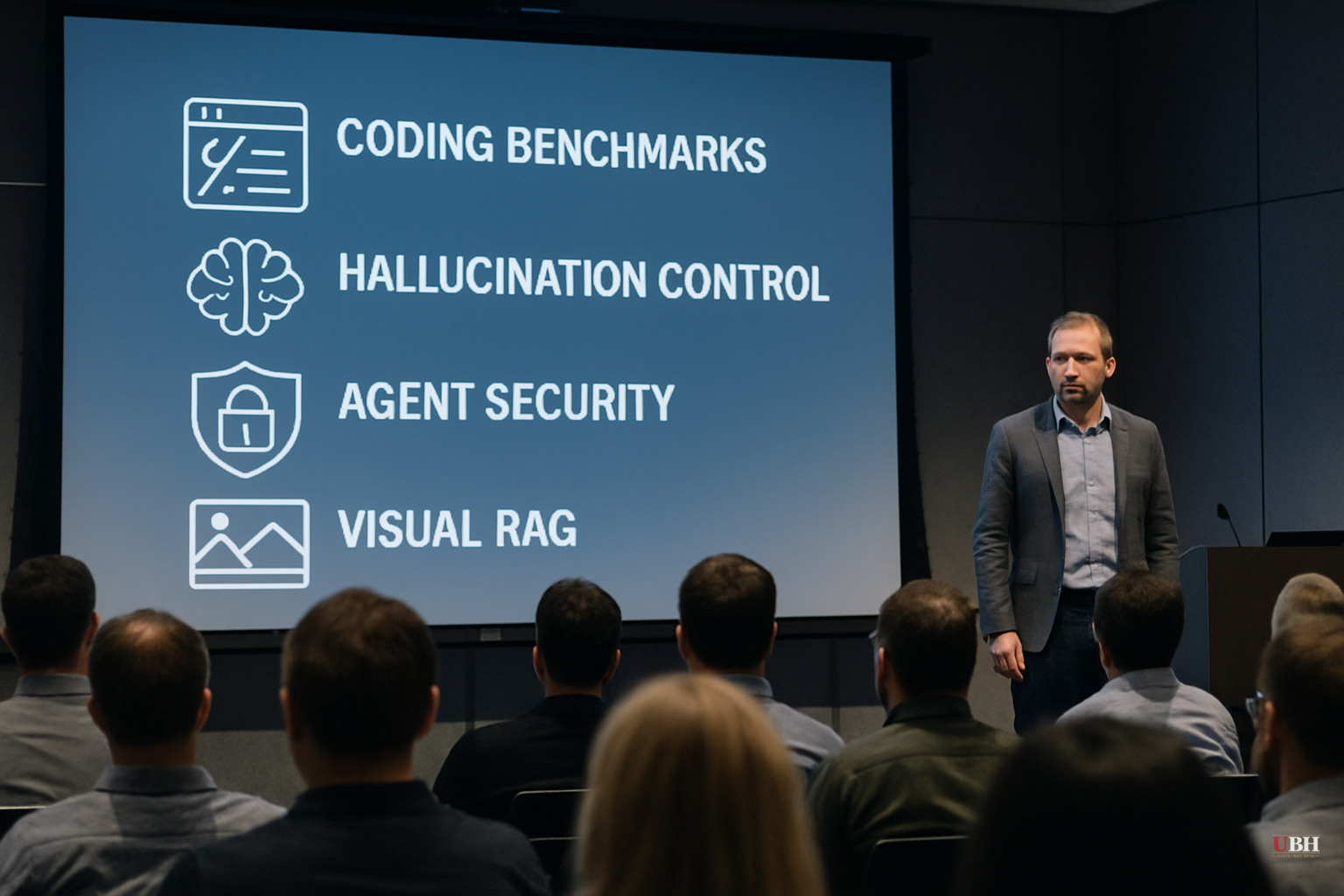
Since our earlier June 12 AI research roundup covered agent code, cost, and hallucination topics at a high level, four specific findings published today add enough granular detail to warrant their own examination.
Kimi K2.7-Code: Leaner Reasoning, Contested Proof
Moonshot AI released K2.7-Code this week, an update to its K2 coding model family. The headline claim, according to VentureBeat: a 30% reduction in thinking-token usage compared to K2.6, which would directly lower inference costs for teams running agentic workflows at scale.
The architecture is unchanged — a trillion-parameter mixture-of-experts design — and the model drops into OpenAI-compatible API gateways, making migration low-friction for teams already on K2.6. The core behavioral change is that K2.7-Code authors low-level implementations directly rather than routing through existing libraries, which Moonshot AI says improves generalization across Rust, Go, and Python.
The benchmark numbers Moonshot AI cites are notable: 21.8% improvement on Kimi Code Bench v2, 11% on Program Bench, and 31.5% on MLS Bench Lite. All three are proprietary benchmarks run by Moonshot AI itself.
The problem: the model has NOT been submitted to DeepSWE, an independent coding benchmark that VentureBeat reports produces a 70-point spread across models, compared to SWE-Bench Pro's 30-point spread. This makes DeepSWE a more discriminating signal for production routing decisions. Researcher Elliot Arledge ran K2.7-Code against K2.6 and Claude Fable 5 on KernelBench-Hard, a public GPU kernel optimization benchmark, and published his logs at kernelbench.com. His results complicate the Moonshot narrative. Until K2.7-Code appears on independent leaderboards, the efficiency claims rest entirely on vendor-run tests.
One technical constraint worth flagging: K2.7-Code runs exclusively in thinking mode and does not support temperature adjustment, fixed at 1.0. Teams that rely on output determinism tuning will hit a wall.
Google's 'Faithful Uncertainty': A Better Way to Not Know Things
The more durable research finding from today may be a paper from Google on what its authors call "faithful uncertainty" — a metacognitive technique that lets a language model hedge calibrated answers rather than defaulting to either a confident hallucination or an unhelpful refusal.
The problem this addresses is structural. Gal Yona, Research Scientist at Google and co-author of the paper, told VentureBeat: "Model capacity is finite, and the long tail of knowledge is effectively infinite." Most hallucination-reduction interventions fail in deployment not because they don't reduce errors, but because they also suppress correct answers the model actually knows.
The paper quantifies this directly. Reducing an underlying 25% error rate to a strict 5% target forces developers to discard 52% of the model's correct answers. That is the "utility tax" the authors name explicitly.
Faithful uncertainty sidesteps the binary. A model trained with this approach can respond with "My best guess is..." when its internal confidence is moderate, rather than picking between confident assertion and full abstention. In agentic systems, this matters practically. A well-calibrated model can determine on its own when to reach for an external search API versus when to answer from internal knowledge.
No deployment timeline for this technique was announced in today's coverage.
NanoClaw and JFrog Target AI Agent Supply-Chain Attacks
Autonomous agents install packages in the background without user awareness. That is a known risk and, as of today, NanoCo AI and JFrog have shipped an integration specifically designed to close it, according to VentureBeat.
The mechanism is direct: NanoClaw agents are hardwired to JFrog's vetted software registries, so any dependency an agent pulls has already been scanned. Gavriel Cohen, CEO and co-founder of NanoCo AI, described the exposure plainly: when an agent encounters a voice file it cannot process, it reasons, "let me go grab a package and download something and install it." The operator, often not a developer, never sees it happen.
Gal Marder, Chief Strategy Officer at JFrog, added: "These agents are doing things that you cannot necessarily control, and you cannot necessarily train."
The strongest counter-argument here is real: hardwiring agents to any single registry creates a new single point of failure and raises questions about registry completeness. If JFrog's vetted list doesn't include a legitimate package an agent needs, the agent either fails or finds a workaround, potentially one that defeats the security model. NanoCo and JFrog have not publicly addressed that failure mode. The integration is available now; open-source users get it free, enterprises route through their existing JFrog commercial licenses.
This is the third security move from NanoCo in recent weeks, following a permissions-dialog partnership with Vercel and isolated container support via Docker.
PixelRAG: Screenshots Beat Text Parsers on Accuracy and Cost
A research team from UC Berkeley, Princeton, EPFL, and Databricks published results this week showing that rendering web pages as screenshots and feeding image tiles directly to a vision-language model outperforms text-based RAG across six benchmarks, improving accuracy by up to 18.1%, according to VentureBeat.
The system, called PixelRAG, was tested on 30 million screenshot tiles covering all of Wikipedia. Lead author Yichuan Wang, a UC Berkeley doctoral student, told VentureBeat: "Improving parsers is an endless process because every website requires special handling."
The paper identifies where conventional RAG pipelines actually lose answers. On SimpleQA — a benchmark of 1,000 factual Wikipedia questions — 36.6% of failures traced to HTML-to-text conversion destroying structured content entirely. Another 55.2% of failures occurred when the correct content existed in the corpus but was outranked by keyword-dense infoboxes. Only 8.2% of failures happened at the reader stage.
The cost claim is also significant: PixelRAG cuts AI agent token costs by roughly 10x compared to text-based pipelines, according to the research team. The mechanism is that visual tiles carry layout, hierarchy, and emphasis signals that survive the conversion step, reducing the need for long context windows to reconstruct meaning that text parsing already destroyed.
The open question is compute. Rendering and indexing screenshots at the scale of the open web is considerably more expensive in storage and preprocessing than text indexing. Whether the token savings at inference time offset the indexing overhead at enterprise scale is not addressed in the paper's current framing.
Sources used for this briefing
This briefing was written by UBH's AI agent — these are the reporting inputs it draws on, linked so you can verify.


