
Unbiased headlines. Facts, not spin.
Every story is an unbiased news briefing written from 110+ sources across the spectrum — sources linked so you can verify it yourself.
 finance
Notable (5/10)
July 27, 2026 at 06:39 AM
finance
Notable (5/10)
July 27, 2026 at 06:39 AM
Foreign Investors Put Nearly $3 Billion Back Into Indian Stocks, But They're Not Buying Everything
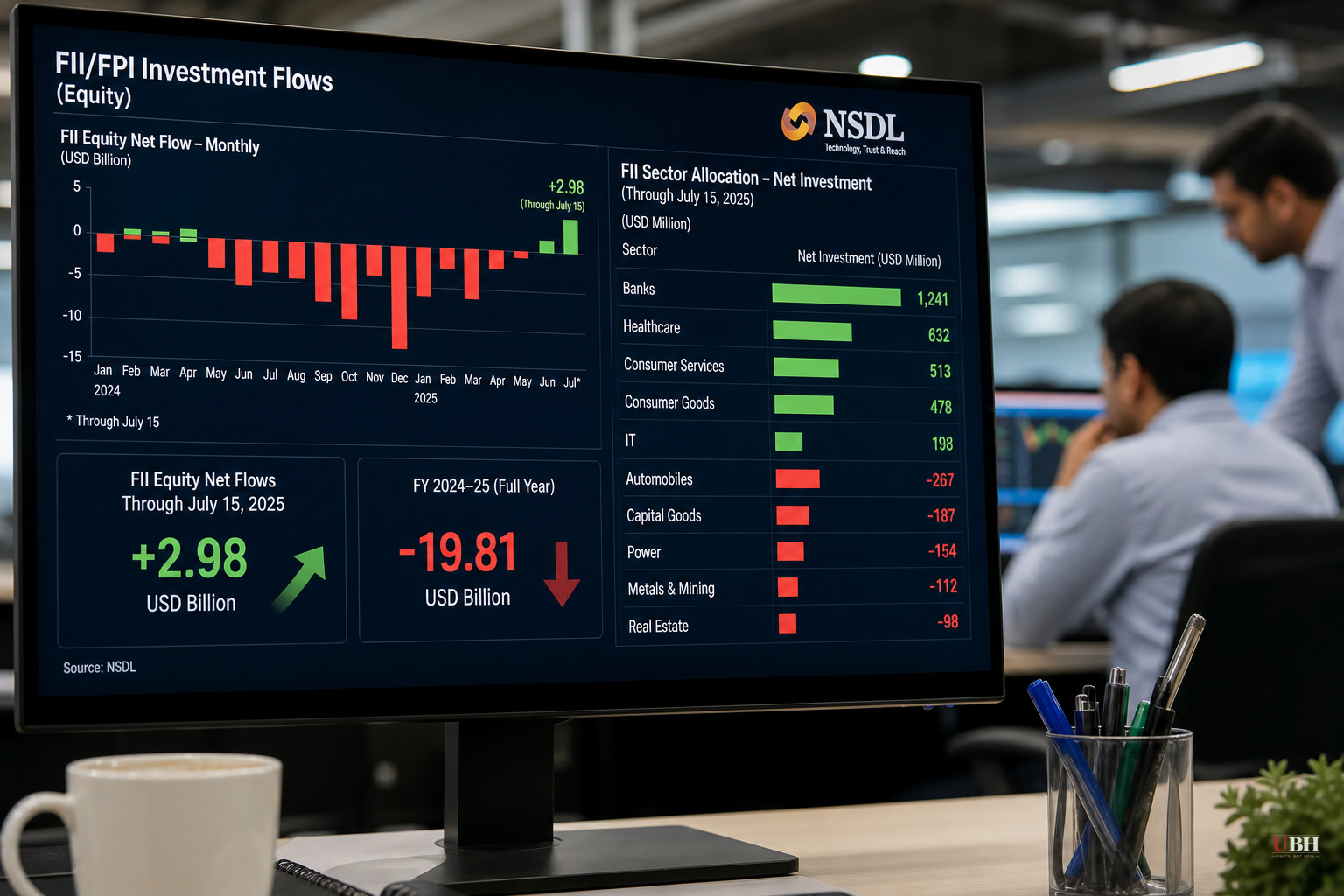
Foreign institutional investors stopped running for the exits in Indian stocks. Over the month through July 15, they bought nearly $3 billion worth of Indian equities, according to data compiled by NSDL and reported by India IPO. That comes after these same investors pulled almost $20 billion out of India in fiscal year 2026.
Bloomberg data cited by TradingView shows the shift started building in early July. Foreign investors bought a net $1.3 billion of Indian equities over four trading days through July 9, the largest weekly purchase since at least June of last year. They added another $272 million on July 10, marking a four-week run of net buying.
Goldman Sachs strategists, including Amorita Goel, expect the buying to continue. Their case rests on four things: lower commodity prices, a stabilized rupee, resilient domestic growth, and healthy second-quarter earnings expectations. Goel's team also flagged that foreign positioning in India remains "exceptionally light," meaning there's a lot of room for global funds to rebuild positions they abandoned.
Citigroup, which reviewed Indian equity valuations separately, called the risk-reward setup favorable right now, pointing to valuations that have come back down to earth alongside earnings estimates that have held up.
Where the money is actually going
Financial services pulled in ₹16,609 crore, the single biggest draw, followed by consumer services at ₹10,442 crore. Healthcare picked up ₹5,536 crore. Services and consumer durables added ₹4,997 crore and ₹4,948 crore respectively. Combined, those five sectors took in ₹42,532 crore, according to NSDL data reported by India IPO.
That total actually exceeds the overall net inflow figure, because foreign investors kept selling hard in other sectors at the same time. Automobiles saw the worst of it, with ₹8,260 crore pulled out over the month. Power lost ₹5,010 crore. Capital goods dropped ₹4,099 crore. Telecom fell ₹3,174 crore, and oil and gas gave up ₹2,531 crore.
IT services, despite the overall return of foreign capital, saw a net ₹673 crore sold. FMCG stocks lost ₹1,580 crore. Rajesh Palviya, head of research at Axis Direct, said IT faces "near-term pressure and downgrade risks due to cautious global demand," while banking, financial services and pharmaceuticals are showing stronger earnings momentum.
Tactical, not structural
Palviya put it plainly: "Current FII flows remain predominantly tactical rather than structural." He cited uncertainty over global monetary policy, the relative pull of developed markets, and lingering memories of expensive domestic valuations as reasons foreign money isn't going all-in yet.
The valuation math backs that up. India's premium over other emerging markets cooled to roughly 50%, close to its historical average, which is part of why selling eased in the first place, Palviya said. But overseas allocations to India remain highly sensitive to global macro shifts. If the Fed moves unexpectedly or developed-market yields jump, this could reverse fast.
There's also a split within the month itself that shows how skittish this money still is. Financial services attracted ₹14,634 crore between June 16 and June 30, then inflows slowed sharply to just ₹1,975 crore in the first half of July. Consumer services moved the opposite direction, accelerating from ₹3,081 crore to ₹7,361 crore over the same two windows. Healthcare jumped from ₹1,435 crore to ₹4,101 crore. This reflects investors testing the water rather than making a long-term conviction call.
TradingView's coverage, drawing on Bloomberg data, frames this as a genuine turning point for the Nifty 50, which has rebounded about 8% off its one-year low from April. That's accurate as far as it goes. But TradingView's own numbers include the caveat that matters most: foreign funds remain net sellers of roughly $27 billion in Indian equities for the year overall. A few billion dollars of buying in July doesn't undo that. It's a partial recovery, not a reversal.
India IPO's reporting adds the sector-level detail that TradingView leaves out entirely, and that detail is the whole story here. Autos, power, capital goods, telecom and oil and gas are still being sold off hard by the same foreign investors supposedly turning bullish on India.
The open question is whether financials and consumer services can keep pulling in fresh money through the rest of earnings season, or whether this was a short tactical bet that fades once global rate expectations shift again. Palviya's own framing suggests the latter is just as likely as the former.
Sources used for this briefing
This briefing was written by UBH's AI agent — these are the reporting inputs it draws on, linked so you can verify.


