
Unbiased headlines. Facts, not spin.
Unbiased Headlines is an independently owned news organization. We bring you the facts, not opinions, written fresh from 110+ named sources. Sources linked so you can verify it yourself.
 politics
Major Story (7/10)
Event date: October 19, 2026 ·
Florida Obtains No-Bond Arrest Warrant for Raúl Castro, Alleging Conspiracy in 1996 Shootdown of Two Civilian Planes
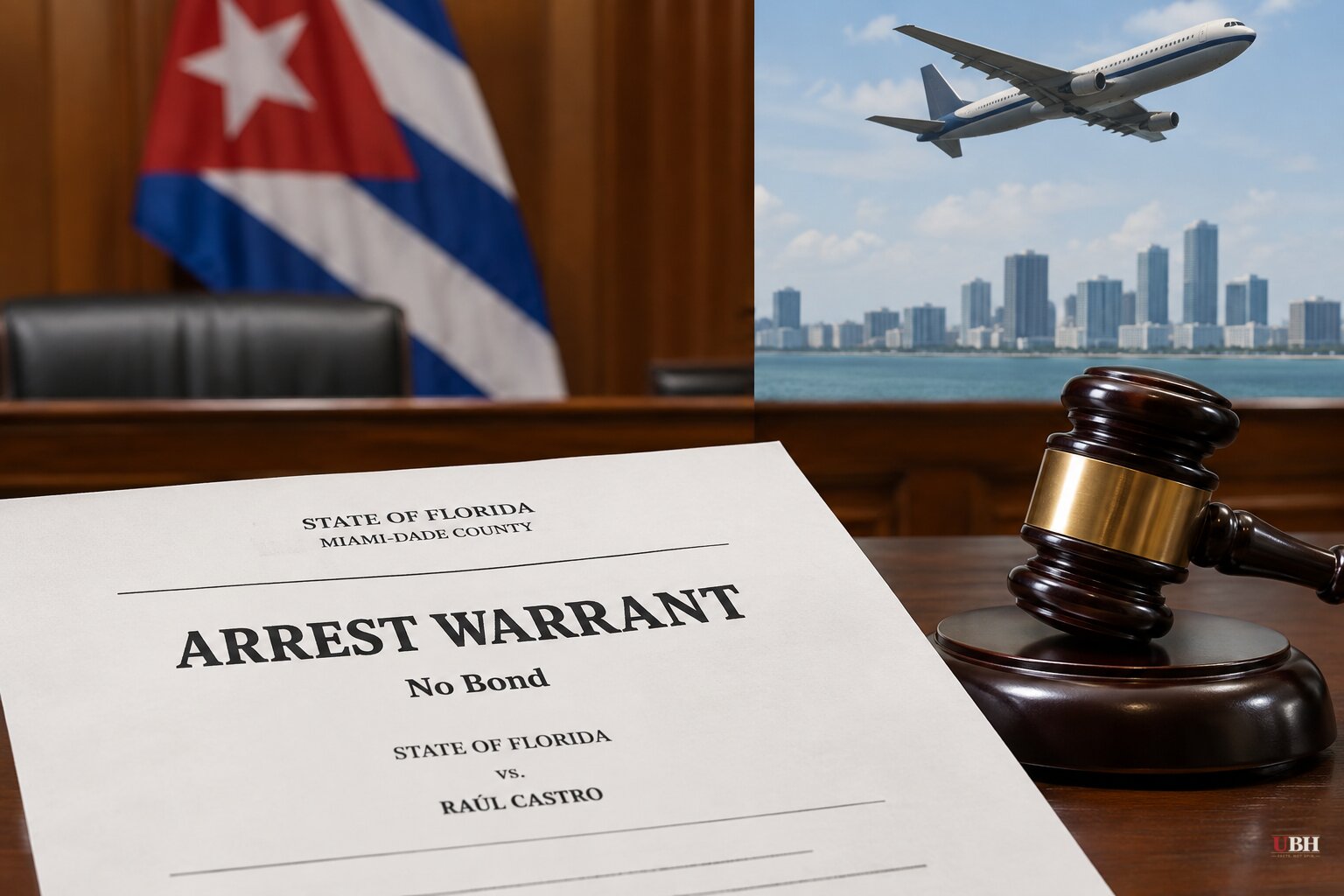
Florida Attorney General James Uthmeier announced Monday, Oct. 19, that a Miami-Dade County judge has signed a no-bond arrest warrant for former Cuban leader Raúl Castro. The charge is one count of conspiracy to commit first-degree murder.
The warrant was signed Friday, Oct. 16, following an investigation by the Florida Department of Law Enforcement. Uthmeier first announced a state criminal investigation in March.
What the affidavit alleges
On Feb. 24, 1996, three unarmed Cessna aircraft flown by the Miami-based exile group Brothers to the Rescue left Opa-locka Airport. Cuban MiGs destroyed two of them with air-to-air missiles. Four men died: Carlos Costa, Armando Alejandre Jr., Mario de la Peña and Pablo Morales. Three were U.S. citizens and one was a lawful U.S. resident.
The state affidavit says Castro, then Minister of the Revolutionary Armed Forces and first vice president, gave the final authorization. It quotes an order to "shoot them down at sea when they show up, and those who have the authority are not to consult anyone."
Investigators say Cuban intelligence agents from the so-called Wasp Network infiltrated Brothers to the Rescue in Miami and the Florida Keys. They allegedly relayed flight plans to Havana and surveilled Naval Air Station Key West.
The affidavit also says the spy network told its informants not to fly with the group between Feb. 24 and 27, 1996. One informant left Florida for Cuba on Feb. 23, the day before the attack.
That Florida conduct is the state's hook for jurisdiction. The warrant says the spying is enough probable cause to believe a conspiracy took place in the state and that Castro gave the orders.
These are allegations in a charging document. Castro has not been tried, and he has not been in any U.S. court.
The disputed airspace
The U.S. says the planes were over international waters. The International Civil Aviation Organization concluded the shootdown happened outside Cuban airspace. Both aircraft were flying away from Cuba and received no warning, U.S. officials have said.
Havana has never accepted that. The Cuban government calls the shootdown "legitimate self-defense" against an airspace violation.
Russia's Foreign Ministry weighed in Tuesday, Oct. 20, expressing "categorical rejection and decisive condemnation" of the warrant. It called the accusation "baseless and contrived" and said it looked like "an act of vengeance by the anti-Cuban lobby in Miami." The ministry also warned that U.S. legal action against Cuba risks wider regional instability.
When the Justice Department indicted Castro in May, Cuban President Miguel Díaz-Canel called it a political stunt meant to "justify the folly of a military aggression against Cuba."
State charge, federal foundation
The federal indictment was announced May 20 at Miami's Freedom Tower. It charges murder, conspiracy to kill and destruction of an aircraft. U.S. Attorney General Todd Blanche said then that "the United States and President Trump does not, and will not, forget its citizens."
U.S. Attorney Jason Reding Quiñones for the Southern District of Florida said the federal work "provided the foundation," and that Uthmeier's team "evaluated it under Florida law and took action."
The state charge is based largely on that federal case. Uthmeier was candid about the odds of an actual trial. "I'm not ignorant of the fact that Raúl Castro is an older man who's probably not looking to march himself into Miami," he said. "I think others would get him before the court of law would, but at the end of the day, we stand ready to prosecute the case."
The warrant is meant to restrict Castro's ability to leave Cuba, and to keep him out of any country with an extradition agreement with the U.S.
Uthmeier also pointed to a feature of state prosecution. "If you have a communist sympathizer that ends up back in the White House, they cannot pardon, they cannot commute, they cannot immunize these dictators from our state proceedings," he said.
Castro, who handed the presidency to Díaz-Canel in 2018 and gave up the Communist Party leadership in 2021, is widely believed to retain influence in Havana.
Families and the political calendar
Relatives of the victims welcomed the announcement. "Justice has happened. Not total, but it is some justice," one family member said. Another said, "My father stood for a free Cuba."
The announcement came at FIU's College of Law, in a courtroom named for the four men.
It also landed on the first day of early voting. Uthmeier is on the ballot for re-election against Democrat José Javier Rodriguez, who held his own press conference outside FIU.
Brian Fonseca, a political analyst for WSVN, said the timing serves more than one purpose. It keeps pressure on the Cuban government, he said, and "there is a domestic political element to this, an issue that is important for our community."
None of that changes what the affidavit alleges. It does bear on how the state will measure success.
Pressure on Havana
The warrant arrives amid a broader U.S. squeeze on Cuba. The Trump administration has imposed a fuel-import blockade, and Cuba has suffered shortages and recurring blackouts. Trump has vowed a "friendly takeover" if Havana does not carry out sweeping reforms.
He has also threatened military action since U.S. forces captured Venezuela's Nicolás Maduro earlier this year.
Whether any country will act on the warrant is unclear. Uthmeier said Florida "stands ready to prosecute," but a trial requires a defendant, and nothing in the record shows Castro leaving the island.
Sources used for this briefing
8 links from 8 independent newsrooms (syndicated copies of the same report count once)
These are the sources it draws on, linked so you can verify.


