
Unbiased headlines. Facts, not spin.
Every story is an unbiased news briefing written from 110+ sources across the spectrum — sources linked so you can verify it yourself.
 politics
Notable (6/10)
July 29, 2026 at 04:53 AM
politics
Notable (6/10)
July 29, 2026 at 04:53 AM
Florida Executes Two Men Six Hours Apart, First Double Execution Since 1964
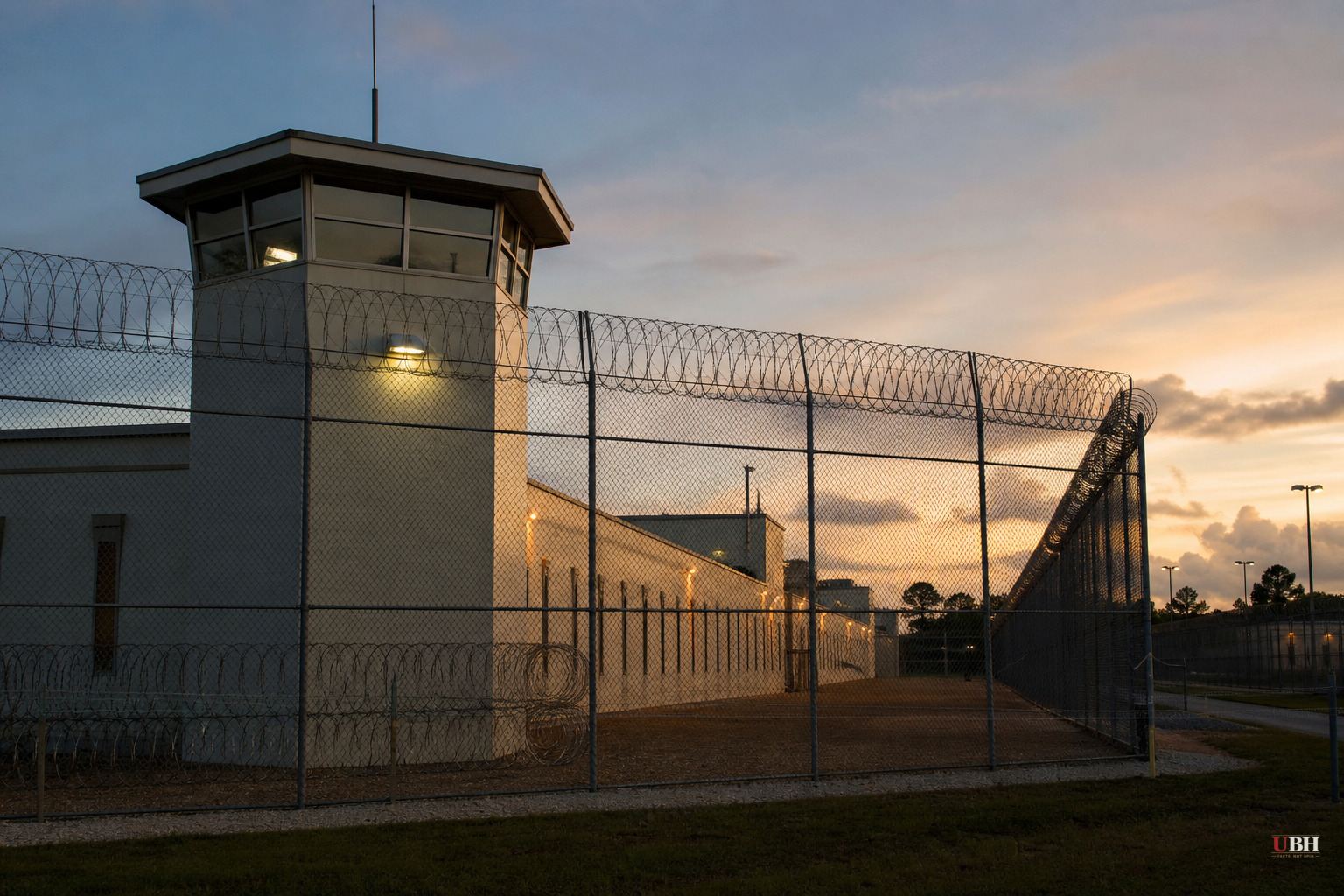
Two men, one day, six hours apart
Florida executed James Aren Duckett, 68, and Dominick Anthony Occhicone Jr., 80, on Tuesday, marking the state's first double execution in a single day since 1964, according to an Associated Press review cited by The Guardian. Duckett died by lethal injection at 1:19 p.m. Occhicone was executed at 6:13 p.m., roughly six hours later.
The executions were the 11th and 12th Florida has carried out this year, and the 39th and 40th under Governor Ron DeSantis, according to the Alligator. Florida has now executed more than double the number of people as Texas, the next most active death penalty state, which had carried out four executions this year as of The Guardian's count before Tuesday.
The crimes
Duckett, a former Mascotte police officer, was convicted of the 1987 rape and murder of 11-year-old Teresa McAbee. Her body was found floating in a lake near Mascotte after her mother reported her missing. Prosecutors said McAbee's fingerprints and palm prints were found on Duckett's patrol car, and a pubic hair similar to Duckett's was recovered as evidence, according to the Alligator. Tire impressions near where her body was found matched an unusual tread design sold only in small numbers locally, two sets of which had recently been installed on Mascotte patrol cars.
Duckett testified he had spoken with McAbee at a nearby Circle K but said he told her to go home and never saw her again. Witnesses gave conflicting accounts: one passerby claimed to see a "small person" in Duckett's patrol car, while a store clerk said she saw no one but Duckett. A jury convicted Duckett and found the crime "heinous, atrocious, or cruel," recommending death by an 8-4 vote.
Duckett maintained his innocence to the end and gave no final statement, according to the Alligator. DeSantis first signed his death warrant in February, but the Florida Supreme Court stayed the execution to allow additional DNA testing. That testing came back inconclusive, and the genetic material was destroyed in the process, according to Courthouse News. Duckett sued over how the state handled the testing, arguing it could have exonerated him, and pushed for further analysis. The state declined, and the Florida Supreme Court vacated the stay.
Occhicone was sentenced to death for the 1986 murders of his ex-fiancee's parents, 62-year-old Martha Artzner and 66-year-old Raymond Artzner. He received a life sentence for the second killing. Unlike Duckett, Occhicone apologized before his execution. "I know it don't mean much, but I'm sorry," he said, according to the Alligator. "I never meant to do what I did."
McAbee's mother, Dorothy Tula, spoke after Duckett's execution. "I've been waiting 40 years to have him dead," she said. McAbee's aunt, Shirley Lancaster, added: "Maybe she would've been a doctor. Maybe she would've been the next president. We never got the chance to find that out because this bastard took her away from us."
The Supreme Court fight
Both men asked the Supreme Court for an emergency stay, arguing that scheduling two executions on the same day created an unacceptable risk of a botched procedure. Attorneys for Duckett wrote that combining the two execution days meant prison and execution teams would be less prepared, raising "the risk of errors with the lethal injection drugs," according to Courthouse News.
The Supreme Court denied both emergency applications and certiorari petitions without explanation and without any noted dissents, clearing the way for the executions roughly an hour after Duckett's had originally been scheduled to begin, Courthouse News reported.
The case against the pace
Death penalty opponents argue Florida's rate of executions under DeSantis, who has set execution dates roughly every two weeks according to Robin Maher, executive director of the Death Penalty Information Center, leaves no real institutional check on the governor's authority and no public explanation for why cases are scheduled when they are. Maher told The Guardian the secrecy around Tuesday's double execution was "consistent with the secrecy that has surrounded every execution, and every execution decision, that Florida is making these days."
Matt Wells of the human rights group Reprieve told The Guardian that public records show Florida has repeatedly violated its own execution protocols, including using expired drugs and incorrect doses, and that the paralytic used in lethal injection can mask visible signs of suffering from witnesses. Reprieve's review of botched executions since 1976 found rushed scheduling was a contributing factor in several cases, including Arkansas's 2017 double execution of Jack Jones and Marcel Williams, carried out three hours apart amid what witnesses described as chaotic conditions.
A state moving two lethal injection procedures through the same execution team and same day, with no public accounting of drug sourcing or protocol changes, presents a legitimate transparency question. Whether Tuesday's executions were in fact administered correctly has not been independently verified by any outside body, and Florida's Department of Corrections has not released a detailed accounting of the drugs or timing used in either procedure.
At the same time, the legal question was squarely put to the nation's highest court. Both men raised Eighth Amendment claims specifically about the risk of a botched execution from same-day scheduling, and the Supreme Court considered and rejected those claims without dissent. That is the system's built-in check functioning, even if the outcome disappoints critics who wanted the Court to explain its reasoning.
Duckett's underlying innocence claim remains legally closed but factually unresolved for his supporters. The DNA testing ordered by the Florida Supreme Court earlier this year came back inconclusive, and the sample was subsequently destroyed, foreclosing any future retesting as forensic technology improves. Whether that outcome reflects the limits of decades-old evidence or a state process critics say moved too fast to get answers is a question that will now never be settled in court.
Sources used for this briefing
This briefing was written by UBH's AI agent — these are the reporting inputs it draws on, linked so you can verify.


