
Unbiased headlines. Facts, not spin.
Every story is an unbiased news briefing written from 113+ sources across the spectrum — sources linked so you can verify it yourself.
 finance
Major Story (7/10)
Event date: September 22, 2026
finance
Major Story (7/10)
Event date: September 22, 2026
Five Stocks Make Up 30% of the S&P 500, and Your 401(k) Owns Every One of Them
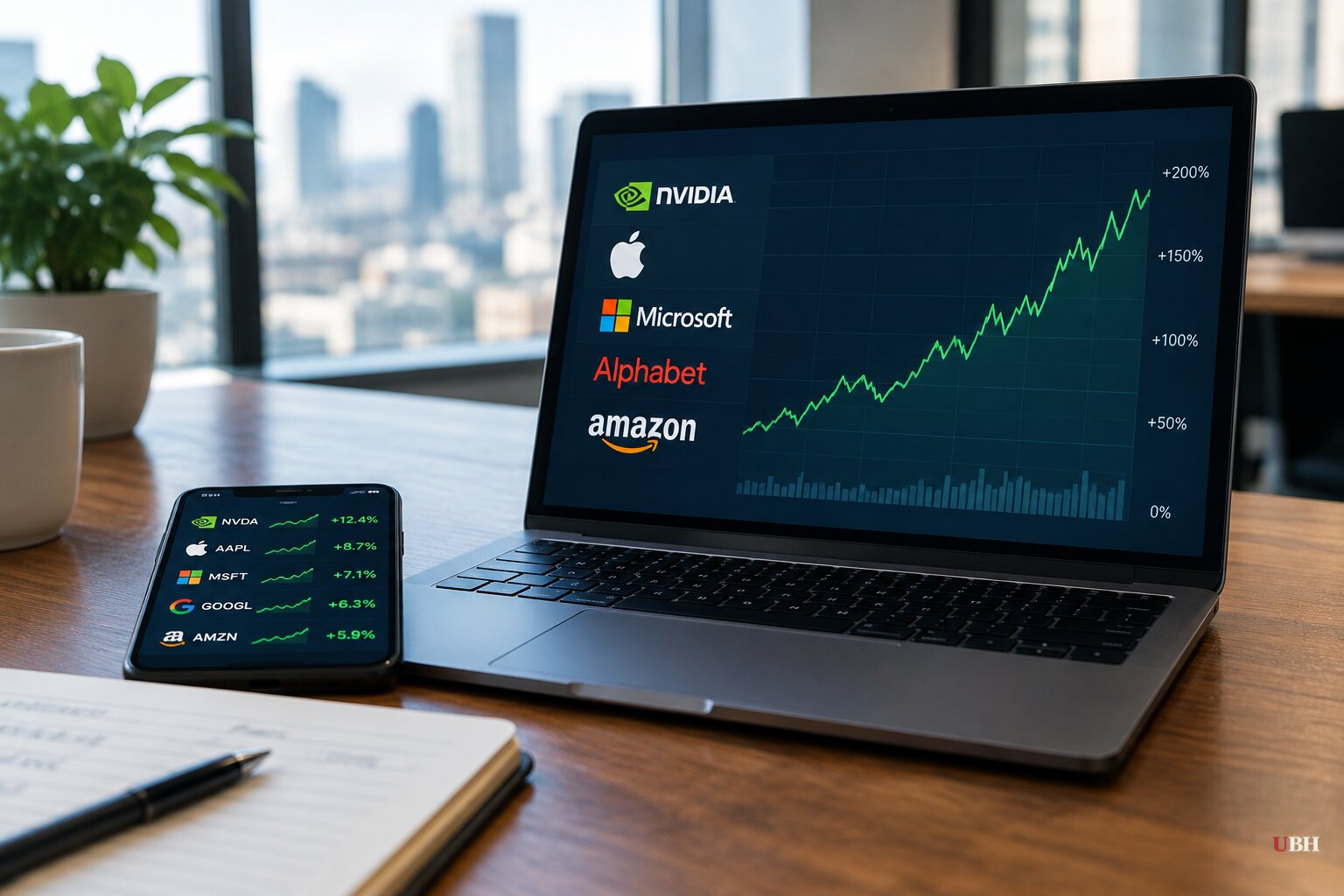
About 54% of U.S. households have a 401(k), according to Federal Reserve data, and most of that money defaults into index funds that buy every stock in the market weighted by size. That means the bigger a company gets, the more of it your retirement account automatically buys, no vote required.
"They didn't choose to buy these stocks, and they don't really know what's going on," said Hera Hyeonseo Lee, a doctoral researcher at Binghamton University, describing how cap-weighted funds work. Jim Rowley, global head of indexing strategy at Vanguard, put it more bluntly: "Market cap weighting isn't a choice, it's not a methodology, it just is."
The Concentration Number
Nvidia, Apple, Microsoft, Alphabet and Amazon made up roughly 30% of the S&P 500 as of a recent Wednesday close, according to Morningstar data reported by finks.ai. Ed Yardeni, president of Yardeni Research, said the broader Magnificent Seven accounts for "something like 30% of the market cap of the S&P 500," with information technology and communication services together making up 45% of the index.
Valentin Haddad, an associate professor of finance at UCLA Anderson, said the current setup combines size and concentration "even more than there was during the dotcom bubble," and warned of "a possible technological shock that's built into the whole economy that could take down a big portion of the market."
The pipeline keeps growing. SpaceX went public in June 2026 and used the Nasdaq's new "fast-entry" rule to join the Nasdaq 100 within 15 days of its debut, after crossing a $2 trillion valuation on day one, according to Fortune. That's a sharp break from the traditional three-month waiting period meant to let new stocks establish trading history before major index funds are forced to buy them. Anthropic and OpenAI are both expected to pursue trillion-dollar-plus IPOs, and fast-entry rules mean whichever exchange lands them could funnel index-fund money into those stocks almost immediately.
Not All the Earnings Are What They Look Like
Some of the recent earnings growth propping up index valuations isn't coming from selling more products. Michael Wilkerson, writing in the Epoch Times, pointed to Alphabet's most recent quarter, in which the company reported $98 billion in other income, almost entirely unrealized markups on its stakes in SpaceX and Anthropic, lifting net income by $77.1 billion. Strip that out, and Alphabet's operating earnings per share came in at $2.85, below the $2.89 analysts expected, and the company posted negative free cash flow for the first time in its history. Amazon booked a further $53.4 billion in one-time gains, largely tied to its Anthropic investment. Wilkerson calculated that excluding those two companies, projected S&P 500 earnings growth would be 40% lower.
The S&P 500 trades at 20 times forward earnings against a 30-year average near 17, Wilkerson wrote, and the Shiller ratio, which measures price against a decade of inflation-adjusted profits, sits at 41. By his account, the market has been that expensive only once before since 1881: the closing months of the dot-com bubble in 1999.
The Retirement Party Bank of America Is Watching
The gains have been real for savers who stayed the course. Fidelity's average 401(k) balance rose 10.5% in the second quarter to a record $155,800, its biggest quarterly jump since late 2020, with millennials up 14.3% to $94,300, according to finks.ai. Contribution rates held steady at 14.4% of pay, and 81.2% of participants collected their full employer match.
That wealth is changing behavior. Bank of America economists Stephen Juneau and Aditya Bhave called it a "stock-fueled retirement party" in an August 2026 research note, according to CNBC, writing that "labor force participation is collapsing among older workers" and that "the strength of the equity market is partly to blame." Labor force participation among Americans 55 and older fell from 38.6% in August 2024 to 37.2%, according to the U.S. Bureau of Labor Statistics, as cited by BigGo Finance.
Sequence-of-returns risk is real. A worker who retires early on paper gains and then hits a market downturn in the first few years of retirement can be forced back into the job market, straining both their finances and, at scale, the labor market itself.
The Counterargument
Rowley's point stands as the strongest defense of the current system: cap-weighting isn't a bet on AI, it's a reflection of what investors collectively already decided these companies are worth. Anyone weighting a stock differently than the market is the one making an active choice, not the index fund. Morgan Stanley's chief investment officer, Lisa Shalett, wrote in a September 2026 report that the "bull case remains intact," even while acknowledging that "risks are becoming harder to ignore" from higher bond yields, elevated oil prices and policy uncertainty.
What happens next depends partly on Washington. The Department of Labor introduced a proposal in March 2026 that would give 401(k) fiduciaries process-based legal protection for adding private equity, crypto and other alternative assets to retirement menus. If finalized, it would mean AI-adjacent exposure inside 401(k) plans could grow well beyond public stocks, layering illiquid, harder-to-value assets on top of an already concentrated equity bet.
Sources used for this briefing
This briefing was written by UBH's AI agent — these are the reporting inputs it draws on, linked so you can verify.


