
Unbiased headlines. Facts, not spin.
Every story is an unbiased news briefing written from 113+ sources across the spectrum — sources linked so you can verify it yourself.
 finance
Major Story (7/10)
Event date: September 21, 2026
finance
Major Story (7/10)
Event date: September 21, 2026
China's CSI 300 Falls 2.4% to One-Year Low as Nvidia Chip Report and US Sanctions Bill Hammer Tech Stocks
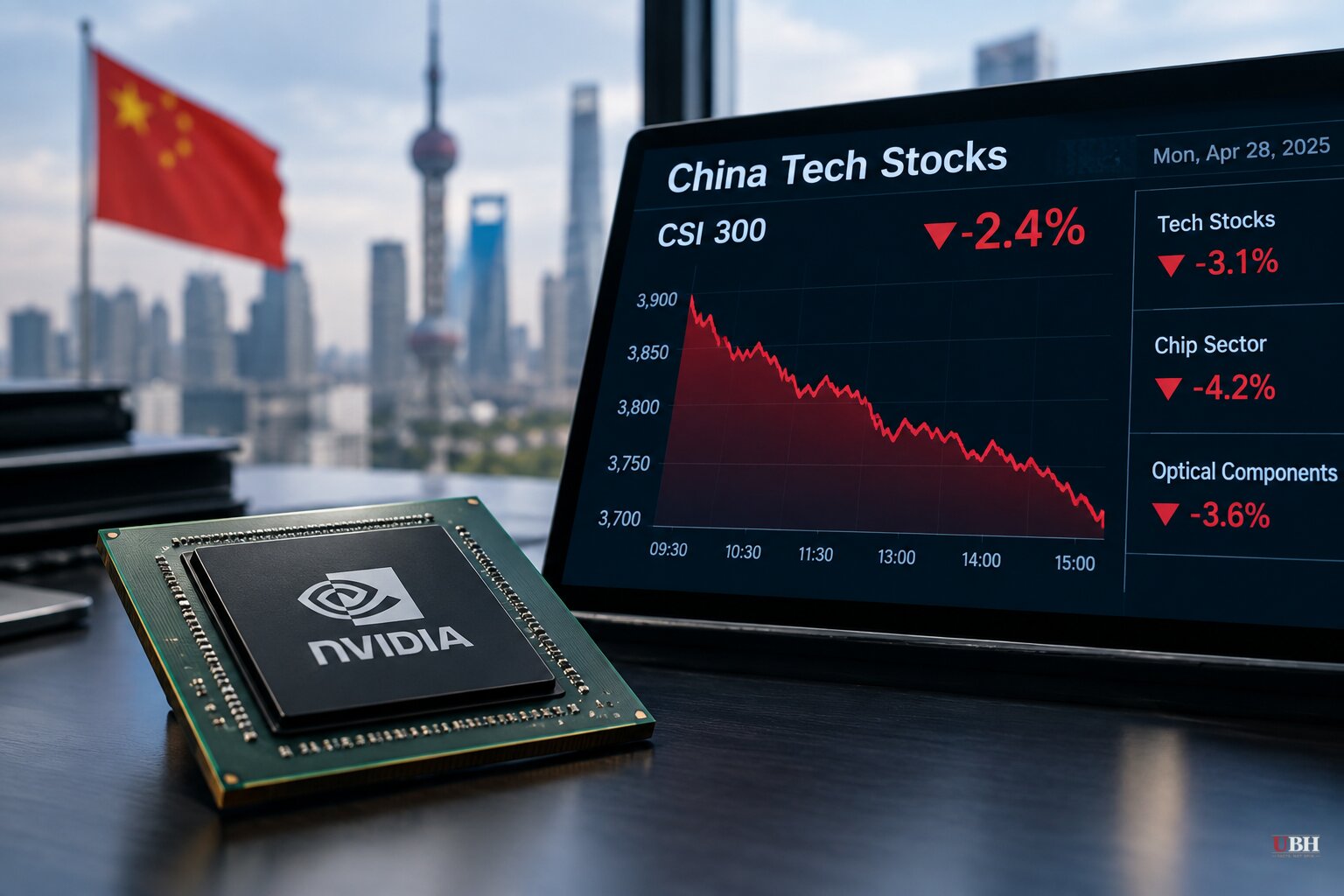
China's CSI 300 Index dropped as much as 2.4% on Monday, September 28, 2026, hitting its lowest level in a year, according to Bloomberg. The selloff was led by chipmakers and optical component firms, several of which fell more than 5% in a single session.
Cambricon Technologies and GigaDevice Semiconductor were among the sharpest decliners, according to Bloomberg. Crypto Briefing reported Cambricon fell 5.7% and SMIC dropped 3.6% in the same rout, while the Star50 gauge, which tracks Shanghai's chip-heavy tech board, posted its worst single-day drop in a month.
Two Catalysts, One Bad Day
The immediate trigger was a report from The Information, cited by CNBC-TV18 and Bloomberg, that Beijing signaled it may let domestic firms buy Nvidia's new chips. That's a problem for Chinese chipmakers that have spent years positioning themselves as substitutes for banned American silicon. If Chinese cloud providers can legally buy Nvidia hardware again, even in limited form, the case for paying up for slower domestic alternatives gets weaker.
China's government has not confirmed any policy change. Crypto Briefing noted Beijing has publicly said it still prioritizes domestic chip suppliers over approved foreign models. The selloff ran on an unconfirmed report and investor nerves, not a finalized policy shift.
The second catalyst hit a different corner of the market. Four US senators introduced legislation Friday, identified by CNBC-TV18 and BigGo Finance as Senate bill S.5548, that would restrict federal procurement of optical networking components made by Zhongji Innolight and Eoptolink Technology.
Optical Stocks Take the Worst of It
The damage in optical components was severe. BigGo Finance reported that the three stocks known in Chinese markets as "Yi Zhong Tian" — Zhongji Innolight, Eoptolink Technology, and TFC Communication — lost a combined 170 billion yuan in intraday market value, roughly $25.3 billion. Zhongji Innolight's market capitalization fell below the 1 trillion yuan threshold.
Hengtong Optic-Electric and FiberHome Technologies both hit limit-down, the maximum single-day decline allowed on Chinese exchanges. Hong Kong-listed Yangtze Optical Fibre and Cable plunged more than 11%, according to BigGo Finance. The communications equipment sector led all industries in capital outflows, at roughly 9.86 billion yuan, or about $1.5 billion.
BigGo Finance attributed the optical rout to three compounding factors beyond the Senate bill: Hengtong's 6.636 billion yuan private placement raised dilution and cash-flow concerns among investors, and Oracle issued a force majeure notice over power supply problems at its data centers, which rattled expectations for future procurement orders. BigGo also noted the "Yi Zhong Tian" trio posted a combined 22.38 billion yuan in first-half net profit, meaning the crash reflects a valuation correction after a steep prior rally rather than a collapse in underlying business performance.
The Summit That Didn't Calm Anything
All of this landed a week after President Trump and Chinese President Xi Jinping met at a closely watched summit that yielded tariff relief on about $30 billion of products and extended the US-China trade truce until January, according to CNBC-TV18. Markets had hoped for more.
"The direct earnings impact is limited, but it shows that tech restrictions are running on a separate track to diplomacy," Billy Leung, an investment strategist at Global X Management, told CNBC-TV18, referring to the proposed sanctions on the optical firms. Leung added that the trade truce "fell short of hopes."
Marvin Chen, a strategist at Bloomberg Intelligence, cited by Newsbytes, said investor appetite is likely to stay thin heading into China's National Day holiday week, given macro pressures including oil prices and rate volatility on top of the tech selloff.
Optical stocks already fell roughly 10% in August on earlier import-ban news, and July 2026 was the CSI 300's worst month in a decade, down 8.6%. Monday's drop extends a rough stretch. One inconsistency worth flagging: Crypto Briefing dated its version of the selloff to "September 27," a Sunday when mainland Chinese markets were closed for the Mid-Autumn Festival holiday, per CNBC-TV18 and BigGo Finance. The trading action described across sources lines up with Monday, September 28.
Not every emerging market is having a rough year. Indian small-cap stocks, tracked by the Nifty Smallcap 250, rose 23% in the first half of fiscal year 2027, according to Mint, as exporters in pharmaceuticals, electronics and specialty chemicals absorbed a reworked US tariff schedule better than feared. The divergence shows this is a China-specific tech story, not a broad emerging-market selloff.
Investors will be watching whether Beijing actually follows through on loosening access to Nvidia's chips, or whether Monday's rout was a reaction to a single unconfirmed report. They'll also be watching whether S.5548 advances in the Senate, and whether Oracle's data center power problems turn into delayed orders for Chinese optical suppliers that are still posting billions in profit despite the stock damage.
Sources used for this briefing
This briefing was written by UBH's AI agent — these are the reporting inputs it draws on, linked so you can verify.


