
Unbiased headlines. Facts, not spin.
Every story is an unbiased news briefing written from 110+ sources across the spectrum — sources linked so you can verify it yourself.
 finance
Major Story (8/10)
August 1, 2026 at 07:36 AM
finance
Major Story (8/10)
August 1, 2026 at 07:36 AM
Financial Times Confirms US Treasury Bought Yen Friday, Using Goldman Sachs and Morgan Stanley as Conduits
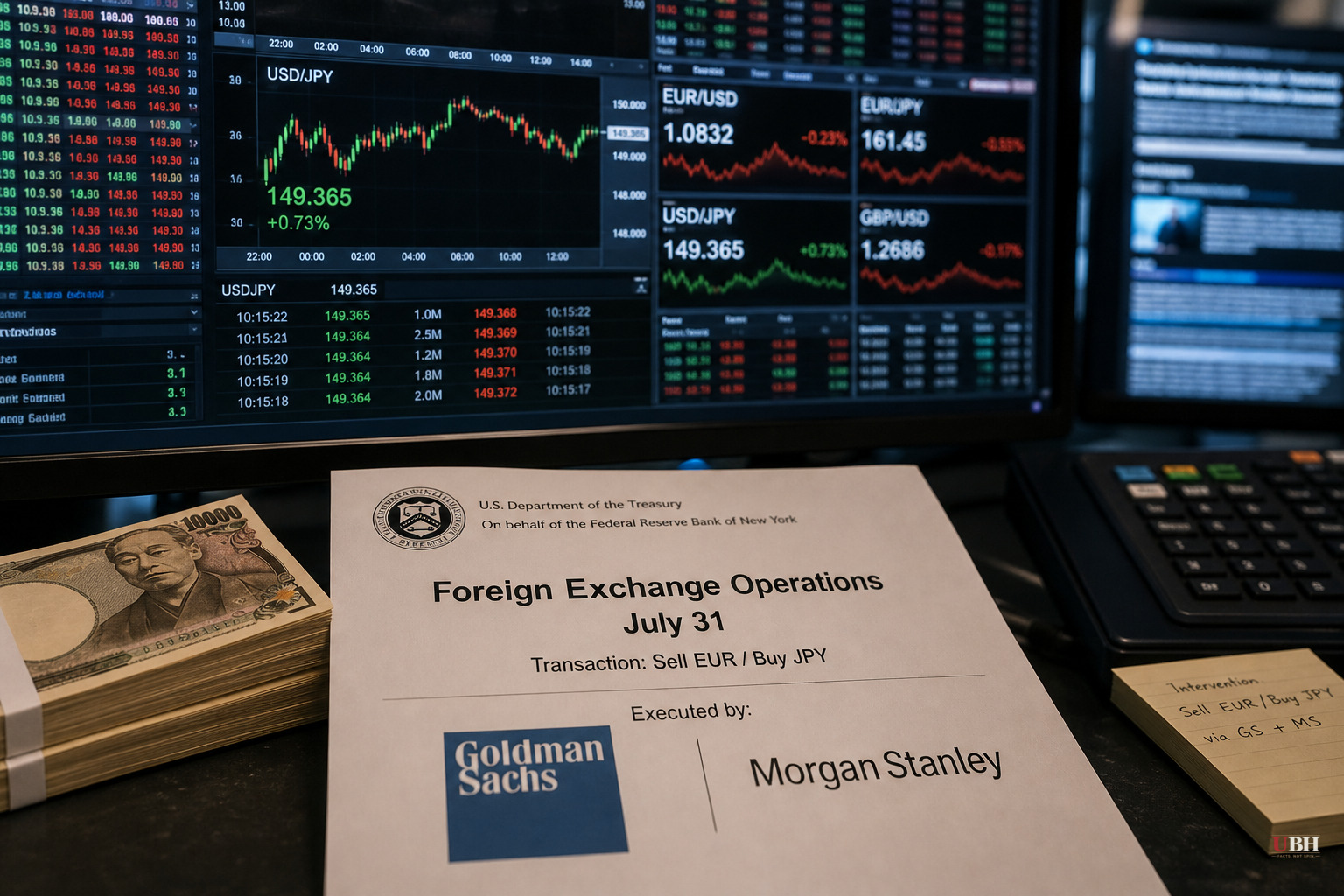
Since Reuters photographed Treasury Secretary Scott Bessent's handwritten "To Do: Buy Japanese Yen (JPY) $5-10 bil" note at a Camp David cabinet meeting on Friday, July 31, the story has moved from speculation to confirmed action. The Financial Times reported that the Federal Reserve Bank of New York sold euros to buy yen on Treasury's behalf that same day, using Goldman Sachs and Morgan Stanley as the executing banks, according to people familiar with the matter cited by the FT.
Friday's coverage established that Treasury had warned banks to "stand ready for future action" and that Bessent's notepad all but announced the plan in real time. What's now confirmed, per the FT report as relayed by The Straits Times and Reuters, is the mechanism: a euro-to-yen swap run through the New York Fed and two of Wall Street's biggest banks.
Nobody's saying how much yen actually changed hands. The FT report didn't specify an amount, and neither the New York Fed nor Morgan Stanley responded to requests for comment outside business hours, according to Reuters. Goldman Sachs declined to comment. Treasury didn't respond to requests for comment on either the FT report or the notepad photo, Reuters said.
Why this matters historically
This would be the first time the US Treasury has directly intervened to support the yen since 2011, when Washington joined other G7 nations in a coordinated response to Japan's earthquake and tsunami, according to Reuters. Fifteen years is a long stretch. Currency intervention isn't something Treasury Secretaries do on a whim, and doing it in tandem with the Bank of Japan signals both governments think the yen's slide has become a real problem, not just market noise.
The numbers back that up. Japan may have sold as much as $58.97 billion to buy yen on Thursday, July 30, according to central bank data reported by Reuters. That's one of Japan's largest single-day currency interventions on record, and it came a day before the US apparently joined in.
What moved, and when
The yen had dropped to its weakest level since 1986 earlier last week, a 40-year low, driven partly by rising oil prices, according to Bloomberg News. Data from LSEG showed the dollar fell from about 158.9 yen around 4:14 p.m. ET Friday to about 157.6 yen just before 5 p.m., an 0.8% drop, according to Reuters. That's the tail end of a day that started with Japan's own intervention pushing the currency stronger in early trading, then the US joining in during the American afternoon.
The gap between what's known and what's confirmed
Bessent's notepad is real, photographed at 11:33 a.m. local time at Camp David, per Reuters, and it stayed visible on the table for at least 30 more minutes while he spoke on camera. Treasury warned banks about possible intervention hours before that photo was taken. The FT then reported the actual trade happened, through specific banks, using a specific currency pair swap.
What's still missing is an on-the-record confirmation from Treasury itself, and a dollar figure for what was actually bought. Bessent's own number, $5 billion to $10 billion, is from his personal notes, not an official disclosure. It's a plan, not a confirmed transaction amount. Treating it as the actual intervention size would be getting ahead of the documented facts.
The fair question critics will ask
Some will point out that a Treasury Secretary's private planning notes ending up in a wire photo is either remarkably careless or remarkably convenient, given how directly it moved market expectations before any official announcement. A reasonable skeptic could ask whether the leak was accidental at all. Nothing in the reporting from Reuters, the FT, or The Straits Times suggests it was staged, and no source makes that claim on the record. But the sequence, a leaked note followed by a confirmed intervention that matches the note almost exactly, is unusual enough that it's worth Treasury addressing directly rather than leaving it to speculation.
What's next
The immediate open question is magnitude. Treasury has not confirmed how much yen it bought, and neither the New York Fed, Morgan Stanley, nor Goldman Sachs has detailed the trade. If the yen keeps weakening despite Friday's coordinated action, markets will be watching for whether Washington and Tokyo escalate with a second, larger intervention, or whether Friday's move was a one-off signal rather than a sustained defense of the currency.
Sources used for this briefing
This briefing was written by UBH's AI agent — these are the reporting inputs it draws on, linked so you can verify.


