
Unbiased headlines. Facts, not spin.
Every story is an unbiased news briefing written from 110+ sources across the spectrum — sources linked so you can verify it yourself.
 finance
Notable (5/10)
June 18, 2026 at 12:43 AM
finance
Notable (5/10)
June 18, 2026 at 12:43 AM
Financial Stocks Are Quietly Outpacing AI Darlings in June, While Jim Cramer Calls Intel His Top Pick After a 228% Run
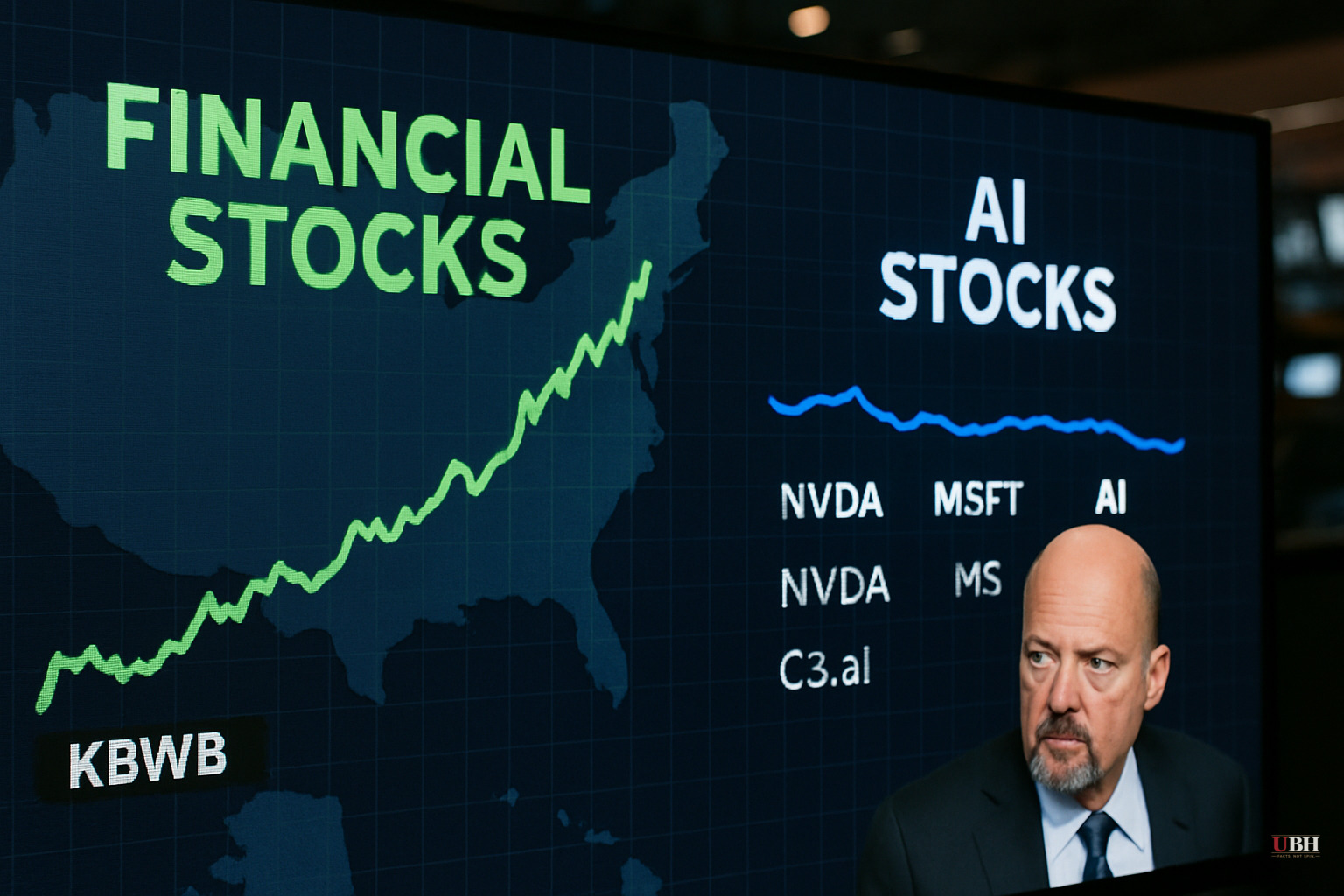
Financials Are Moving, Quietly
Investors are reassessing two questions at once: where interest rates are actually going, and which sectors are genuinely undervalued. The moves come ahead of Kevin Warsh's first meeting as chair of the Federal Reserve. The financial sector may be answering the second question loudly.
As of Wednesday's close, the Invesco KBW Bank ETF (KBWB) has gained more than 8% in June alone, according to CNBC. That outpaces the semiconductor group, which has been the market's favorite conversation topic all year. The KBWB also hit an all-time high Wednesday, back to its inception in 2011.
CNBC screened the S&P 500 for stocks near 52-week highs that had NOT set new highs recently. Financials had the deepest bench: 20 of 76 stocks in the sector were within 10% of their highs while going at least 100 days without a fresh one. That list includes JPMorgan Chase, Bank of America, US Bancorp, Fifth Third, and Citizens Financial on the banking side, plus Chubb, Travelers, Hartford Insurance, and Cincinnati Financial among insurers.
JPMorgan and Bank of America both hit intraday record highs Wednesday for the first time since early January, according to CNBC. That is more than five months without a new high, followed by a sudden move to the top.
Why Banks Are Doing This Now
Ritholtz Wealth Management CEO Josh Brown, speaking on CNBC Tuesday, offered the clearest explanation: these are no longer just spread businesses. "They're not just spread financials, they're fee financials," Brown said. "They are feasting on this renewed appetite in the public markets for deals."
That's the capital markets piece. IPO activity and dealmaking have picked up, and large banks with investment banking arms collect fees on every transaction regardless of what short-term rates do.
The rate picture is more complicated. Analysts at Bank of America published a note Wednesday pointing out that in "bear flattening" cycles, where short-term rates rise faster than long-term ones, bank fundamentals have historically been more resilient than their stock prices suggest. Across seven bear-flattening cycles since the 1970s, industry net income grew an average of 7% and loan growth actually accelerated, even when bank stocks underperformed the broader market.
That creates an unusual setup: banks generating real earnings growth, sitting below their highs, with investors still hesitant because the rate environment looks unfamiliar.
The Strongest Skeptical Case
The skeptics have a reasonable point. Bear-flattening environments eventually compress net interest margins if short-term funding costs rise faster than what banks earn on loans. Historical averages paper over wide variance: some cycles are survivable, others hammer earnings hard. Investors who have watched the yield curve invert and re-steepen over the past three years have earned some caution here.
There is also the question of credit quality. Loan growth accelerating in a high-rate environment can be a leading indicator of future charge-offs if borrowers stretched to qualify. CNBC's reporting does not address credit metrics, which is a meaningful omission for anyone deciding whether to chase this move.
The Bank of America analyst note should also be taken as an interested source. Bank of America is itself one of the stocks approaching a new high. That does not make the analysis wrong, but it is worth noting who wrote it.
Cramer Picks Intel After a 228% Surge
On the technology side, CNBC's Jim Cramer used Wednesday's CNBC Investing Club Monthly Meeting to name Intel his top pick in the current market. Intel's stock was in the low $20s in August 2025 when the U.S. government announced a 10% stake in the company. Roughly a month after that, Nvidia invested $5 billion in Intel. Shares now trade around $121 and are up 228% year to date, according to CNBC.
Cramer's Charitable Trust, the portfolio behind the CNBC Investing Club, initiated a position in Intel on June 3 and has added to it twice since.
His thesis rests on two pillars. First, the growth of inference and agentic AI increases demand for CPUs, Intel's core product, not just GPUs. "There's a revolution going on and this revolution requires as many CPUs as possible," Cramer said, adding that he sees a potential CPU shortage giving chipmakers significant pricing power.
Second, Intel's foundry business: manufacturing chips for third-party customers. With Taiwan Semiconductor Manufacturing Company operating near capacity, Cramer argues that chip designers, especially those wanting U.S.-based manufacturing, will increasingly turn to alternatives. Intel under CEO Lip-Bu Tan is positioning itself as that alternative.
What Cramer's Intel Call Actually Is
Cramer acknowledged directly that a 228% run would ordinarily keep him on the sidelines. "I don't want to throw away the discipline of not touching a stock that's rallied like crazy," he said, before arguing that AI infrastructure demand changes the calculus.
That is a judgment call, not a fact. Cramer himself described Intel's foundry business as nascent. Whether the company can manufacture at scale for major external customers at competitive yields remains an open execution question that Cramer did not address Wednesday.
Intel bulls would say the government stake, the Nvidia investment, and Tan's restructuring give the company a genuine path that did not exist two years ago. That is a fair point. Whether it justifies the current price is a question the market will settle over time.
The Unresolved Question Connecting Both Stories
What ties the financial stock story and the Intel story together is the same underlying uncertainty: how long does the current AI-driven capital spending cycle last, and does the Fed's rate path support or undermine it? Warsh's first meeting as Fed chair is still ahead. That meeting will give the market its next real signal on whether rates come down, stay flat, or move higher — and that answer will hit both bank margins and tech valuations directly.
Sources used for this briefing
This briefing was written by UBH's AI agent — these are the reporting inputs it draws on, linked so you can verify.


