
Unbiased headlines. Facts, not spin.
Every story is an unbiased news briefing written from 110+ sources across the spectrum — sources linked so you can verify it yourself.
 finance
Major Story (7/10)
June 17, 2026 at 10:37 PM
finance
Major Story (7/10)
June 17, 2026 at 10:37 PM
Fed's Dot Plot Now Projects a Rate Hike This Year. Warsh Refused to Submit His Own Forecast.
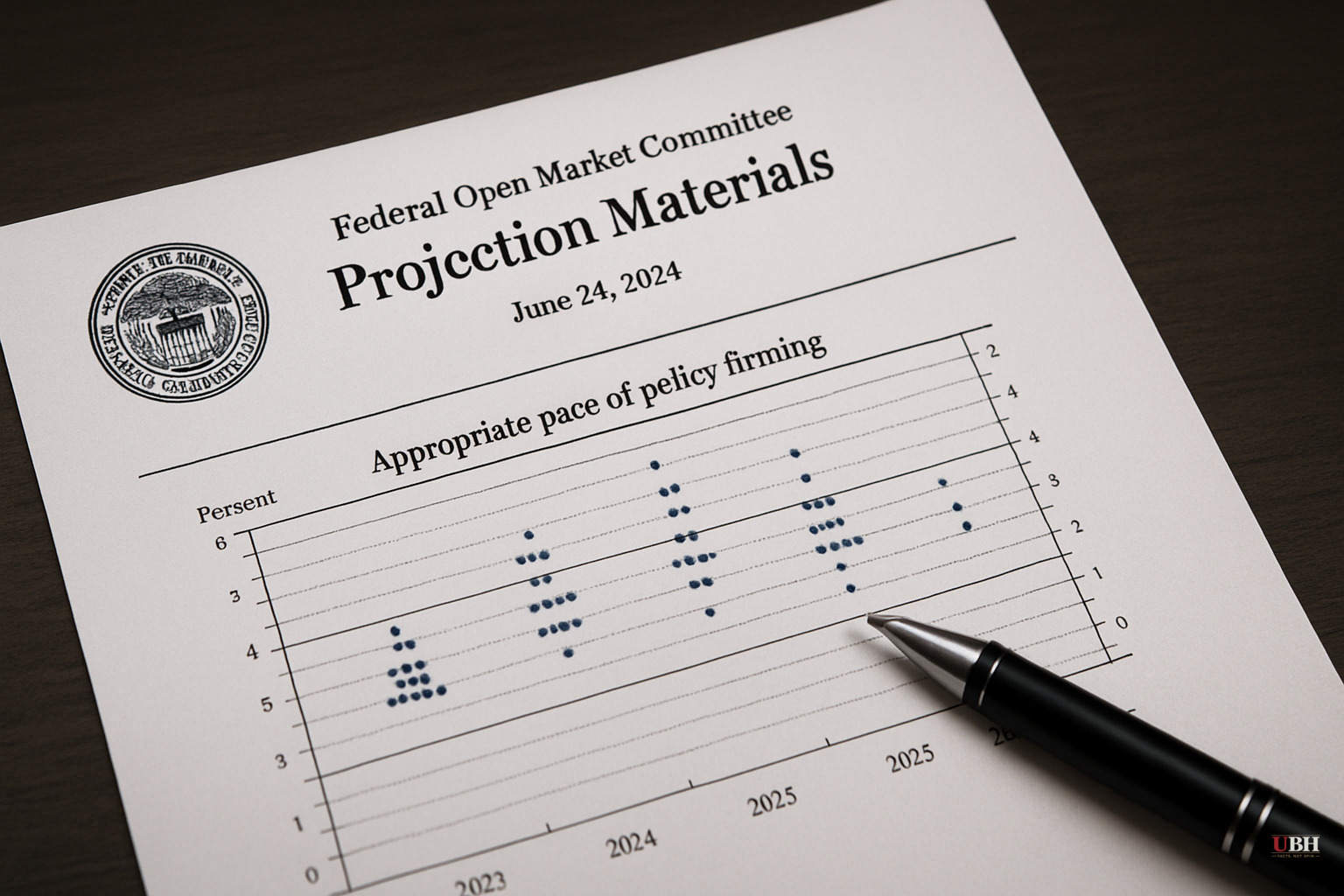
Since Warsh's first FOMC meeting concluded Wednesday, June 17, the Fed's updated projections have reshuffled market expectations that just months ago were betting heavily on rate cuts.
What the dot plot actually says
The FOMC's June Summary of Economic Projections, published Wednesday and reported by FXStreet, shows the median year-end 2026 federal funds rate forecast at 3.8%, up from 3.4% in the March projection. Nine officials now expect at least one quarter-point hike this year. Six expect at least two. Nine others project no move or a cut. The committee submitted 18 forecasts, not the usual 19, because Warsh did not file one.
Warsh has previously criticized forward guidance as distorting markets. His abstention is consistent with that criticism, but it also means the chair of the Federal Reserve is the one voice missing from the committee's published rate roadmap.
The 2026 PCE inflation projection jumped to 3.6% from 2.7% in March, according to FXStreet. That's nearly a full percentage point higher than the prior estimate, and nearly double the Fed's 2% target. GDP growth was trimmed to 2.2% from 2.4%. Unemployment was revised slightly down, to 4.3% from 4.4%.
The statement overhaul
The post-meeting policy statement was notably shorter than its predecessors, according to the Daily Record (Maryland), which cited Reuters. Previous statements had included language signaling an easing bias. That language is gone. The new format, approved unanimously 12-0 by the FOMC, simply states the rate decision and reaffirms the Fed's reserve management intent. Warsh told reporters the statement dropped forward guidance because it is "not well suited to the current economic moment."
This represents a repudiation of the communication style used by Jerome Powell's Fed. The Daily Record noted the format echoes the terse statements of Alan Greenspan's era.
Warsh also announced five internal task forces covering Fed communications and balance sheet management, among other issues. He said each task force will work toward "a Federal Reserve that is clear-eyed about its mission, fit for purpose, and focused on the future."
What markets did
According to CNBC, the 2-year Treasury yield rose more than 16 basis points to 4.216% by Wednesday's close. The 10-year yield climbed more than 7 basis points to 4.499%. The spread between the two narrowed to within 30 basis points, the smallest gap in more than a year, per Anadolu Ajansı.
A flattening yield curve of this kind typically signals that investors expect tighter Fed policy to slow future growth. Money markets, according to Anadolu Ajansı, are now pricing a hike as likely by September and fully expected by December.
This marks a shift from the rate-cut expectations that dominated when Trump nominated Warsh earlier this year. Anadolu Ajansı noted that expectations shifted after U.S. and Israeli strikes on Iran in late February pushed energy prices higher and revived inflation concerns. The Treasury market has fallen roughly 1.5% since late February, with 10-year yields up nearly half a percentage point during that stretch.
The legitimate concern about Warsh's approach
Critics of Warsh's communication overhaul have a real argument. Dropping forward guidance isn't costless. Forward guidance—telling markets what conditions would prompt action—reduces volatility and helps businesses and households plan. Gina Martin Adams, chief market strategist at HB Wealth, told CNBC that the shift in the dot plot, votes, and statement language has "financial markets a bit on edge." That edge showed up directly in Wednesday's yield moves. If Warsh's task forces eventually recommend scrapping the dot plot entirely, as prior coverage noted he has signaled, markets lose one of the clearest signals they've had about Fed intentions. More opacity can mean more volatility, not less.
Warsh's counterargument is also substantive: forward guidance can paint the Fed into corners, as Powell's repeated rate-cut signals in 2024 and early 2025 demonstrated when inflation proved stickier than expected. Warsh is betting that meeting-by-meeting decisions, anchored to incoming data, produce better outcomes than pledges the committee may have to walk back.
Where this leaves borrowers and the broader economy
The revised 3.8% median rate forecast means the FOMC's central expectation is that the federal funds rate ends 2026 above its current midpoint of 3.625%. For borrowers, the relief that seemed imminent earlier this year is now in serious doubt. Mortgage rates, credit card rates, and business lending costs all respond to Treasury yields that Wednesday's session pushed higher.
FXStreet's projections data shows officials expect the rate to ease to 3.6% in 2027 and 3.4% in 2028, with longer-run rates held at 3.1%. The Fed is not signaling a sustained tightening cycle. But it is clearly signaling that the path back to lower rates runs through an inflation problem that has gotten worse, not better, since March.
The next FOMC meeting is scheduled for late July. Warsh has said the committee will reassess at each meeting. With PCE inflation projected at 3.6% and money markets pricing a September hike as likely, the open question heading into that meeting is whether incoming June and July inflation data give any of the nine rate-hike advocates a reason to change their minds before the vote.
Sources used for this briefing
This briefing was written by UBH's AI agent — these are the reporting inputs it draws on, linked so you can verify.


