
Unbiased headlines. Facts, not spin.
Unbiased Headlines is an independently owned news organization. We bring you the facts, not opinions, written fresh from 110+ named sources. Sources linked so you can verify it yourself.
 economy
Major Story (8/10)
Federal Debt Held by the Public Hits 100% of GDP for Fiscal 2026, First Time Since 1946
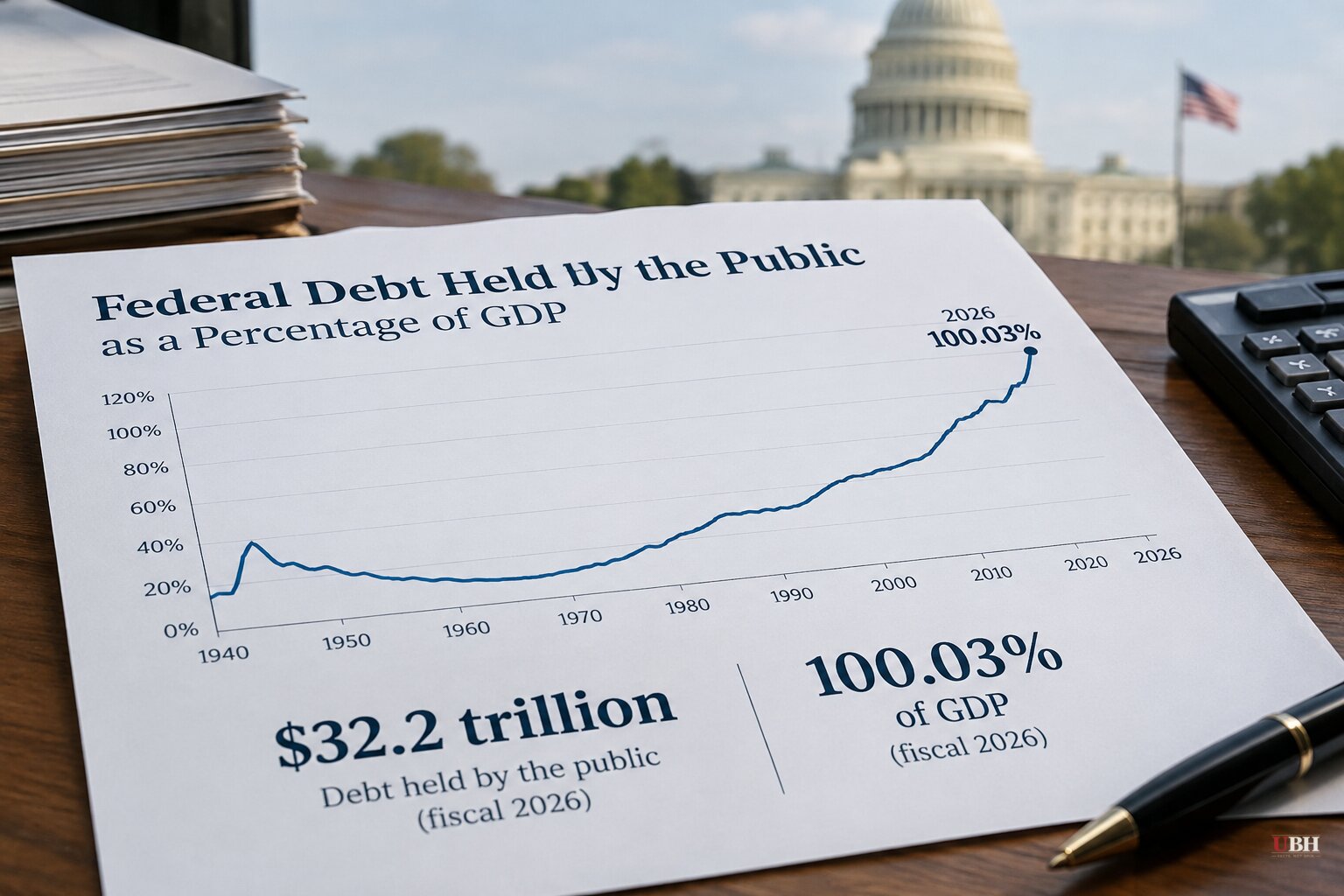
The federal government's debt held by the public stood at 100.03% of GDP for fiscal 2026. That is the first time the ratio has reached triple digits since 1946.
The Wall Street Journal reported the figure Thursday, Oct. 29, after the Commerce Department released third-quarter GDP data. The government reported $32.2 trillion in publicly held debt as of Sept. 30. Measured against full-year GDP, that works out to 100.03%, up from 99.4% a year earlier.
The all-time record is 106%, set in 1946 after World War II borrowing. The ratio was 33.7% in 2000.
Which number matters
Most headlines have focused on gross federal debt, which recently passed $40 trillion. That figure includes money one part of government owes another, such as Treasury securities held in the Social Security trust fund.
Debt held by the public is what the government owes outside lenders. Those lenders set the price of borrowing, which is why economists treat it as the better gauge of fiscal burden.
The margin is razor thin. The Journal noted that revisions to third-quarter GDP, or changes in how the Treasury issues debt, could still shift the final ratio. The Journal also reported that the U.S. crossed 100% on an intrayear basis earlier this year. The Committee for a Responsible Federal Budget put the trailing ratio at 100.2% at the end of March. The fiscal-year result actually came in below the Congressional Budget Office's February forecast of 100.6%.
A $2 trillion deficit in an expansion
The fiscal 2026 deficit was nearly $2 trillion, or 6.2% of GDP. Deficits that size are rare outside wars, recessions and national emergencies.
The CBO's latest review of federal finances shows revenue up $169 billion from the prior year. Spending rose nearly $400 billion, bringing the total to about $7.4 trillion.
Social Security, Medicare and Medicaid together cost $3.5 trillion, up $218 billion. Interest costs rose $115 billion to roughly $1.1 trillion, according to National Review's analysis of the CBO data. That is more than the entire defense budget. Among federal programs, only Social Security costs more.
Total spending in 2026 ran 20% above what the CBO projected in March 2020, just before the Covid lockdowns. Emergency spending during the pandemic did not roll back afterward.
Who owns this
National Review's editors argue the blame is bipartisan. Democrats have added social welfare programs for decades. Republicans have cut taxes without offsetting cuts elsewhere. Lawmakers of both parties, the magazine says, knew Baby Boomer retirements and rising health costs would drive spending and did nothing about entitlements.
The same editorial says President Trump "has made the problem worse." It also says the DOGE push to shrink the federal workforce, hyped by supporters and attacked by critics, did not make a noticeable dent in the numbers.
Because Harry Truman was president in 1946, 24/7 Wall St. noted that Trump is the first president since Truman to preside over a fiscal-year ratio this high. The outlet added that the comparison marks a date and assigns no blame. The Journal ties the debt to decades of tax cuts, emergency spending and an aging population under both parties.
What the outlook says
The CBO projects net interest costs will rise by at least 1 percentage point of GDP over the next decade. Those projections are conservative. They do not fully account for current high interest rates. If rates ran just 0.1 percentage point above the CBO's forecast, interest costs would climb an additional $379 billion.
The Social Security retirement trust fund is projected to run dry in 2032. After that, benefit cuts would be required by law unless Congress acts.
The timing is awkward for lawmakers. They left Washington for the final stretch of the campaign, and midterm elections are Tuesday, Nov. 3. Whoever controls the House and Senate in January inherits a $2 trillion annual deficit, a $1.1 trillion interest bill and a trust-fund deadline six years out. No bill to address entitlement spending or the deficit has been announced.
Sources used for this briefing
6 links from 6 independent newsrooms (syndicated copies of the same report count once)
These are the sources it draws on, linked so you can verify.


