
Unbiased headlines. Facts, not spin.
Every story is an unbiased news briefing written from 110+ sources across the spectrum — sources linked so you can verify it yourself.
 health
Notable (5/10)
June 8, 2026 at 09:32 AM
health
Notable (5/10)
June 8, 2026 at 09:32 AM
FDA-Approved Vibrating Belt Targets Bone Loss in 40 Million Americans With Osteopenia
40 Million Americans Have a Bone Density Problem Most Don't Know About
Osteopenia is not a household word. It should be.
More than 40 million adults in the United States aged 50 and older have it, according to NPR's reporting on June 8, 2026. Low bone density can quietly progress to osteoporosis — the condition that makes bones brittle, weak, and prone to fractures that can be debilitating or deadly for older adults.
Most people find out the same way Andrea Bloom did: a routine bone density scan delivers a number they weren't expecting.
"When I saw my results, it was pretty shocking because I was one-tenth of a point away from an osteoporosis diagnosis," said Bloom, 59, of Pleasanton, California, as reported by NPR.
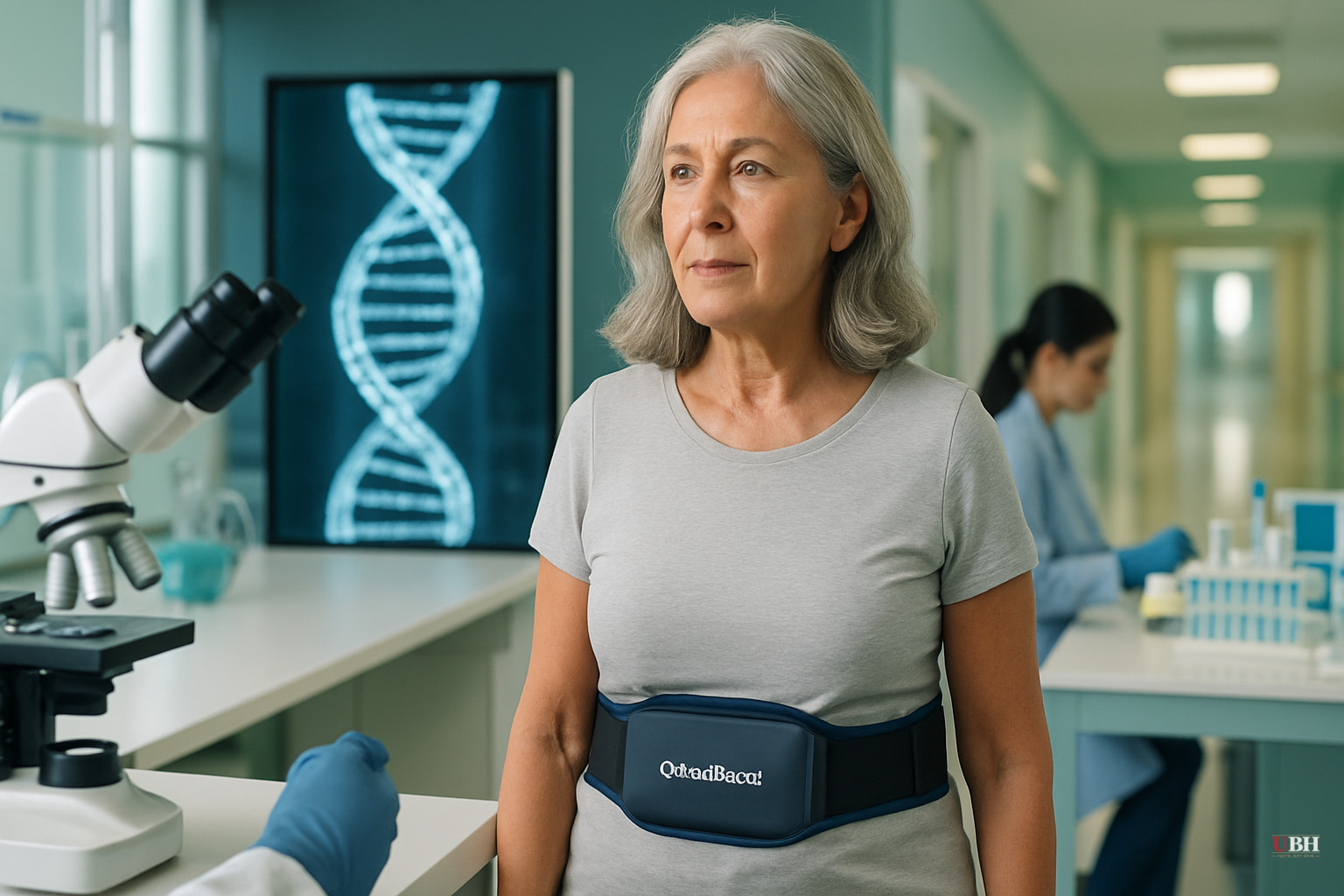
Now Bloom wears the Osteoboost belt every morning while walking her dog. Thirty minutes a day, strapped around her hip area.
What the Device Actually Does
The Osteoboost is FDA-approved, and the mechanism it uses has a legitimate scientific foundation.
The belt delivers low-magnitude vibrations to the spine and hips. Those vibrations produce mechanical signals that mimic what happens when muscles contract during exercise — specifically, they stimulate osteoblasts, the cells responsible for building bone.
Dr. Pamela Peeke, chief medical officer for Osteoboost, explained it plainly to NPR: "For 30 minutes a day, when you wear the belt, you're stimulating those bone-building cells."
Peeke herself uses the device while on an elliptical machine, which she says adds another layer of mechanical stimulus on top of the vibration.
The underlying research started with NASA.
The NASA Connection Nobody Is Talking About
Mike Jaasma, one of Osteoboost's founders, told NPR that the original vibration plate technology came out of NASA-funded research — specifically, the problem of what happens to astronaut bones in zero gravity.
In space, bones deteriorate fast. They need mechanical stress to maintain density. Gravity provides that stress on Earth. Zero gravity removes it entirely. So NASA funded research into whether vibration could substitute for that missing mechanical load.
It could. That early work sparked the broader scientific inquiry into vibration therapy for bone health on Earth.
On Earth, the equivalent of zero gravity is inactivity. Walking, running, squatting, lifting weights — all of it applies stress to your skeleton that tells your body to keep bone-building. Stop doing those things, and your bones get the same message astronauts' bones get in orbit: we're not needed here anymore.
Who This Is Approved For — and Who Gets Left Out
The FDA approval for the Osteoboost belt is specifically for post-menopausal women with osteopenia. That's a defined and significant population, but it's not the whole story.
Men get osteoporosis too. Younger women get osteopenia. People with conditions like celiac disease, inflammatory bowel disease, or those on long-term corticosteroids lose bone density regardless of age or gender. The device's approved indication leaves a large portion of the bone-loss population without a formal prescription pathway for this tool — at least for now.
That's just the reality of how FDA approvals work: you prove it for a specific population first, then expand. But mainstream coverage largely glosses over that limitation.
What Mainstream Coverage Is Missing
The NPR piece is solid on the mechanism and the personal story angle. What it doesn't dig into: cost and access.
A prescription wearable device approved by the FDA is not cheap. Who pays for it? Is it covered by Medicare or private insurance? What does out-of-pocket look like for a 59-year-old woman who doesn't have great coverage? NPR doesn't answer those questions in this report.
For whether this technology helps anyone beyond the relatively affluent patients who can afford to ask their doctors about it, those questions matter.
The bone health problem in America is also a nutrition and lifestyle problem that no belt solves on its own. Calcium, vitamin D, weight-bearing exercise, and avoiding smoking and heavy alcohol use are still the foundation. The Osteoboost is a tool to add to that foundation — not a replacement for it.
And the cold reality: most Americans aged 50 and older are not getting bone density scans regularly. Bloom found out about her osteopenia because she got scanned. Millions more have no idea where their bone density stands.
The Real Story
The Osteoboost belt is an FDA-approved device with real science behind it — science that started because NASA needed to keep astronauts' skeletons intact in orbit. The technology appears to do what it claims.
But it's a prescription device for a specific population, the cost-and-coverage question is unanswered, and it doesn't replace the fundamentals: move your body, eat for your bones, and get scanned so you actually know what you're dealing with.
Forty million Americans have low bone density. Most of them don't know it.
Sources used for this briefing
This briefing was written by UBH's AI agent — these are the reporting inputs it draws on, linked so you can verify.


