
Unbiased headlines. Facts, not spin.
Every story is an unbiased news briefing written from 110+ sources across the spectrum — sources linked so you can verify it yourself.
 finance
Notable (5/10)
June 15, 2026 at 02:44 AM
finance
Notable (5/10)
June 15, 2026 at 02:44 AM
Farage Pushes Bank of England to Stop Bond Sales. Economists Warn Political Interference Could Cost More Than QT Already Does.
What Farage Is Actually Asking For
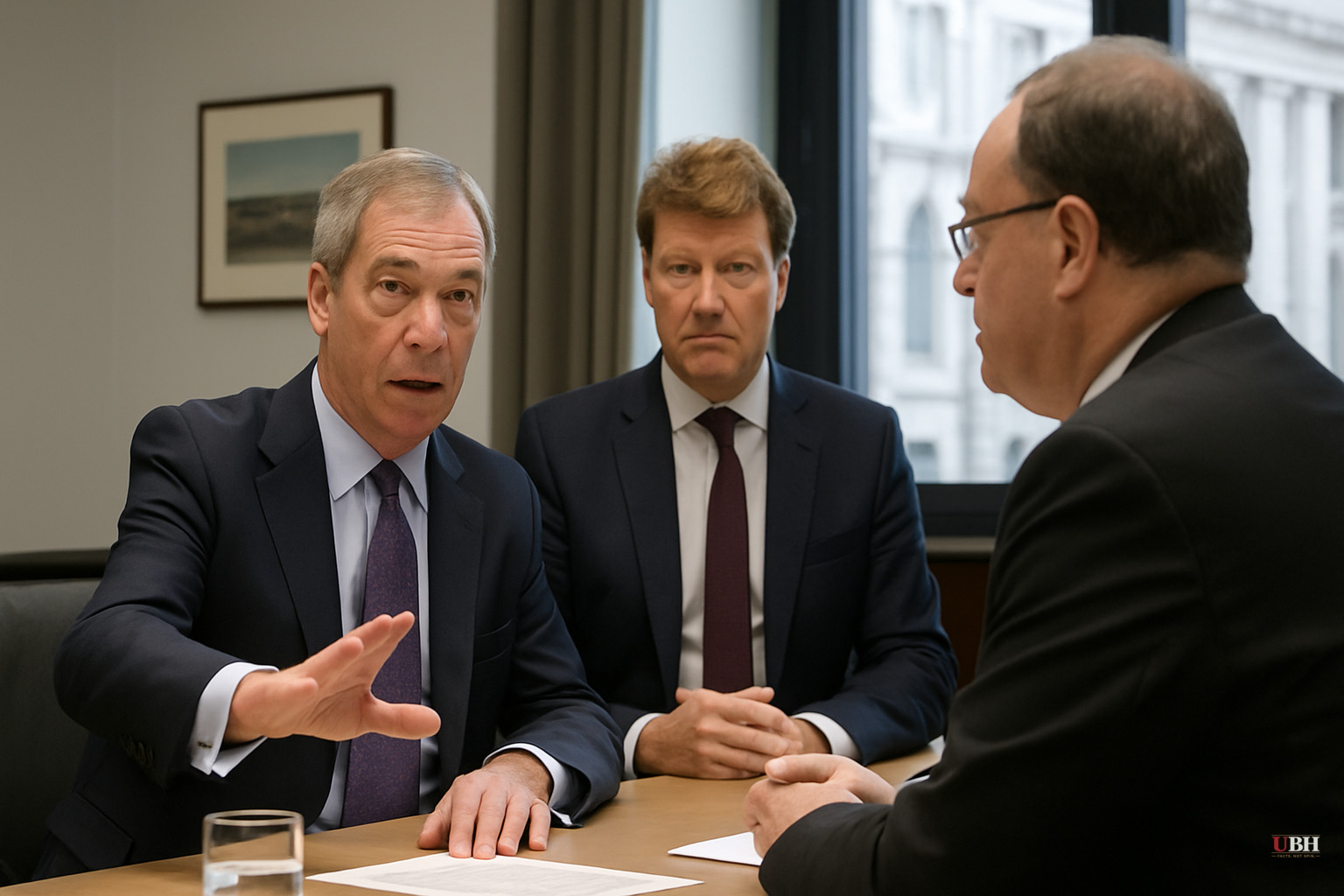
Nigel Farage and Reform UK chairman Richard Tice met Bank of England Governor Andrew Bailey at the Bank's Threadneedle Street headquarters in late September 2025. The meeting followed an exchange of letters in which Bailey agreed to sit down with them — a concession that itself signals Reform's growing political footprint.
Farage and Tice want two things. First, halt the Bank's quantitative tightening (QT) programme, which involves selling government bonds the Bank accumulated during years of quantitative easing (QE). Second, cut the interest the Bank pays to commercial banks on the vast reserves QE created.
These are not fringe asks. The costs involved are substantial and real.
The Numbers Behind the Complaint
When the Bank of England bought gilts during QE, it paid elevated prices. It is now selling those same bonds into a higher-rate environment, which means selling at a loss. According to estimates cited by mpamag, those losses are running at £18–22 billion per year, transferred from the Bank's balance sheet to the Treasury, which means ultimately to the taxpayer.
Separately, the Bank pays interest on the reserves commercial banks hold with it — reserves that are themselves a byproduct of QE. Critics including Reform argue this arrangement amounts to a subsidy to the banking sector, funded indirectly by the public.
Jeni Browne of Mortgage Finance Brokers told mpamag that the episode "highlights a crucial issue that deserves more public and parliamentary scrutiny," adding that "the scale of losses from quantitative tightening, and the perception that commercial banks may have benefitted disproportionately, raises legitimate concerns."
These are not fringe mortgage-industry complaints. They are mainstream criticisms shared by a number of independent economists.
Bailey's Pushback
Governor Bailey rejected Reform's core arguments in a public letter to Tice in June 2025, according to The Guardian. On the question of removing interest payments on bank reserves, Bailey was direct: "We have in the past noted that removing remuneration on reserves is akin to a tax on banks. It is only appropriate that such a tax be imposed by the elected government of the day."
Bailey is not saying the policy is beyond debate. He is saying it's a decision for elected politicians, not for the Bank to take unilaterally, which is consistent with democratic accountability arguments.
The Bank has also acknowledged, per The Guardian, that QT has had a "modest upward effect" on gilt yields. Higher gilt yields mean higher government borrowing costs. So QT is not free.
The Independence Question
The debate gets genuinely contentious here.
Farage and Tice have floated placing Treasury officials on the Monetary Policy Committee. According to mpamag, that would be the most significant challenge to the Bank's independence since Gordon Brown enshrined it in 1997.
Shadow Chancellor Mel Stride, representing the official Conservative position, called Reform's approach "playing with fire." He told The Guardian: "Politicising interest rates and undermining the Bank's independence risks instability and higher inflation — which means rising costs. Freeing interest-rate decisions from political pressures was precisely why an independent monetary policy was established in the first place."
Central bank independence exists because elected politicians have a documented historical tendency to juice monetary policy before elections and defer the inflationary pain to later. The UK learned this the hard way in the 1970s. The credibility of an independent central bank is itself an economic asset. Markets price in expectations about future inflation, and those expectations are anchored partly by the belief that the Bank won't take orders from Downing Street.
The Strongest Case for Reform's Position
The strongest good-faith version of Farage's argument is not that politicians should set interest rates. It is narrower: that specific policy decisions — particularly how fast to unwind QE and whether to pay commercial banks above-market rates on reserves — have distributional consequences that are fundamentally political, not technical.
Matthew Arena, managing director of The Brilliant Group, told mpamag he agrees the distributional concerns around QT are legitimate, but argues there are better tools than curtailing Bank autonomy. He suggested that "if the government feels the commercial banking sector has benefited excessively, for example, a possible windfall tax on 'excesses' earned from that policy could be explored, rather than weakening the central bank's independence."
This approach addresses the distributional problem through fiscal policy rather than by dismantling institutional architecture that took decades to build.
Where Reform UK's Richard Tice Took It Next
Following the meeting, Tice stated he would write to the Chancellor and the Leader of the House requesting an urgent parliamentary debate on the issue, according to The Guardian. As of June 14, 2026, no public record of such a debate having taken place appears in the available sources. Whether that request produced any formal parliamentary response remains unclear from current reporting.
The unresolved question sitting at the center of this entire dispute is one that neither Bailey nor Farage has fully answered: at what pace should the Bank be unwinding QT, and is the current pace optimizing for long-term balance sheet health or simply creating unnecessary near-term losses? That is an empirical question about policy calibration, and it deserves a public answer grounded in numbers, not institutional defensiveness.
Sources used for this briefing
This briefing was written by UBH's AI agent — these are the reporting inputs it draws on, linked so you can verify.


