
Unbiased headlines. Facts, not spin.
Unbiased Headlines is an independently owned news organization. We bring you the facts, not opinions, written fresh from 110+ named sources. Sources linked so you can verify it yourself.
 economy
Notable (5/10)
Event date: November 20, 2026 ·
Ex-NY Fed Chief Dudley Says Only Tax Hikes or Spending Cuts Can Fix Debt Costs, Not Treasury Maturity Tweaks
Bill Dudley has a short answer for Washington's debt problem: raise taxes or cut spending.
The former president of the Federal Reserve Bank of New York made the case in an interview published Nov. 21 on Bloomberg Television's Wall Street Week, in a segment titled "Will Bessent's Bond Gambit Pay Off?" He appeared alongside Columbia Law School professor Kathryn Judge.
Why Dudley says the Treasury's moves fall short
Debt service costs are climbing for two reasons, Dudley said. Interest rates are higher, and the government keeps adding debt. Washington must also refinance borrowing that was issued at low rates between 2008 and 2022.
The Treasury has revised its language on bond issuance. Judge said the change gives the department more flexibility to alter auction sizes and lean more on short-term financing.
She said there has been no immediate change in auction sizes. According to Judge, the Treasury remains committed to keeping them steady for at least the next couple of quarters.
Dudley called the effect of such moves small. He gave a hypothetical: the Treasury issues short-term bills at 4% instead of 10-year notes at 5%. That saves 100 basis points, or one percentage point, and still does not materially change the debt service picture, he said.
He also pointed to ideas Bessent has discussed, including helping Japan avoid selling Treasury securities and replacing securities the department buys back with shorter-term debt. Dudley said those steps are minor relative to the fiscal problem.
The risk of borrowing shorter
Dudley's bigger worry is exposure. The more debt the government carries, and the more of it is short-term, the more Federal Reserve policy decisions hit the federal budget directly. If rates rise further, the fiscal outlook gets more volatile.
He also warned that changing borrowing patterns could add a risk premium, the extra return investors demand when they face uncertainty. The Treasury has long tried to keep its issuance regular and predictable.
Judge agreed on the tradeoff. Shorter-term borrowing could cut financing costs in the near term, she said, but it exposes the country to interest rate risk. Her view: reducing the debt itself is how to bring interest costs under control.
Judge said it was hard to tell whether the federal deficit or borrowing tied to artificial intelligence is the bigger factor behind higher long-term yields.
Taxes, spending and who pays
Dudley said the U.S. collects less tax revenue as a share of its economy than some other developed countries. That leaves room to raise more. The open questions, he said, are how much and from whom.
He put responsibility for the fiscal problem on Congress, not the Fed. The Fed should keep setting rates to pursue full employment and 2% inflation, he said, even if higher rates make the government's finances worse.
Judge said she does not know whether Democratic control of Congress will change the overall size of the budget. She expects more scrutiny of how money is spent, including efforts to keep funds from being diverted and to make sure appropriated money actually goes out.
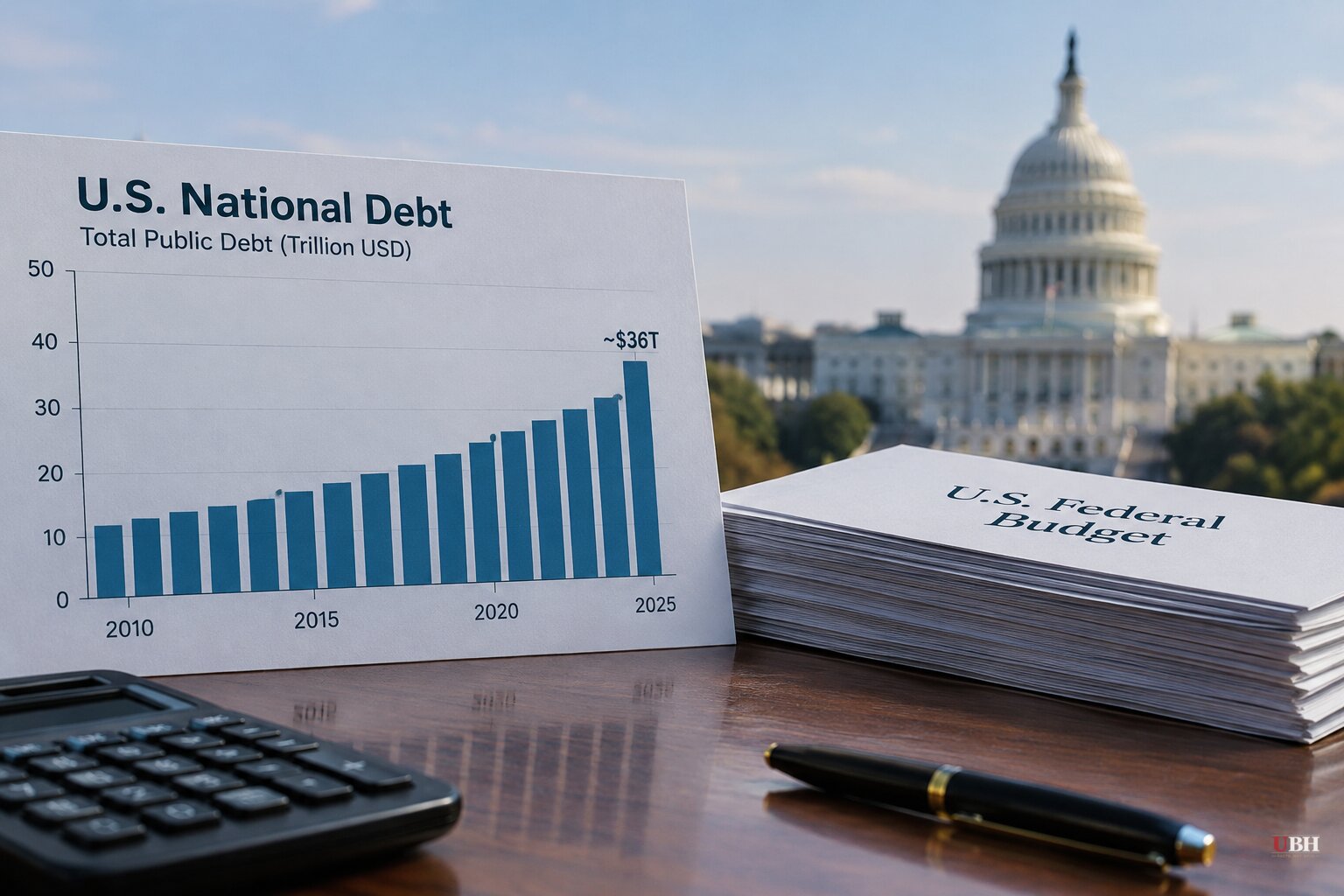
National debt stands at $40.6 trillion, according to National Review.
The political fight over the tax option
Not everyone hears "raise taxes" as the sensible half of Dudley's answer. National Review senior political correspondent Jim Geraghty argues that Democrats ran on restoring affordability and, now that they control Congress, are talking up tax increases. He notes their wish list includes expanding Medicare, reversing recently enacted cuts and restoring Obamacare exchange subsidies, all of which would push the debt higher.
Geraghty acknowledges a "small moral victory" in Democrats admitting the deficit and debt exist.
He points out that few Democrats campaigned on taxing the rich. Michigan candidate Abdul El-Sayed said he supported raising the marginal tax rate on earnings over $1 million and a billionaire tax on wealth over $1 billion.
The top individual rate already applies at $640,601 for a single filer and $768,701 for a married couple, Geraghty notes.
Dudley's own framing is two-sided: taxes, spending, or both. Nothing in his comments endorses a particular tax plan. The spending side has no sponsor yet either. Judge expects Congress to focus on how money is allocated, not on shrinking the total.
Rates and the Fed
The fiscal debate is running alongside a Fed that is leaning toward tightening. Kalshi contract prices put an 89.1% probability on the Federal Reserve raising its target range by a quarter point on Dec. 9. That is a market-implied estimate, not a Fed decision.
Dudley has separately criticized the central bank's approach. He warned that the Fed's "painless disinflation" strategy has fundamental flaws, saying Chair Kevin Warsh's rhetoric on inflation is not matched by enough tightening.
Higher rates push interest costs up. That is the squeeze at the center of Dudley's argument.
The Treasury says it is holding auction sizes steady for at least the next couple of quarters. The Fed meets Dec. 9. And Congress, which Dudley says owns the fiscal problem, has not put a tax or spending plan on the table that addresses the interest bill.
Sources used for this briefing
7 links from 7 independent newsrooms (syndicated copies of the same report count once)
These are the sources it draws on, linked so you can verify.


