
Unbiased headlines. Facts, not spin.
Unbiased Headlines is an independently owned news organization. We bring you the facts, not opinions, written fresh from 110+ named sources. Sources linked so you can verify it yourself.
 economy
Notable (5/10)
Event date: November 18, 2026 ·
17 House Members Back $25 Federal Minimum Wage While D.C. Heads Toward April Vote on Same Number
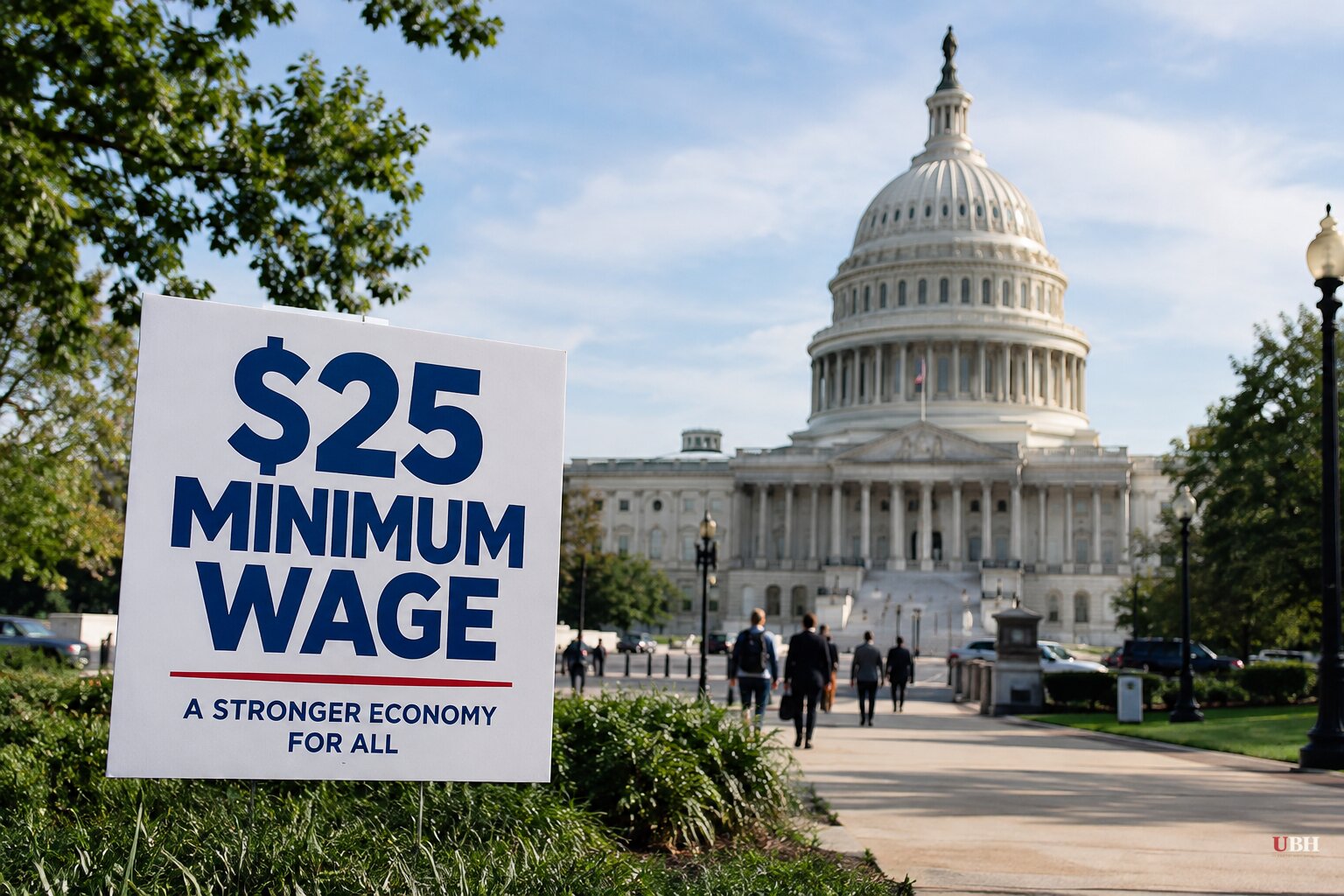
A group of 17 lawmakers, a mix of sitting and newly elected House members, is stepping up pressure for the Living Wage For All Act. The bill has sat idle since it was introduced in April.
It would raise the federal minimum wage from $7.25 to $25 an hour and abolish the separate tipped cash wage of $2.13.
The original lead sponsors are Reps. Delia Ramirez and Jesus "Chuy" Garcia of Illinois and Rep. Analilia Mejia of New Jersey. Brad Lander, the congressman-elect from Brooklyn, says he will sign on as a co-sponsor when the new session opens in January.
"Doing it federally is the right way to go," Lander said. He called the tipped subminimum wage "inexcusable" and said the 45 million working people who make less than $20 an hour deserve a raise.
What the federal bill would do
The phase-in depends on employer size. Companies with more than 500 employees nationwide or at least $1 billion in annual revenue would reach $25 by 2031. Smaller employers would have until 2038.
After that, the minimum would be pegged to two-thirds of the U.S. median hourly wage, adjusted every year.
The federal floor has not moved since 2009. The $2.13 tipped cash wage has been frozen since 1996. Congress created a separate tipped rate in 1966, initially at half the standard minimum.
Supporters argue the freeze has steadily eroded workers' buying power. Al Jazeera's calculation puts the $7.25 rate at about 36 percent less purchasing power than in 2009 and about 53 percent below the 1968 peak.
States already diverge widely. Washington, D.C., has the highest minimum at $18.40, followed by Washington state at $17.13. Twenty states, including Texas, Georgia and Iowa, have not gone above the federal rate. Seven states, including Alaska, California and Nevada, require the full minimum before tips. New York allows a tip credit, with a restaurant-worker cash wage of $11.35 in the New York City area and $10.70 elsewhere.
One Fair Wage, the group campaigning against the subminimum wage, released a poll on Wednesday, Nov. 18. It found 78 percent of voters said a $25 minimum was an important factor in how they voted in the midterms. That is the group's own survey of an issue it advocates for. Republicans took heavy losses in the elections, with cost of living a central concern.
D.C. tries it again
The District is the nearest test case. In 2022, D.C. voters passed Initiative 82 with more than 70 percent support, promising to raise the tipped base wage until it matched the regular minimum by 2027.
The D.C. Council partially repealed it last year. Mayor Muriel Bowser had called for full repeal. At the time of the repeal, the tipped base was $5.35 an hour against a $16.10 minimum.
Reason magazine says full-service bar and restaurant jobs in D.C. fell 5 percent after passage and worker earnings dropped more than $11 million. It says surrounding Virginia and Maryland counties saw declines under 1 percent. Reason also says many restaurants added service fees or auto-gratuity to bills and that many tipped workers themselves opposed the law.
The pattern is not new. In 2018, D.C. voters passed Initiative 77 to end the tip credit. The council repealed it in full a few months later.
Now comes Initiative 87. It would raise the District minimum to $25 by 2029 and phase out the tip credit by 2031. Supporters have delivered the required signatures to the D.C. Board of Elections, which likely sets up a District-wide vote in April 2027. One Fair Wage, based in New York, is leading the push.
Reason also reports that D.C. Mayor-elect Janeese Lewis George has voiced support for scrapping the tip wage credit, distinguishing her from Bowser, even while expressing reservations about a top-line minimum wage increase to $25.
The opposition
A new coalition of small businesses, nonprofits and workers, "No on 87," launched a campaign this week. It says the measure would also ban sharing service charges with back-of-house employees.
"Initiative 87 doesn't solve the problem, it makes things worse," said Anthony A. Williams, CEO and Executive Director of the Federal City Council and a former D.C. mayor. He called it "an experiment no American city has tried."
Shawn Townsend, president and CEO of the Restaurant Association of Metropolitan Washington, said the mandate would mean higher prices "at the grocery store, at the child care center, and on every single delivery order." He tied the timing to what he described as tens of thousands of federal job losses in the region.
The coalition's release says living costs in D.C. already run 39 percent above the national average. It also notes the District's $18.40 minimum rises automatically with inflation. Those are the coalition's figures and arguments, and the campaign has a direct stake in the outcome.
What to watch
The federal bill has 17 backers and has not moved since April. Lander's co-sponsorship is slated for January, when the new session opens.
In D.C., the open question is whether an April 2027 District-wide vote is locked in after supporters delivered their signatures to the Board of Elections. If the measure passes, it would raise the District minimum to $25 by 2029 and phase out the tip credit by 2031. It would also be the third time D.C. voters have been asked to end the tip credit.
Sources used for this briefing
7 links from 6 independent newsrooms (syndicated copies of the same report count once)
These are the sources it draws on, linked so you can verify.


