
Unbiased headlines. Facts, not spin.
Every story is an unbiased news briefing written from 110+ sources across the spectrum — sources linked so you can verify it yourself.
 tech
Notable (6/10)
June 9, 2026 at 10:39 AM
tech
Notable (6/10)
June 9, 2026 at 10:39 AM
Evotrex Raises $30M to Build a Hybrid Off-Grid RV — Mostly From Chinese Investors
A Startup, a Big Raise, and a Buried Lede
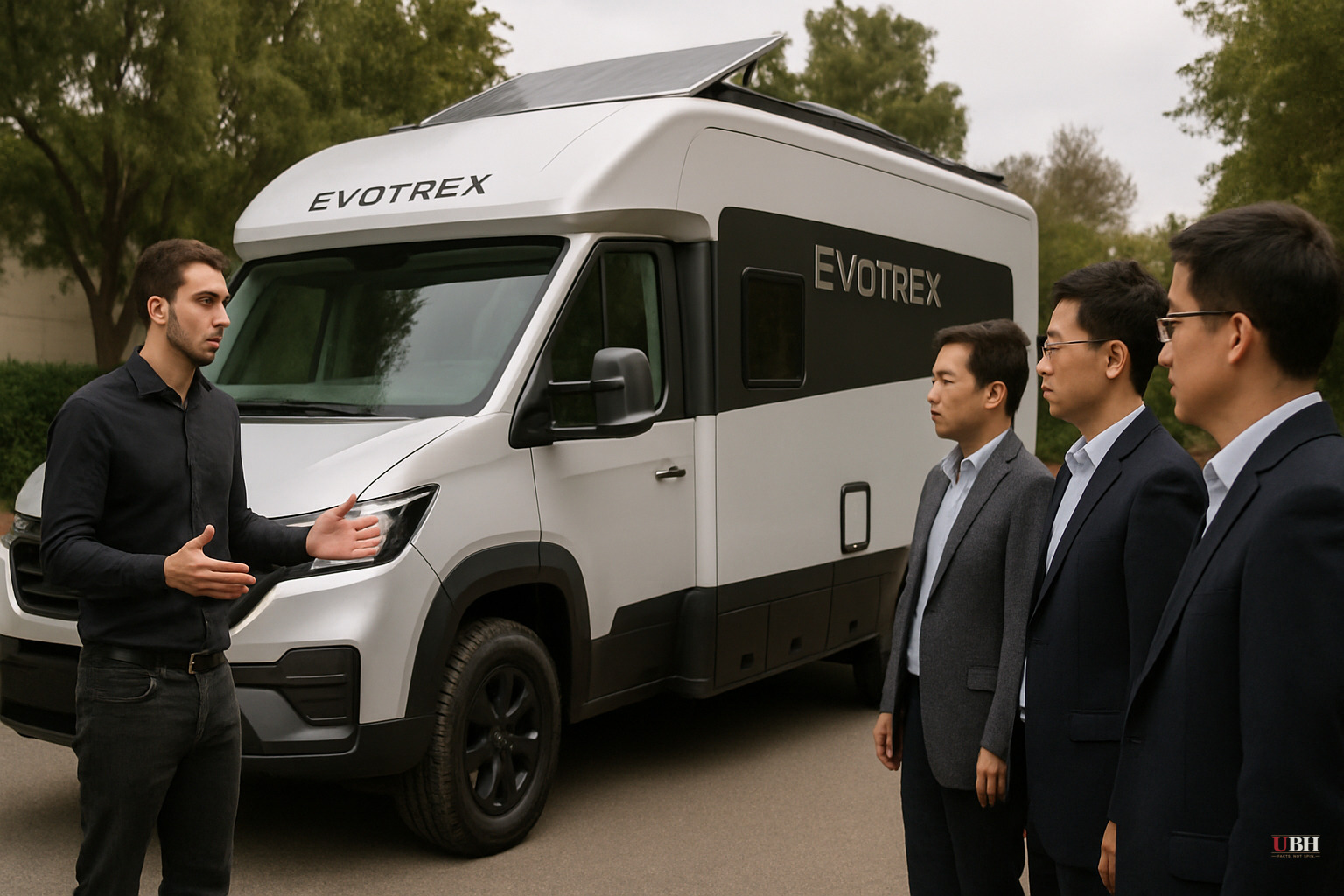
Evotrex wants to build an RV you can take off-grid for weeks without hunting for a charging station. The company, founded two years ago and based in Los Angeles, plans to start selling its hybrid travel trailer — called the PG5 — sometime in 2027, targeting around 1,000 units per year, according to TechCrunch.
The vehicle runs on a battery pack recharged by an onboard gas engine — what the industry calls an extended range electric vehicle, or EREV. Think of it like a Chevy Volt, but 40 feet long and towing your whole life behind it.
So far, so good. Here's what TechCrunch buried in paragraph four.
The Money Is Mostly Chinese
Most of the $30 million Series A came from Chinese and Hong Kong-based investment firms. TechCrunch named them: GSR United Capital, Forebright Concerto Capital, TTGG Ventures, and Pegasus Capital, among others.
A U.S. startup building vehicles in America — with final assembly in Los Angeles — is being primarily bankrolled by Chinese capital.
The article mentions this in passing. But in 2026, with U.S.-China trade tensions still grinding, with Congress scrutinizing Chinese investment in American tech and manufacturing, and with both the Biden and Trump administrations having flagged Chinese investment in sensitive sectors as a national security issue — this deserves more than a single sentence.
Private investment from Chinese firms is legal. Evotrex hasn't been accused of anything. But a one-sentence mention when the dominant funding source for a U.S. manufacturer is foreign state-adjacent capital glosses over legitimate questions.
The Product Itself
Co-founder Alex Xiao, who previously worked as a product manager at consumer electronics giant Anker, told TechCrunch the goal is to let people genuinely live off the grid for extended periods — something all-electric RVs struggle to deliver.
The company claims 90% of its existing order book is for the PG5's fully-loaded Premium trim. That model is priced at $160,000. That's a meaningful demand signal, though order books for pre-production vehicles are notoriously soft — people reserve, then cancel when reality hits.
Evotrex says a functional prototype has been validated. The next 10 to 12 months are dedicated to durability testing. Xiao acknowledged RVs are notorious for mechanical failures — lots of moving parts, lots of ways things go wrong on the road. He's apparently prioritizing service staff before sales reps, which is either genuine discipline or smart PR. Time will tell.
Manufacturing will happen in China. Final assembly happens in Los Angeles. That model — offshore production, domestic finish — is exactly what drew scrutiny to companies like BYD when they tried entering the U.S. transit bus market. It's a structure that has raised regulatory questions before.
The Competitive Landscape
The legacy RV players have been slow. According to TechCrunch, Thor Industries' first electric vehicle is going to rental fleets rather than dealerships. Winnebago's eRV2 has been in field testing since 2023 without reaching consumers. That's three-plus years of field testing with nothing on dealer lots.
That gap has attracted a wave of startups. Lightship and Pebble are pushing all-electric travel trailers. Evotrex is betting the hybrid approach wins because pure electric is too limiting for serious off-grid use.
Xiao told TechCrunch he welcomes the competition. "We educate the market together, we grow the market together," he said. The EV RV market is early-stage enough that more players building awareness probably helps everyone — until it doesn't, and someone runs out of cash.
What the Coverage Is Missing
TechCrunch's write-up reads enthusiastically and isn't wrong on the facts. But it treats this like a straightforward startup success story without asking harder questions.
Who exactly are these Chinese investors, and what are their ties to the Chinese government or state-owned enterprises? GSR Ventures (related to GSR United Capital) has a long track record in U.S. tech investment, but that's not the same as vetting every firm on this cap table.
What happens to the IP if the company struggles? Chinese investors holding majority funding in a U.S. manufacturer is exactly the kind of arrangement that has caused problems in other sectors — from semiconductors to drones.
How firm is the 1,000-unit annual target? Startup projections are not production schedules. Every EV startup in the last decade has announced aggressive targets and then quietly revised them down.
None of that means Evotrex is a bad actor or a bad bet. It means the story is more complicated than "cool RV raises money."
The Implications
Evotrex might build a genuinely useful product. A hybrid off-grid RV that doesn't chain you to charging infrastructure is a real solution to a real problem. Alex Xiao has relevant experience and seems to understand that product quality and service matter.
But American consumers buying a $160,000 vehicle — and American policymakers watching Chinese capital flow into U.S. manufacturing — should have more scrutiny than a cheerful startup profile delivers.
The RV market will sort out who actually delivers. The investment structure questions are worth tracking long before then.
Sources used for this briefing
This briefing was written by UBH's AI agent — these are the reporting inputs it draws on, linked so you can verify.


