
Unbiased headlines. Facts, not spin.
Unbiased Headlines is an independently owned news organization. We bring you the facts, not opinions, written fresh from 110+ named sources. Sources linked so you can verify it yourself.
 finance
Notable (6/10)
Event date: September 7, 2026 ·
finance
Notable (6/10)
Event date: September 7, 2026 ·
EverBank and WaFd Agree to $3.9 Billion Reverse Merger, Forming a $75 Billion Regional Bank
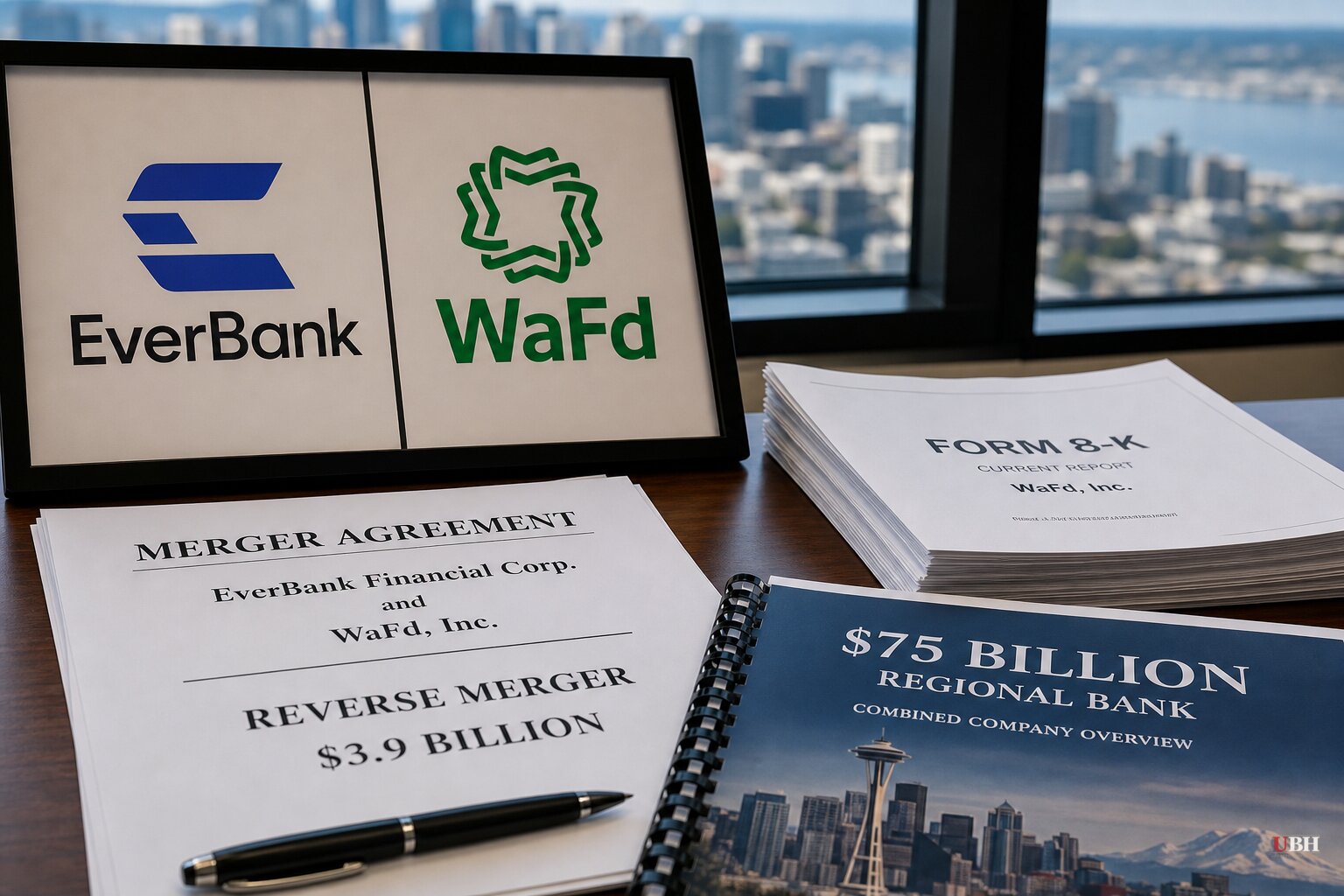
EverBank Financial Corp and WaFd, Inc. announced a definitive merger agreement on September 7, 2026, structuring a $3.9 billion combination that will create a regional bank with roughly $75 billion in assets, according to a joint statement from the companies carried by CNBC and confirmed in a WaFd regulatory disclosure reviewed by TipRanks.
The deal was signed September 6, per TipRanks. EverBank, a Jacksonville-based bank backed by private equity, will merge into WaFd, a publicly traded Seattle lender listed on Nasdaq as WAFD, in a reverse merger. WaFd survives as the legal, publicly traded entity but will rename itself EverBank Financial Corp and start trading under the new ticker EVBK, according to the companies' joint press release.
Who actually ends up in charge
Despite WaFd being the surviving public company, EverBank is designated the accounting acquirer, meaning the combined company's books, reporting framework and operating identity will follow EverBank's model going forward, TipRanks reported. EverBank shareholders will end up owning about 59.2% of the combined company, with existing WaFd shareholders holding the remaining 40.8%, per figures confirmed across CNBC, Yahoo Finance and the companies' own announcement.
The leadership split reflects that same balance of power. EverBank's Robert Radway becomes chairman of the combined board, EverBank CEO Greg Seibly stays on as chief executive, and WaFd's current CEO Brent Beardall moves into the president role, per TipRanks. EverBank gets seven of thirteen board seats. WaFd has also signed Beardall to a new five-year employment agreement that only takes effect if the merger closes, along with continuity payments for Beardall and WaFd's chief operating officer Kim Robison, according to TipRanks' review of the filing.
EverBank's ownership includes funds managed by Stone Point Capital, Warburg Pincus, Reverence Capital Partners, Sixth Street, Bayview Asset Management and TIAA, according to fstech and Yahoo Finance. Those firms will convert their EverBank holdings into new WaFd common stock issued in the merger.
The numbers behind the pitch
The companies project the deal will boost WaFd's 2027 earnings per share by roughly 29% and push return on tangible common equity to about 15% once cost savings are fully realized, according to the EverBank corporate announcement. Ground News' aggregation cites a projected $135 million in annual cost savings, and the combined bank is expected to carry about $59 billion in deposits and $58 billion in loans. Tangible book value dilution from the deal is expected to be earned back in under two years, per the joint statement.
Geographically, the two banks barely overlap. WaFd Bank, formerly Washington Federal, runs 210 branches across Arizona, California, Idaho, New Mexico, Nevada, Oregon, Texas, Utah and Washington, according to fstech. EverBank operates more than 40 branches concentrated in Florida, California and New York. Yahoo Finance's Retail Banker International report describes the combined branch and digital network as exceeding 250 "financial centres" once merged.
This is not EverBank's first acquisition in recent memory. The company bought Sterling Bank and Trust for $261 million in September 2025, a deal that pushed EverBank into the California and New York markets under the rebranded Sterling name, fstech reported.
What still has to happen
The merger is targeted to close in early 2027, subject to approval from WaFd shareholders, listing of the new shares on Nasdaq, and regulatory clearance from the Federal Reserve and the Office of the Comptroller of the Currency, according to TipRanks. Once the holding company merger closes, WaFd Bank itself will merge into EverBank, N.A., with EverBank's national bank charter surviving under OCC oversight rather than WaFd's Washington state charter.
The agreement carries a long-stop date of September 6, 2027, and a $101 million termination fee payable by WaFd if the deal falls apart under specified circumstances, TipRanks reported. Both companies' boards unanimously approved the agreement, according to the joint statement, but shareholder approval and two separate federal regulators still stand between the announcement and a closed deal.
No timeline has been given for when WaFd shareholders will vote, and neither the Federal Reserve nor the OCC has publicly commented on the pending applications as of this writing. The next concrete marker will be the filing of a joint proxy statement laying out the shareholder vote date.
Sources used for this briefing
8 links from 7 independent newsrooms (syndicated copies of the same report count once)
These are the sources it draws on, linked so you can verify.


