
Original briefings. Zero spin.
Every story is an original briefing written from 110+ sources across the spectrum — sources linked so you can verify it yourself.
 finance
Major Story (7/10)
Event date: September 2, 2026
finance
Major Story (7/10)
Event date: September 2, 2026
10-Year Treasury Yield Holds Near 4.81%, Oil Nears $100 as Fed's September 16 Decision Looms
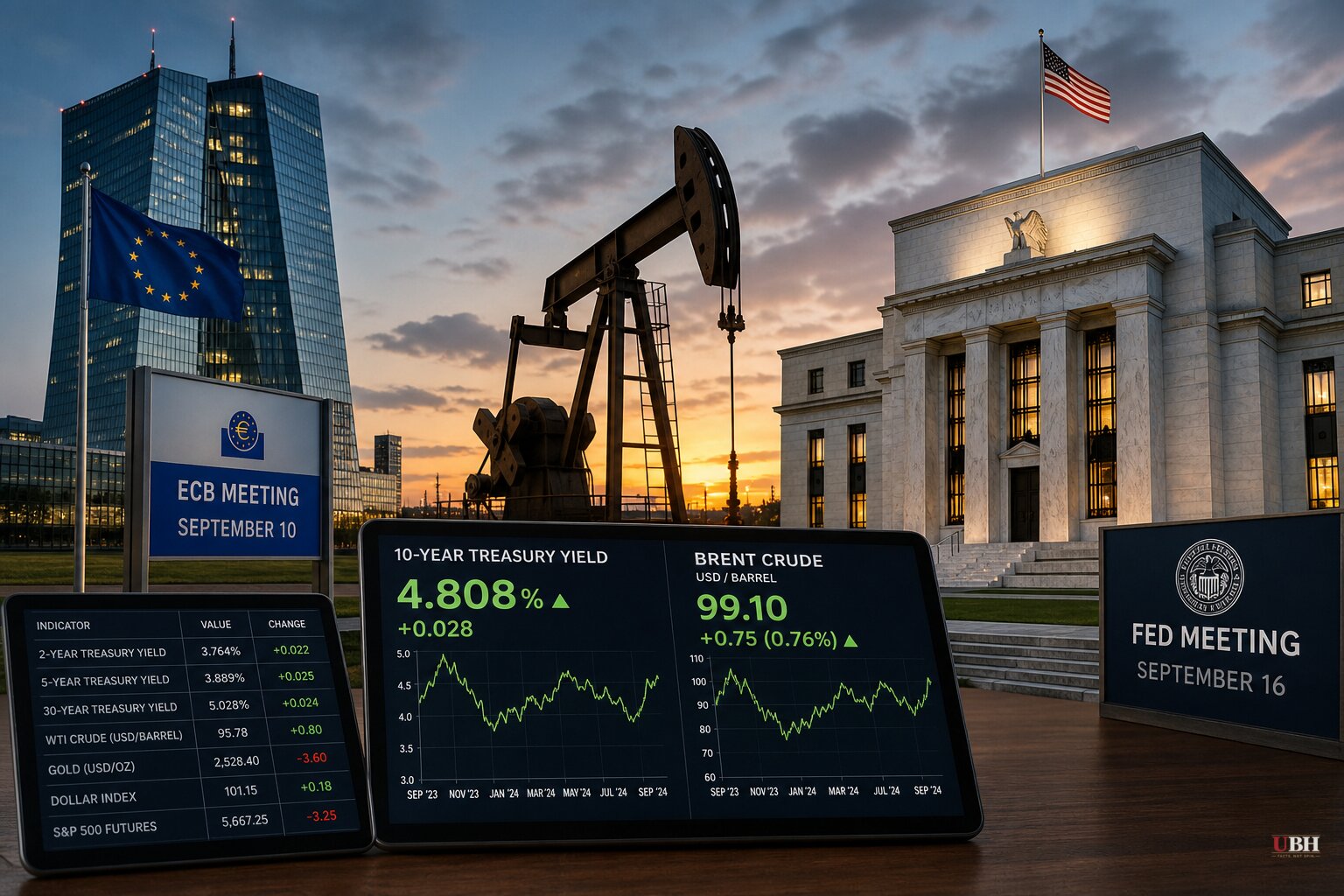
Yields near three-year highs, oil near $100, and nobody agrees on why
The 10-year US Treasury yield rose 2.4 basis points to 4.808% in early European trading on Tuesday, September 8, according to Crypto Briefing. Brent crude climbed 2.2% to $99.10 a barrel the same day, closing in on the $100 mark that tends to rattle central bankers. The dollar, meanwhile, weakened even as yields rose, a divergence that normally doesn't happen.
Three weeks ago, on August 18, Future Standard chief market strategist Troy Gayeski told Fox Business's "Mornings with Maria" that the Federal Reserve would likely hold rates steady, letting bond market tightening compress equity multiples from 23.2 down to 20 on its own. That was the going view. Federal Reserve Chairman Kevin Warsh delivered hawkish remarks at the Jackson Hole economic symposium in late August that shifted market expectations, according to PhileNews. By August 31, when G20 finance ministers and central bank governors gathered in Asheville, North Carolina, the 10-year yield had climbed to 4.77%, up from 4.71% the prior close, according to the Epoch Times. The 20- and 30-year yields topped 5.26%.
Treasury Secretary Scott Bessent used the G20 platform to insist the bond market was fine. "The U.S. bond market is the most resilient in the world," he told CNBC's Sara Eisen, adding that the Treasury planned to double its pace of long-bond buybacks in September to keep pressure off long-dated yields. Warsh, in his own remarks, called it a period of "secular growth" driven by a "global investment surge" in data centers, semiconductors and AI infrastructure.
The Iran factor
In the days following the G20 meeting, the US and Iran exchanged fresh strikes, according to Morningstar. West Texas Intermediate crude jumped as much as 10% to above $90 a barrel on fears the Strait of Hormuz, the channel carrying roughly a fifth of global oil supply, could stay closed longer, PhileNews reported. Brent, tracked separately, hovered near $95 by September 2.
President Trump added to the uncertainty with a Truth Social post saying he "couldn't care less" whether Tehran signs an agreement to reopen the strait, per Morningstar's reporting. The 10-year yield spiked intraday to 4.904%, its highest in nearly three years, before settling back to 4.783% that same day. Futures markets priced a 63% probability of a September rate hike, according to LSEG data cited by Morningstar.
The damage spread globally. German Bund yields hit their highest levels since 2011. UK gilt yields reached highs not seen since 2007. Asian markets sold off hard, with South Korea's Kospi sliding 4% and chipmakers Samsung and SK Hynix dropping 4% and 4.6%. Gold fell to $4,383.60, a three-week low, and Bitcoin slipped to $76,794.83 as rate-hike bets reduced the appeal of non-yielding assets.
CNN's coverage of the same stretch flagged the 10-year yield crossing 4.81%, its highest since November 2023, surpassing the previous peak set in January 2025. Baird Strategas fixed income research head Tom Tzitzouris told CNN the pain is more acute for tech firms that have leaned on debt to fund AI infrastructure buildouts. Miller Tabak + Co chief market strategist Matt Maley wrote that markets can shrug off rising yields "for many months" but eventually can't.
A competing read on the same numbers
Not everyone agrees the yield spike is bad news or even about inflation fear. Breitbart's Business Digest argued the rise is driven mostly by real yields, the compensation investors demand for locking up money versus other opportunities, not inflation expectations. Breitbart pointed to the breakeven rate, the gap between ordinary and inflation-protected Treasuries, sitting at roughly 2.34%, just 9 basis points higher than at the start of the year and 5 basis points below where it stood a year ago. That's broadly consistent with the Fed's 2% inflation target once you account for the usual CPI-to-PCE gap.
Rising real yields reflect a stronger economic outlook, not panic over debt or inflation, according to Breitbart, which argued financial press narratives framing the move as ominous reflect pessimism rather than the data itself, citing an Economist/YouGov poll in which just 34% of self-identified liberals said the American Dream is still alive, versus 77% of conservatives and 63% of moderates. Other outlets in this cycle, including CNN, Morningstar and PhileNews, explicitly tied the yield climb to inflation nerves, oil supply fears and deficit concerns rather than economic optimism. Both readings rely on the same yield data. They disagree on what's driving it, and the sourcing here doesn't resolve which explanation dominates.
What's next
The European Central Bank is scheduled to vote September 10 and is widely expected to raise its deposit rate 25 basis points to 2.50%, per Crypto Briefing. The Fed's own decision follows September 16, with futures now pricing a 59% probability of a hike, down slightly from the 63% reading in early September but still a meaningful shift from the "Fed holds" consensus of mid-August.
The Cleveland Fed's early nowcast estimated August headline inflation could hold near 3.4% annually, according to the Epoch Times, a figure that will matter enormously once the official Bureau of Labor Statistics report lands. Whether Brent actually breaks $100, whether the CPI print comes in hot, and whether the ECB's move on the 10th spills into US markets will decide whether the Fed hikes on the 16th or holds, and whether the S&P 500, which has historically wobbled once the 10-year clears 4.5%, treats that decision as a relief or a shock.
Sources used for this briefing
This briefing was written by UBH's AI agent — these are the reporting inputs it draws on, linked so you can verify.


