
Unbiased headlines. Facts, not spin.
Unbiased Headlines is an independently owned news organization. We bring you the facts, not opinions, written fresh from 110+ named sources. Sources linked so you can verify it yourself.
 finance
Major Story (7/10)
Event date: September 3, 2026 ·
finance
Major Story (7/10)
Event date: September 3, 2026 ·
Japan's 30-Year Bond Auction Cools Again as Takaichi's Record Budget Requests Push Yields Higher
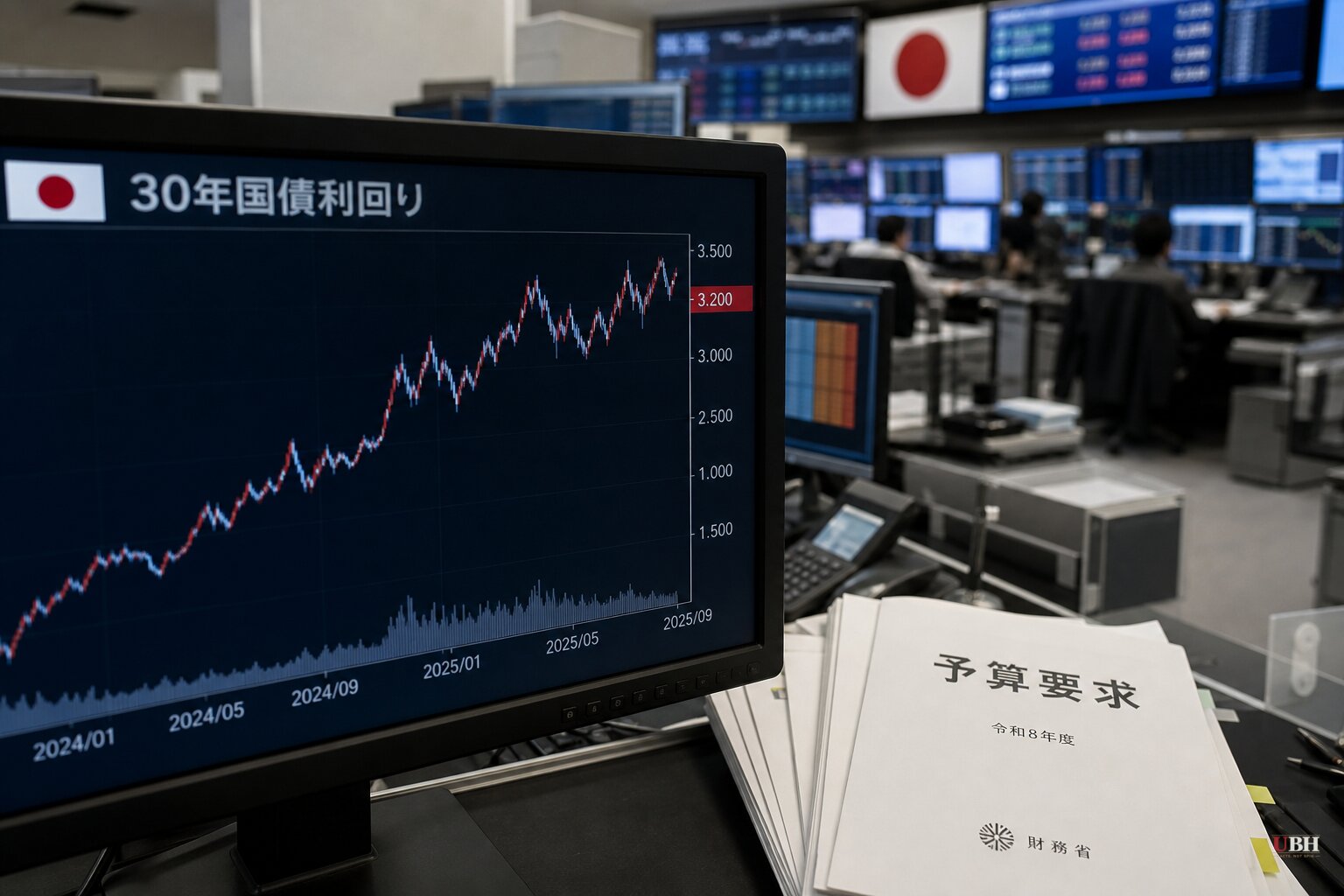
Since Japan's five-year bond auction drew the weakest demand since February back on June 22, the pressure on Tokyo's debt market has not let up. The latest data point landed September 3, when Japan's Ministry of Finance auctioned 30-year government bonds and got a bid-to-cover ratio of 3.79, down from 3.86 at the prior sale, according to Nikkei QUICK News as reported by BigGo Finance.
The ratio still beat the 12-month average of 3.52, and market participants described the result as "not extremely weak, but lacking momentum," per BigGo Finance's reporting. But the details underneath tell a more pointed story: the lowest accepted price came in at ¥98.65, below the ¥98.75-98.95 range Nikkei QUICK News had forecast, and the spread between average and lowest accepted price widened to 0.28 from 0.21, a sign fewer buyers were willing to pay up.
Japan's government ministries have submitted record-scale budget requests for fiscal 2027, and investors are increasingly demanding higher yields to compensate for holding longer-dated debt as Prime Minister Sanae Takaichi's expansionary fiscal management draws scrutiny, BigGo Finance reported. More government spending means more bond supply, and more supply competing for the same pool of buyers pushes yields up regardless of what the Bank of Japan does next.
Supporters of Takaichi's approach would argue Japan needs to spend to stimulate growth after decades of stagnation and rising regional security costs. Critics counter that piling more debt onto an economy that already carries one of the largest debt loads relative to GDP of any developed nation is not a free lunch. Someone has to buy that debt, and buyers are now charging more for the privilege. Neither side has settled the argument. The auction results are simply the market's real-time verdict on how much that argument is worth in yield.
Japanese money is flowing in new directions. Official data show Japanese investors sold a net 3 trillion yen, roughly $18.7 billion, in overseas debt through August 22, the biggest year-to-date outflow since 2022, according to BusinessWorld Online. With Japan's 10-year yield breaking through the 3% threshold for the first time in three decades, domestic bonds are starting to look competitive against foreign holdings for the first time in a generation.
"It's easy to buy the 10-year at above 3%," Toshinobu Chiba, a fund manager at Simplex Asset Management, told BusinessWorld Online. "Most of the lifers have a strong incentive to buy right now." A J.P. Morgan Asset Management survey of 82 corporate Japanese pension funds released the same week found the net share planning to boost domestic bond holdings was the highest since the poll began in 2008, per BusinessWorld Online.
Japan is one of the largest holders of foreign sovereign debt in the world, with roughly $2.4 trillion in overseas bond holdings, and has long been a reliable buyer of US Treasuries and other developed-market debt, BusinessWorld Online reported. If Japanese capital keeps rotating home, that removes a steady source of demand for US and European bonds at the exact moment those markets are already under strain.
The US side of that strain is real. The 30-year Treasury yield hit 5.34% in early August, its highest level since 2007, before easing slightly, CNN reported. The US Treasury Department responded by announcing it will double the size of its long-end debt buybacks to $4 billion starting September 9, focused on 10-to-30-year bonds, according to The Epoch Times. Yields fell modestly on the news, with the 10-year dropping below 4.7% and the 30-year easing to roughly 5.2%.
Lawrence Gillum, chief fixed income strategist at LPL Financial, called the buyback move "more of a band-aid than a panacea," telling The Epoch Times the operation isn't large enough to meaningfully move yields on its own. Ipek Ozkardeskaya, senior analyst at Swissquote Bank, put the dilemma more bluntly: "Something must give: either yields will come lower... or stock valuations will readjust."
Japan's Ministry of Finance is scheduled to meet with JGB market special participants later this month to discuss the auction results and fiscal outlook, BigGo Finance reported. The Bank of Japan's next policy meeting will test whether yen weakness and creeping inflation force the central bank to act faster than markets currently expect. Every auction result out of Tokyo is being read as a referendum on how much more debt the world's bond buyers are willing to absorb before they demand a bigger discount.
Sources used for this briefing
7 links from 6 independent newsrooms (syndicated copies of the same report count once)
These are the sources it draws on, linked so you can verify.


