
Unbiased headlines. Facts, not spin.
Unbiased Headlines is an independently owned news organization. We bring you the facts, not opinions, written fresh from 110+ named sources. Sources linked so you can verify it yourself.
 finance
Major Story (7/10)
Event date: June 1, 2026 ·
finance
Major Story (7/10)
Event date: June 1, 2026 ·
Anthropic Locks In $15 Billion Credit Line as IPO Marketing Slips to Mid-October, Valuation Talk Hits $2 Trillion
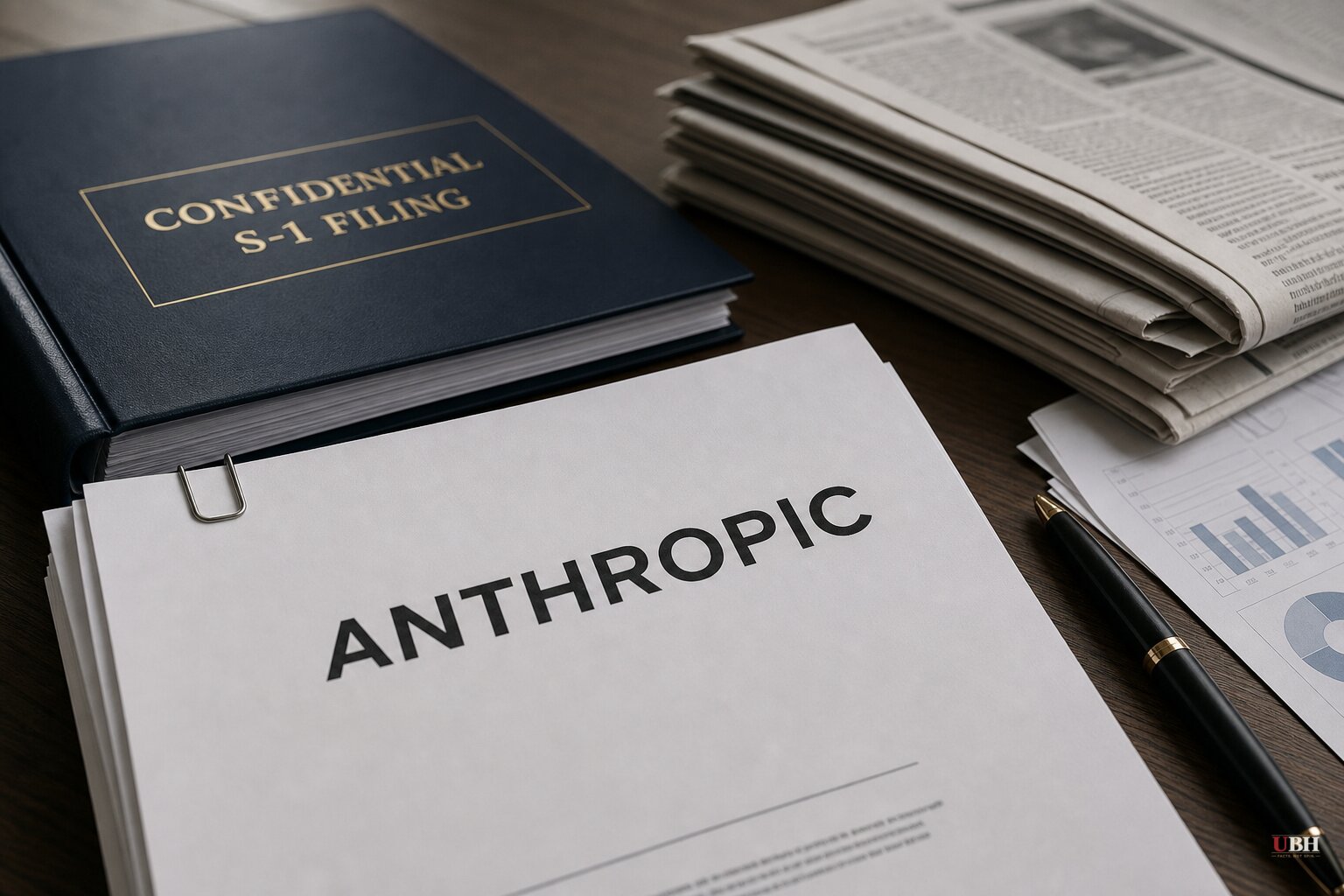
Anthropic filed its confidential S-1 with the SEC on June 1, 2026. Since then the company has moved from private funding milestones to the mechanics of an actual public listing, and the numbers keep getting bigger.
The credit facility is done, and it's bigger than planned
Anthropic set out to raise roughly $10 billion in a pre-IPO revolving credit facility. It landed at $15 billion, according to Bloomberg News as reported by Outlook Business. That's six times the $2.5 billion five-year revolving line the company secured last year.
Morgan Stanley is leading the deal, with Goldman Sachs, JPMorgan Chase and Citigroup in prominent roles, per Bloomberg. The actual lender group is far larger than the four-bank picture Crypto Briefing described. Bloomberg's reporting, relayed by Outlook Business, lists Barclays and Wells Fargo in key roles, plus Bank of America, Deutsche Bank, Royal Bank of Canada, UBS, Bank of Montreal, BNP Paribas, Credit Agricole, Mizuho, Mitsubishi UFJ, Sumitomo Mitsui and Toronto-Dominion as participants. Dealroom separately confirmed the $15 billion figure and put it in the 99th percentile of all-time debt rounds for U.S. deep tech companies, based on a sample of 1,927 comparable deals.
That facility is separate from the roughly $35 to $36 billion structured notes package Apollo Global Management and Blackstone finalized to fund Anthropic's chip procurement, which received mid-investment-grade ratings with Broadcom backing it. Between the two, Anthropic now has something like $50 billion in debt infrastructure sitting under a company that hasn't gone public yet.
The IPO timeline just moved, and the price tag moved with it
Reuters reported that Anthropic's IPO marketing is now expected to begin in mid-October at the earliest, a shift from earlier expectations that the prospectus could go public as soon as the first week of September. The prospectus itself is now more likely to file in late September, per Reuters, though the timeline remains subject to change.
That pushes a potential stock market debut to land days before the November midterm elections. Investor expectations cited by Reuters put a potential valuation as high as $2 trillion. That's more than double the $965 billion post-money valuation Anthropic locked in with its $65 billion Series H round in late May 2026.
The company's revenue growth is the case Anthropic is making for that number. Anthropic is on track for annualized revenue exceeding $65 billion, according to Bloomberg, up more than sevenfold from where it stood at the end of 2025.
The circular financing question hanging over the credit ratings
Anthropic signed a $35 billion cloud compute deal in which it rents GPU capacity from Lambda, an Nvidia-backed cloud provider, according to the Wall Street Journal as reported by 24/7 Wall St. Nvidia supplies the chips, holds an equity stake in Lambda, and holds the lease on the 700 megawatt Texas data center campus where the compute lives. That follows a separate $45 billion deal Anthropic signed in August with EnCore, another Nvidia-backed cloud provider.
Nvidia CFO Colette Kress addressed the structure directly on the company's Q2 FY27 earnings call: "We recognize the scale of this support, and we know some will call this circular financing. We see it differently," arguing the compute is "fungible and durable" and can be redeployed to other customers. Nvidia's own balance sheet carried $279 billion in supply obligations and $108.5 billion in guarantee obligations for AI cloud and data center partners as of that quarter.
The concern critics raise is that when the chip supplier is also backing the cloud tenant and holding the real estate lease, a credit rating built on that revenue stream may be measuring something closer to a closed loop than an independent business. This is a structural feature the rating agencies and the Apollo-Blackstone notes have to price in.
The bigger picture: Big Tech's debt binge
This isn't happening in isolation. Corporate bond issuance by hyperscalers, including Amazon, Meta, Alphabet and Microsoft, jumped from $16.7 billion in 2024 to roughly $220 billion by August 10, 2026, according to LSEG data cited by disruptionbanking. Goldman Sachs estimates debt will cover 33% of AI capital expenditure this year, rising to 35% in 2027. Nomura estimates that borrowing by the largest tech companies now equals about 25% of the Treasury's net issuance of notes and bonds to private investors, five times its share in 2025.
S&P Global analysts have also noted hyperscaler bond spreads widening, a sign that investor demand for this debt may be softening even as the volume keeps climbing.
The political groundwork
Separately, OpenAI has been building out its own state-level lobbying operation ahead of its own confidential S-1, filed June 8. Axios reported OpenAI hired Jessica Schumer, daughter of Senate Democrat Chuck Schumer, to lead Northeast policy and partnerships, alongside Caulder Harvill-Childs for the Southeast and Thomas MacLellan for state cyber policy. OpenAI's top lobbyist, Chris Lehane, has described the strategy as "reverse federalism," using large states to set de facto national AI rules that Congress hasn't passed.
Neither Anthropic nor OpenAI has filed a public prospectus as of this writing. The next concrete marker is late September, when Anthropic's S-1 is expected to become public, followed by the mid-October marketing window Reuters described. Whether the $2 trillion valuation chatter survives contact with public market scrutiny, and whether rating agencies revisit the circular-financing structures once real investors are pricing the stock daily, remains an open question.
Sources used for this briefing
7 links from 6 independent newsrooms (syndicated copies of the same report count once)
These are the sources it draws on, linked so you can verify.


