
Unbiased headlines. Facts, not spin.
Unbiased Headlines is an independently owned news organization. We bring you the facts, not opinions, written fresh from 110+ named sources. Sources linked so you can verify it yourself.
 finance
Notable (6/10)
Event date: August 27, 2026 ·
finance
Notable (6/10)
Event date: August 27, 2026 ·
Chainalysis Estimates $457 Billion in Crypto Activity Went Largely Untaxed in 2025, New Global Rules Cover Just 14%
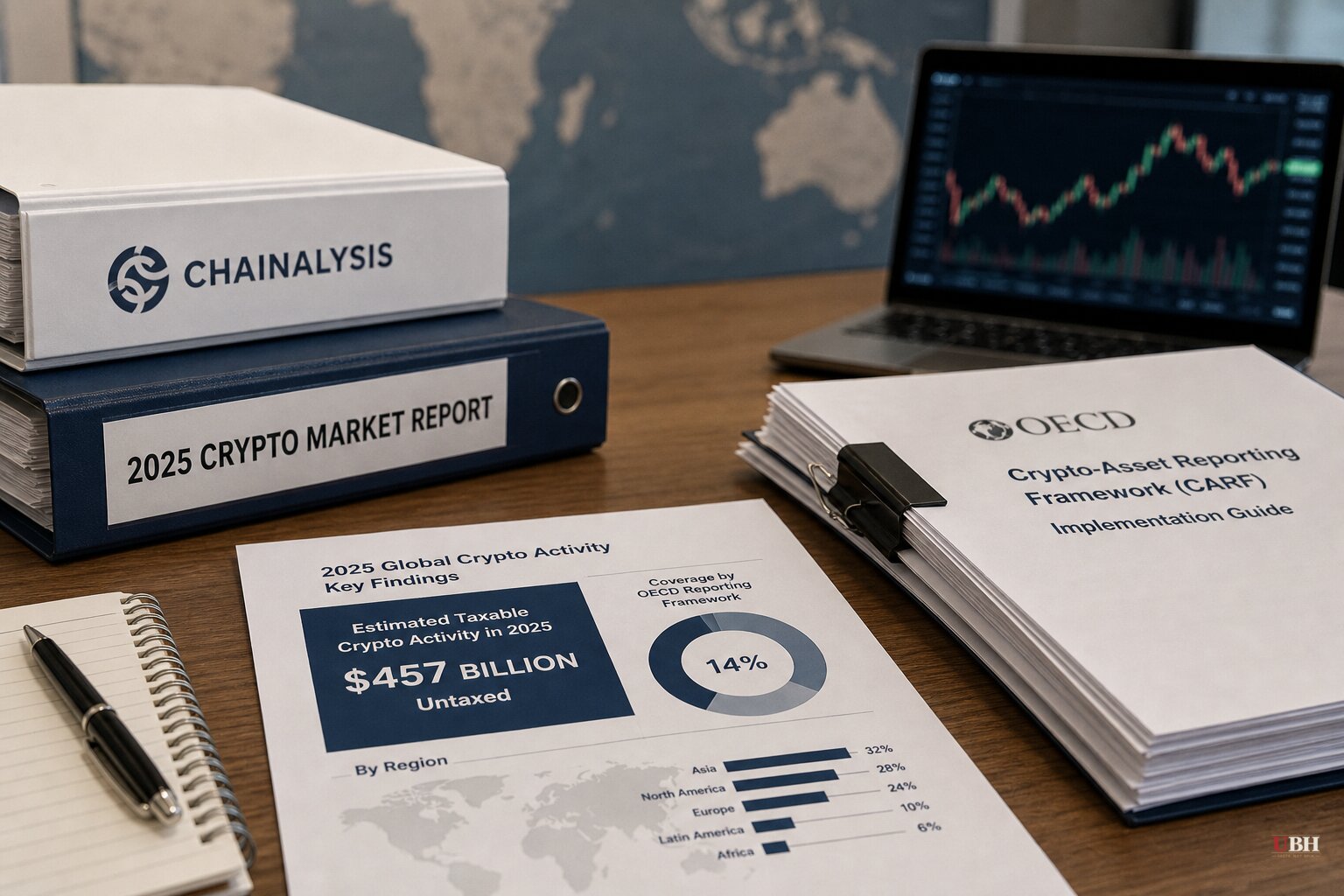
Chainalysis, the blockchain analytics firm that sells tracking tools to governments and exchanges, estimates that crypto generated more than $457 billion in potentially taxable activity worldwide in 2025. Most of that money, by the firm's own accounting, sits well outside the reach of the tax rules governments are currently building.
The company's report, cited by CoinMarketCap and CryptoRank, breaks the $457 billion into three buckets: realized gains from exchanges, income from mining, staking, lending, and gambling, and crypto-denominated payments. North America leads with $134.6 billion, the European Union follows with $125.1 billion, and East Asia comes in at $54.7 billion, according to Chainalysis.
The United States alone accounts for $112.6 billion in taxable on-chain activity, per Chainalysis figures cited by KuCoin and Airdrops.com. China, where onshore crypto trading is banned, shows just $21 billion, according to Bitcoin.com News' reporting on the same data. The firm notes that the ban makes Chinese activity especially hard to track since it often moves offshore.
France Is the Clearest Case Study
Nowhere is the compliance gap more visible than in France. Chainalysis estimates the country's taxable crypto activity reached $9.4 billion in 2025: $2.5 billion in capital gains, $1.7 billion in mining and staking income, and $5.2 billion in payments, according to Crypto Briefing and WEEX.
What French taxpayers actually reported doesn't come close. For the 2024 income year, just 24,000 individuals declared a combined €368 million in net gains. The year before that, roughly 7,700 taxpayers reported €150.8 million, according to Crypto Briefing.
François Volpoet, Director of Chainalysis France, cited these numbers as evidence of a systemic underreporting problem. France currently taxes net capital gains from digital asset sales at a flat 31.4%, with a small exemption for total disposals under €305 in a year.
WEEX, citing French outlet Cryptoast, added a complication worth taking seriously: a security incident exposed the data of 678,000 French taxpayers, which the outlet said could deepen public reluctance to voluntarily report crypto holdings to the same tax administration. That's a legitimate concern for anyone asked to hand over more financial data to an agency that has already had a breach on its watch, and it's the kind of trust problem no reporting framework fixes by itself.
CARF Covers 14%. That's the Whole Story.
The OECD's Crypto-Asset Reporting Framework (CARF) is the mechanism supposed to close this gap. At least 46 countries have committed to implementing it starting in 2027, with 29 more joining in 2028 and the United States following in 2029, according to Bitcoin.com News.
But Chainalysis's own analysis, reported by CryptoRank and Bitcoin.com News, puts CARF's practical coverage at just 14% of the $457 billion total. The remaining 86%, according to Chainalysis, includes decentralized exchange activity, peer-to-peer transfers, self-custody wallets, mining and staking income, and many goods-and-services payments that never touch a regulated intermediary.
The framework's design is the problem. CARF and the EU's parallel DAC8 directive both rely on centralized exchanges and brokers that already know their customers through KYC checks. In the EU, DAC8 takes effect January 1, 2026, requiring crypto service providers to collect detailed user and transaction data, with the first international data exchanges scheduled for September 30, 2027, according to Crypto Briefing. Anyone who moves money through a self-custody wallet or a decentralized protocol stays invisible to both systems.
Even where CARF does apply, Chainalysis noted, exchanges often lack cost-basis data for assets bought elsewhere, making it hard for tax agencies to calculate actual gains rather than just gross proceeds. CoinMarketCap's coverage of the report echoed this point.
The Compliance-Cost Angle Cuts Both Ways
A separate industry estimate cited by OneBullex found average compliance budgets for small and mid-sized crypto firms rose 28% in 2025, to $620,000 annually. That's the flip side of tighter reporting rules: new mandates raise costs for legitimate businesses long before they catch the activity actually escaping the tax net.
Divly's 2026 Global Crypto Taxation Report, also cited by OneBullex, found just 1.76% of crypto owners worldwide declare their holdings for tax purposes. A separate Chainalysis figure cited by CryptoRank put U.S. reporting compliance at roughly 54%, still far from full compliance but notably better than the global average.
Chainalysis is a company that sells blockchain-tracking and compliance software to the same governments this report is aimed at. CoinMarketCap flagged that its findings align with the firm's own compliance business, and OneBullex noted the figures are proprietary estimates, not official government statistics, and should be treated as methodology-dependent rather than an audited fact. That doesn't make the underlying gap between $9.4 billion in French crypto activity and €368 million in reported gains untrue, but it's a reason to treat the precise 90%-plus non-compliance figure as an estimate from an interested party rather than a government-verified statistic.
The open question is whether CARF and DAC8, once they're both fully phased in by 2029, actually move the needle beyond that 14% ceiling, or whether decentralized finance and self-custody wallets keep growing faster than the reporting infrastructure built to catch them.
Sources used for this briefing
7 links from 7 independent newsrooms (syndicated copies of the same report count once)
These are the sources it draws on, linked so you can verify.


