
Original briefings. Zero spin.
Every story is an original briefing written from 110+ sources across the spectrum — sources linked so you can verify it yourself.
 finance
Notable (6/10)
Event date: September 3, 2026
finance
Notable (6/10)
Event date: September 3, 2026
Japan's 10-Year Bond Yield Hits Highest Level Since 1996 as Yen Surge Raises Bitcoin Carry-Trade Risk
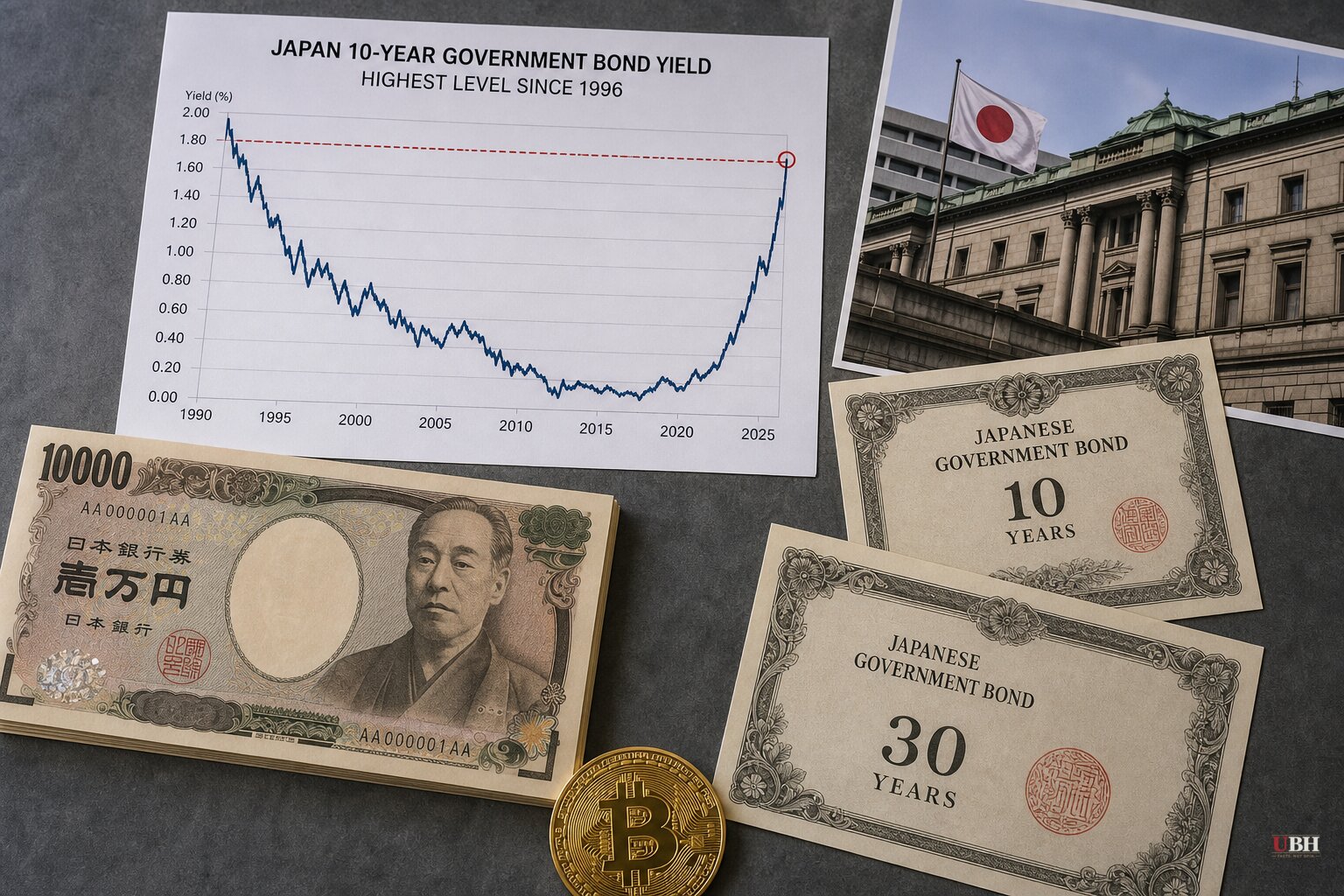
Japan's 10-year government bond yield climbed to 3% on Monday, September 7, the highest level since 1996, according to Crypto Briefing. The 30-year JGB yield pushed even higher, approaching 4.18% to 4.205%, near record territory.
At the same time, the yen has staged a sharp comeback. The dollar peaked at 163.9 yen on July 29 before Tokyo and Washington launched a coordinated intervention, according to WEEX, citing remarks from U.S. Treasury Secretary Scott Bessent, who said he would not hesitate to join further joint action if currency moves turn disorderly. The dollar fell to around 156.5 yen that day and kept sliding. By Monday, September 7, USD/JPY hit 154, its lowest level since February, WEEX reported. Crypto Briefing put the combined U.S.-Japan intervention effort at roughly $96 billion.
Why the Yen Move Matters for Bitcoin
The Bank of Japan's policy rate sits at 1%, the highest since 1995, following a June 2026 hike. Its next meeting is scheduled for September 17-18. Takuji Aida, economic advisor to Prime Minister Sanae Takaichi and chief economist at Crédit Agricole, told reporters Monday, per remarks WEEX cited from Reuters, that the BOJ will likely hike again at that meeting and then roughly every three months through January 2027, before slowing to twice a year. Aida himself warned the pace could weigh on Japan's economy.
There's a political wrinkle here. Takaichi has pushed an accommodative agenda, including a two-year, credit-financed suspension of Japan's 8% food tax set for debate in an extraordinary parliamentary session in October. Her own economic advisor is now betting on the opposite: monetary tightening. WEEX flagged the contradiction directly.
The mechanism worrying crypto traders is the yen carry trade, estimated at up to $500 billion in size, according to Crypto Briefing. For years, traders borrowed cheaply in yen to fund bets on stocks, bonds, and crypto elsewhere. When the yen strengthens, those dollar-denominated debts get more expensive to repay. When Japanese yields rise at the same time, the cost of holding the trade climbs from both directions.
KuCoin's market analysis noted the dollar index has actually fallen 0.4% to 99.22 as the yen rallies, testing its 200-day moving average, a level widely watched by traders. A break below that line could trigger broader dollar selling, which historically supports Bitcoin and gold. That's part of why Bitcoin and gold have both ticked higher even as the yen strengthens, a dynamic KuCoin called counterintuitive given the "risk-off" reputation yen rallies usually carry.
But the precedent cuts the other way too. During the August 2024 yen carry unwind, Bitcoin fell roughly 20% within days before recovering, according to KuCoin and Crypto Briefing. A repeat drawdown of that size from current levels would put Bitcoin near $62,000, back to late-2024 territory, Crypto Briefing calculated.
Bitcoin's Price Remains Choppy
Bitcoin was trading between roughly $77,900 and $79,300 as of Tuesday, according to KuCoin and Mitrade's market data, down about 1% on the day per Mitrade's ticker. That represents a notable gap from a separate Cointelegraph report, relayed through Crypto News, that Bitcoin logged its first weekly close above $80,000 since early May, alongside a "buy" signal from its supertrend indicator not seen since late 2025. The data points to a market bouncing around the $80,000 line rather than clearing it decisively.
Analysts remain split on where this goes next. Mitrade's market page cited Ben Cowen putting the odds of an extended bear market at 65%, with a target near $53,000, while a separate item cited two unnamed analysts arguing the bottom is already in. Neither claim is independently verified here; they reflect genuine disagreement among chart-watchers right now.
The Bigger Macro Backdrop
Crypto markets aren't just watching Tokyo. The Fed's own inflation data lands this week, with the August Producer Price Index due Thursday and the Consumer Price Index due Friday, ahead of the Fed's September 16 rate decision, according to Crypto News. Fed Chair Kevin Warsh told the Jackson Hole symposium in late August that even better-than-expected inflation readings don't yet show underlying trends have meaningfully improved. CME Group's FedWatch Tool showed 58.4% odds of a 0.25% rate hike as of the most recent data cited by Crypto News, a shift driven partly by a stronger-than-expected August jobs report of 162,000 new positions against a prior estimate of just 56,000.
Writing in the Epoch Times, Jeffrey Tucker argued the bond market's message extends well beyond Japan, pointing to U.S. debt service costs that crossed $1 trillion in late 2023 and have kept climbing to new highs through 2025-2026. Tucker cited forecasts suggesting debt service could devour 100 percent of federal revenue by 2052, though he noted that projection rests on what he called "very modest assumptions" and is not a government forecast. It underscores why traders are treating rising yields everywhere, not just in Tokyo, as a signal worth watching.
The next concrete date is September 16, when the Fed announces its rate decision, followed by the Bank of Japan on September 17-18. Whether Bitcoin holds near $78,000, breaks above $80,000 for good, or slides toward the $62,000 level Crypto Briefing modeled depends heavily on which central bank surprises markets first.
Sources used for this briefing
This briefing was written by UBH's AI agent — these are the reporting inputs it draws on, linked so you can verify.


