
Unbiased headlines. Facts, not spin.
Unbiased Headlines is an independently owned news organization. We bring you the facts, not opinions, written fresh from 110+ named sources. Sources linked so you can verify it yourself.
 health
Notable (5/10)
Event date: November 3, 2026 ·
Evaxion Reports 75% Response Rate for AI-Designed Melanoma Vaccine in 16-Patient Trial
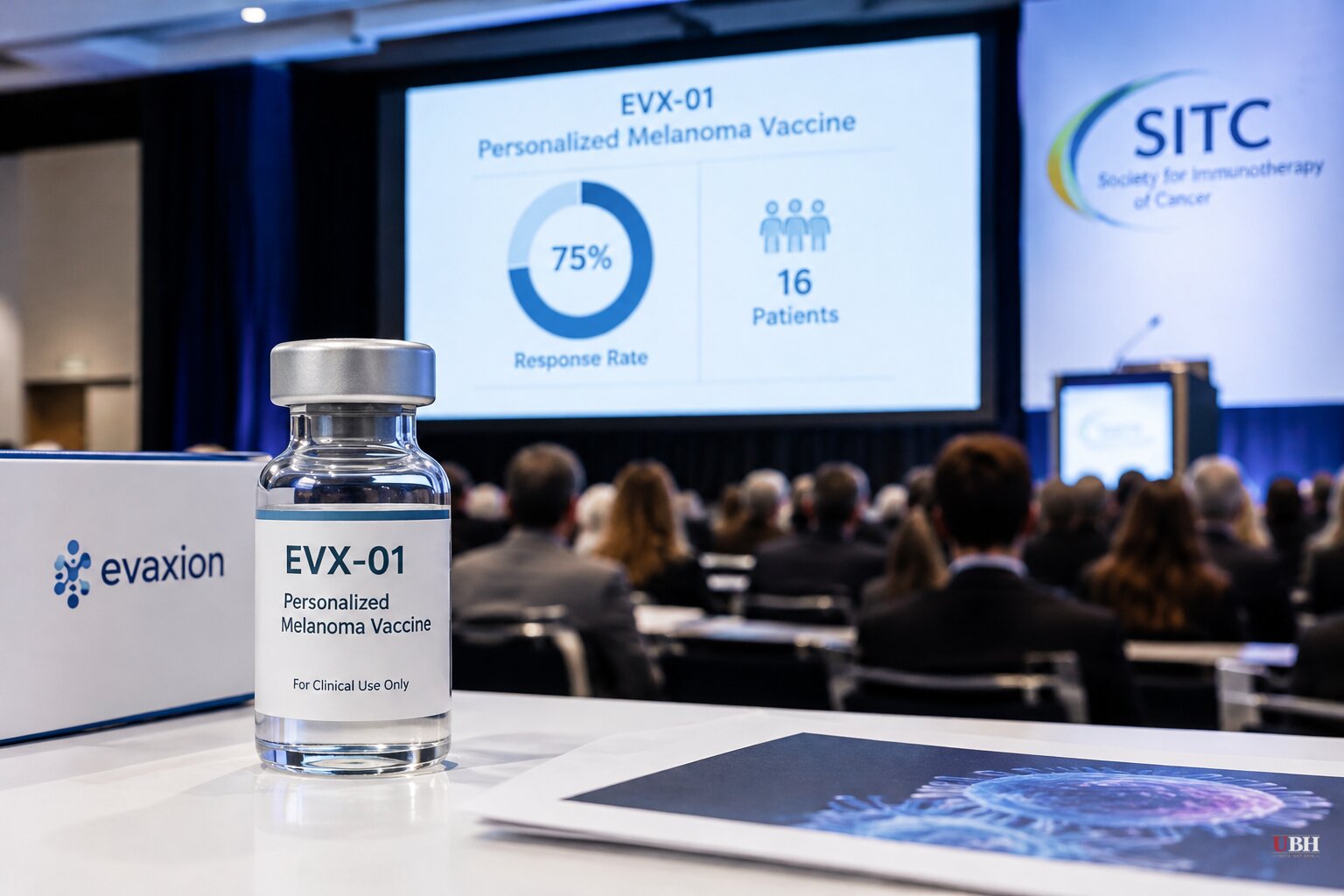
Danish biotech Evaxion A/S (NASDAQ: EVAX) put new data on its personalized melanoma vaccine in front of researchers on Friday, Nov. 6, at the Society for Immunotherapy of Cancer's annual meeting in Phoenix. Senior scientist Mads Lausen presented the oral session. Two poster sessions follow today, Saturday, Nov. 7, at 12:30 p.m. and 6:40 p.m. Mountain Time.
The vaccine is called EVX-01. Each dose is built for one patient, with targets picked by Evaxion's AI-Immunology platform, and it is given alongside Merck's pembrolizumab (Keytruda).
What the trial showed
The phase 2 study (NCT05309421) was open-label and single-arm. It enrolled 16 patients with stage IV or unresectable stage III melanoma who had not previously received checkpoint inhibitor therapy.
Twelve of the 16 had an objective response, a 75% rate. Four patients (25%) had complete responses and eight (50%) had partial responses. One patient had stable disease. Three (19%) had progressive disease as their best response. Responses were assessed under RECIST 1.1 criteria and confirmed on follow-up scans.
Evaxion says clinical and T-cell responses held at three-year follow-up. That longer-term data was first presented at the European Society for Medical Oncology congress in October.
The patient group skewed toward advanced disease. About 87.5% had stage IV melanoma and 12.5% had unresectable stage IIIB. Sixty-nine percent were male, 56% were 65 or older, and 94% had an ECOG performance status of 0, meaning fully active. Half had BRAF-positive tumors.
The immune data
The new presentation focuses on why the vaccine appears to work. Of 118 vaccine neoantigens tested, 89% induced a T-cell response, according to the presentation.
"We showed that EVX-01 induced sustained neoantigen T-cell responses with enrichment of effector memory T cells," Lausen said. "Altogether, these data support the potential of EVX-01 as a cancer vaccine against advanced melanoma."
Evaxion also reported that vaccine-induced T-cells were detectable directly ex vivo, which the company calls evidence of the size of the response. Those responses were dominated by CD4+ T-cells. CD8+ responses showed up in half of patients.
The company reported a statistically significant association (p<0.001) between the AI platform's predictions and the T-cell responses actually seen. Birgitte Rønø, Evaxion's chief scientific officer and COO, said the data "validates our AI-Immunology platform further."
The dosing schedule
Patients received pembrolizumab at 400 mg intravenously every six weeks starting at week 0, while their vaccines were manufactured. Six priming doses of EVX-01 went in every two weeks from week 12 through week 22. Four boosters followed at weeks 30, 42, 54 and 78.
Patients were followed for two years in the main phase. Six then continued on EVX-01 alone in a one-year extension, with additional doses at weeks 115 and 139. The trial ended at week 151.
What 16 patients can and cannot say
The 75% figure is a company-reported result from a trial with no comparison arm. Tech Times, which covered the presentation, put pembrolizumab's historical response rate in first-line metastatic melanoma at 33% to 45%. Comparing a 16-patient single-arm study against rates from other, larger trials is a rough guide at best. Each patient added or removed moves the percentage by more than six points.
That is the nature of phase 2 work. It tells a company whether to spend the money on a bigger, randomized study. It does not tell a doctor or a patient that the combination beats Keytruda alone.
The broader field is watching personalized vaccines closely. At the same SITC meeting, Dr. Catherine J. Wu of Dana-Farber Cancer Institute is delivering the Smalley Award Lecture, titled "Getting Off the Rollercoaster: Personalized Cancer Vaccines Come of Age."
Stock and funding
EVAX is a small-cap stock. BioPharma Watch's catalyst tracking lists a $2.92 close on Nov. 2, before Evaxion announced its SITC schedule on Nov. 3. By the same tracker's figures, the stock closed 1.4% above that baseline on the day of the announcement, 1.7% higher the next day and 2.7% higher after three days. The tracker notes that other EVAX headlines fell in the same window, so the move may not be attributable to any single item.
Evaxion has said openly why it is in Phoenix. Rønø said the company is looking forward to sharing the data "with both scientific stakeholders and potential business partners." A small biotech with an early-stage asset generally needs a larger partner or fresh capital to fund a pivotal trial. Evaxion has not announced either.
What comes after the poster sessions is not yet clear. Evaxion has not said whether it will run a randomized trial of EVX-01 against pembrolizumab alone, and it has not named a partner.
Sources used for this briefing
8 links from 8 independent newsrooms (syndicated copies of the same report count once)
These are the sources it draws on, linked so you can verify.


