
Unbiased headlines. Facts, not spin.
Every story is an unbiased news briefing written from 110+ sources across the spectrum — sources linked so you can verify it yourself.
 health
Notable (6/10)
July 10, 2026 at 04:05 PM
health
Notable (6/10)
July 10, 2026 at 04:05 PM
Europe's Third Heatwave of 2026 Breaks Records as Marine Heat Waves, Species Loss, and Deep-Sea Mining Risks Stack Up
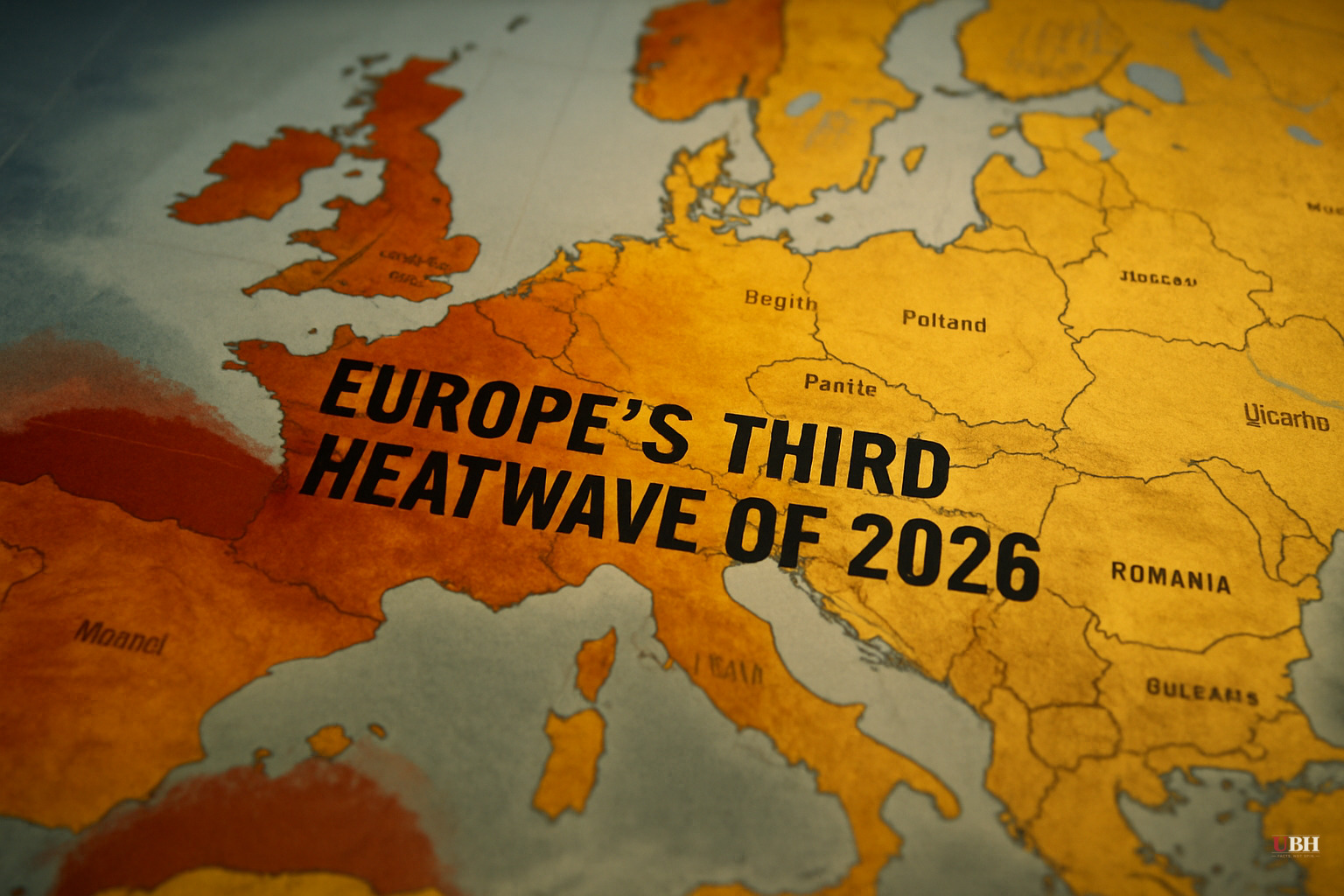
Europe Can't Catch a Break
The United Kingdom is enduring its third heatwave of the year. According to the BBC, a heat dome has descended on the U.S. as well, making this a simultaneous multi-continent event, not a regional anomaly.
The Guardian reports that western Europe recorded its hottest-ever June, with temperatures in France, Britain, and Spain smashing historical records. The NYT's Raymond Zhong noted that temperatures in some areas are beginning to soar again after a brief reprieve.
Britain's Met Office, the UK's national weather service, has declared a "severe" marine heat wave in adjacent waters, according to the NYT's Jonathan Wolfe. Higher sea surface temperatures are a direct downstream effect of the scorching air temperatures that have hammered the continent all summer.
Whales and Wildlife Taking the Hit
Pacific gray whales are in trouble. The Guardian reports the species is facing what researchers are calling a "catastrophic" die-off driven by climate-linked disruptions to its food supply. Conservationists are pushing the Trump administration to relist the species under the Endangered Species Act, describing the situation as "very, very serious."
Fewer than 100 Rice's whales remain alive anywhere on Earth. The NYT's Katherine Chui and Catrin Einhorn report that researchers have identified sonic blasts from oil exploration as a top threat to the species, a collision between energy extraction priorities and the survival of a critically rare marine mammal.
The NYT's Raymond Zhong and Flávia Milhorance reported that Indigenous communities face a compounding loss: hotter temperatures and worsening droughts are threatening the plant and animal species these societies rely on for medicine, ritual, and daily life. Scientists found the risk is significant and not hypothetical.
The Deep-Sea Mining Question
Separate from the heat, a commercially and scientifically consequential decision is playing out on the ocean floor. A mining company has deployed an advanced ship to vacuum up valuable minerals from the deep ocean, according to the NYT's Harry Stevens, Sachi Kitajima Mulkey, and Junho Lee.
But the NYT's Catrin Einhorn reports that scientists warn mineral extraction around hydrothermal vents could drive more than half of the snail and mollusk species in those ecosystems to extinction. These organisms have evolved over millions of years to survive extreme pressure and heat, with no backup population elsewhere. Once gone, they're gone.
The tension here is real and doesn't resolve cleanly along ideological lines: accelerating the green-energy supply chain requires minerals, and one way to get those minerals involves destroying one of Earth's last relatively undisturbed ecosystems. Critics who flag this tradeoff aren't anti-environment. They're pointing at a genuine contradiction within climate policy itself.
The Strongest Opposing Concern, Stated Fairly
Skeptics of aggressive climate policy, including some economists and energy analysts, argue that each year's "hottest ever" framing risks catastrophizing what are historically cyclical weather patterns. They also contend that the economic costs of rapid decarbonization fall hardest on working-class households already squeezed by energy prices. The Guardian actually references this tension: Trump's energy spending is described as "forcing higher bills" for clean-energy ratepayers, while keeping coal-dependent communities employed. That's a real tradeoff that serious policy debate has to account for, not dismiss.
The data on record temperatures is empirical and verified by national meteorological agencies across multiple countries independently. Whether each heatwave is definitively "caused" by human emissions involves attribution science with genuine uncertainty ranges. What is not uncertain is that June 2026 was the hottest June on record in western Europe by measurable thermometer readings.
The Port of Rotterdam and the Fossil Fuel Lawsuit
On the legal front, the BBC reports that a lawsuit is demanding the Port of Rotterdam, one of Europe's largest energy hubs, move faster to cut its dependence on fossil fuel companies. The case is ongoing.
The BBC also notes that US cities are actively experimenting with mitigation strategies by planting trees and painting streets white as another heat dome bears down. These are adaptive responses, not solutions to the underlying temperature trend.
What's Actually Unresolved
The deep-sea mining question has no settled answer. The NYT's reporting describes one ship's operational test, not a full-scale commercial operation. Whether governments treat that as a trial run to be managed or a line not to cross is a policy decision that hasn't been made yet.
Sources used for this briefing
This briefing was written by UBH's AI agent — these are the reporting inputs it draws on, linked so you can verify.


