
Unbiased headlines. Facts, not spin.
Every story is an unbiased news briefing written from 110+ sources across the spectrum — sources linked so you can verify it yourself.
 defense
Notable (6/10)
Event date: September 18, 2026
defense
Notable (6/10)
Event date: September 18, 2026
EU Nations Declare Russia a 'Long-Term Threat' as NATO Allies Build a 10-to-1 Stealth Jet Advantage in the Arctic
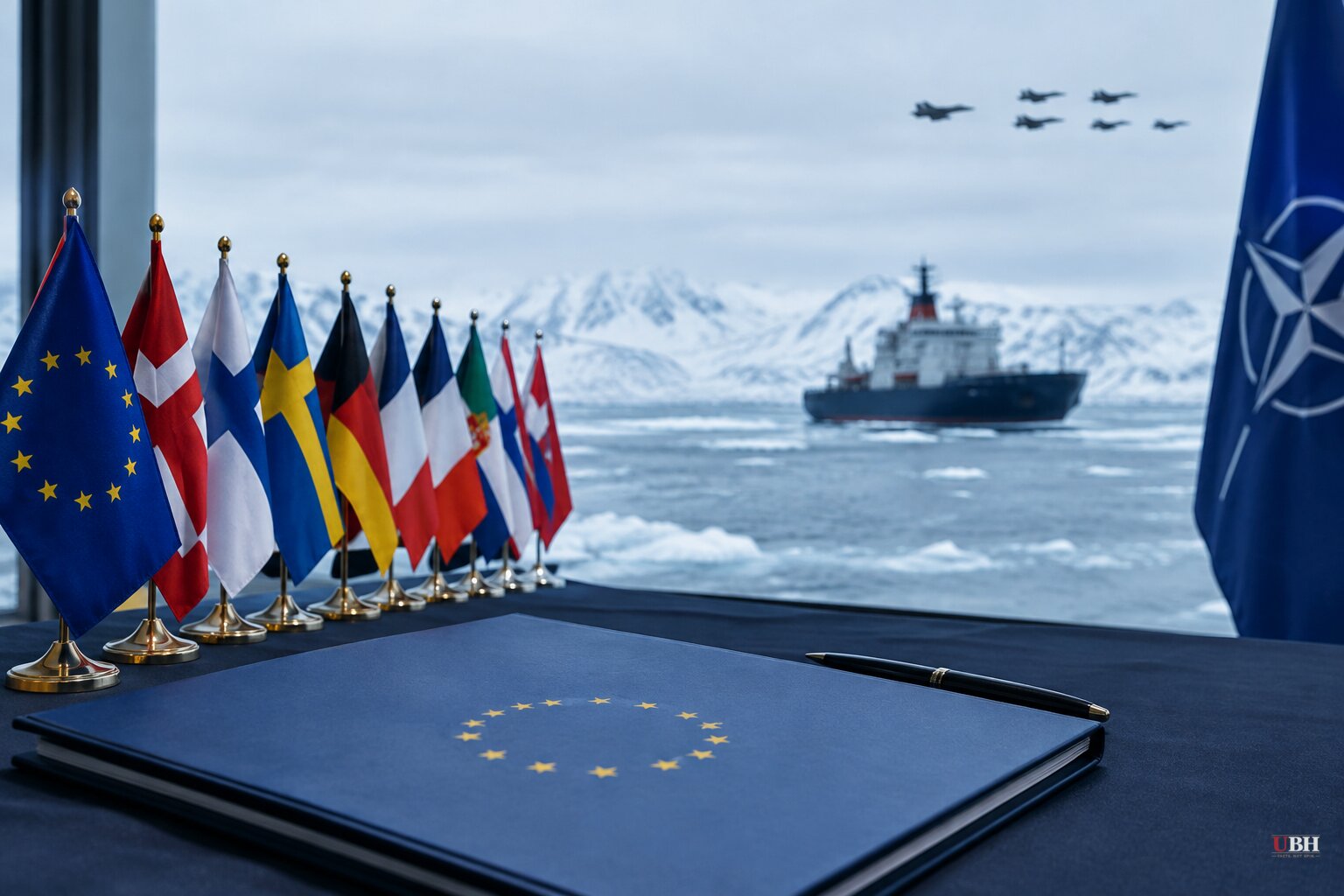
Twelve European Union countries put their names on a joint declaration this month calling Russia a "significant and long-term threat" to Euro-Atlantic security. The statement came out of a two-day European Arctic Summit hosted by Finland, according to Arctic Today, and was signed by Finland, Denmark, Estonia, France, Greece, Germany, Latvia, Lithuania, the Netherlands, Poland, Romania and Sweden.
"We note with serious concern the significant and long-term threat Russia poses to Euro-Atlantic security," the declaration read, per Arctic Today. The countries cited Russia's war in Ukraine, its "hybrid activities," China's growing interest in the Arctic, and melting sea ice opening new shipping lanes.
EU foreign policy chief Kaja Kallas raised the idea of the bloc jointly owning icebreakers. "Considering the geopolitical situation that we are in and considering climate change and opening of the maritime routes, we need more icebreakers," she said at a press conference after the summit, according to Arctic Today. German Chancellor Friedrich Merz backed the idea, saying Arctic operations are "not just an issue for Finland, for Norway, for Sweden" but "something for the entire European Union." An updated EU Arctic policy is expected later this fall, per Arctic Today.
The jet numbers, and where they come from
Separately, RT published a review of what it described as the 2026 Russian Military Yearbook, a document sponsored by a state arms company and intended for senior Russian national security officials. Analyst Andrew Korybko, writing on Substack and republished by ZeroHedge and other outlets, summarized its Arctic section: Finland plans to acquire 64 F-35A stealth fighters, Canada 88, and Norway already has 52. Russia's own fifth-generation fighter, the Su-57, numbers roughly 20 aircraft, per the same analysis. Sweden currently has no fifth-generation jets.
Do the math on just those four countries and Russia is outnumbered more than 10 to 1. Add the U.S.'s stated fleet of over 500 F-35s and the ratio climbs to 35 to 1, according to Korybko's analysis.
Those figures deserve a caveat. They trace back to a single Russian government-linked document characterized by RT and interpreted by one analyst, then republished nearly word-for-word across ZeroHedge, TheAltWorld, Pressenza and the Norwegian outlet Steigan.no. That's one source appearing five times, not five independent confirmations. No NATO government or U.S. defense official has been cited disputing or confirming the specific figures, though Norway's F-35 fleet size and Canada's and Finland's purchase plans are consistent with previously reported NATO acquisition programs.
Golden Dome and the Northern Sea Route
Korybko's analysis also argues the U.S. is pursuing a three-part strategy: building "Golden Dome" missile defense infrastructure in the Arctic to blunt Russia's nuclear second-strike capability, arming Canada and the Nordic states, and eventually testing Russian limits along the Northern Sea Route to make that shipping corridor too dangerous to use. That characterization comes from Russian experts cited in the Yearbook and from Korybko himself. No U.S. official is quoted confirming that Golden Dome is aimed at neutralizing Russia's second-strike capability specifically. The project has been publicly framed by the Trump administration as broader homeland missile defense.
Canada's EU tilt
European Commission President Ursula von der Leyen invited Canada to become an "associate member" of the EU during her state of the union address, according to TheAltWorld's Korybko. Trump warned the U.S. would impose "very heavy tariffs" on the EU if the arrangement amounted to a "hostile act," per the same analysis, apparently concerned about EU goods reaching the U.S. market through Canada. Canadian Prime Minister Mark Carney separately applied to join the UK-led Joint Expeditionary Force, which includes the Nordic countries, the Baltic states and the Netherlands.
A merging front, according to Moscow
Irina Strelnikova, who directs the Higher School of Economics' Center for Interdisciplinary Arctic Studies, told RT that the countries at the Arctic summit "no longer view the Arctic in isolation" and are linking it to the Baltic and Black Sea regions, calling it "a genuinely worrying signal," according to Global Research's summary of her remarks.
Russia's argument, consistent with its late-2021 security guarantee requests to NATO, is that Western military buildups on its borders constitute encirclement regardless of NATO's stated defensive intent. NATO governments counter, as the joint EU declaration shows, that Russia's invasion of Ukraine and "hybrid activities" are what triggered the buildup in the first place. No source here resolves that dispute. Both are framed as competing risk assessments rather than settled fact.
Finland, Canada and Norway are buying stealth fighters Russia can't currently match in numbers. Twelve EU states have put a threat assessment in writing, and Brussels is set to publish an updated Arctic policy sometime this fall. Whether that policy addresses joint icebreaker ownership, and how Moscow responds to it, remains to be seen.
Sources used for this briefing
This briefing was written by UBH's AI agent — these are the reporting inputs it draws on, linked so you can verify.


