
Unbiased headlines. Facts, not spin.
Unbiased Headlines is an independently owned news organization. We bring you the facts, not opinions, written fresh from 110+ named sources. Sources linked so you can verify it yourself.
 economy
Notable (6/10)
Event date: October 20, 2026 ·
EU Deficit With China Nearly Doubled Since 2024 as Cost-of-Living Protests Spread Across Europe
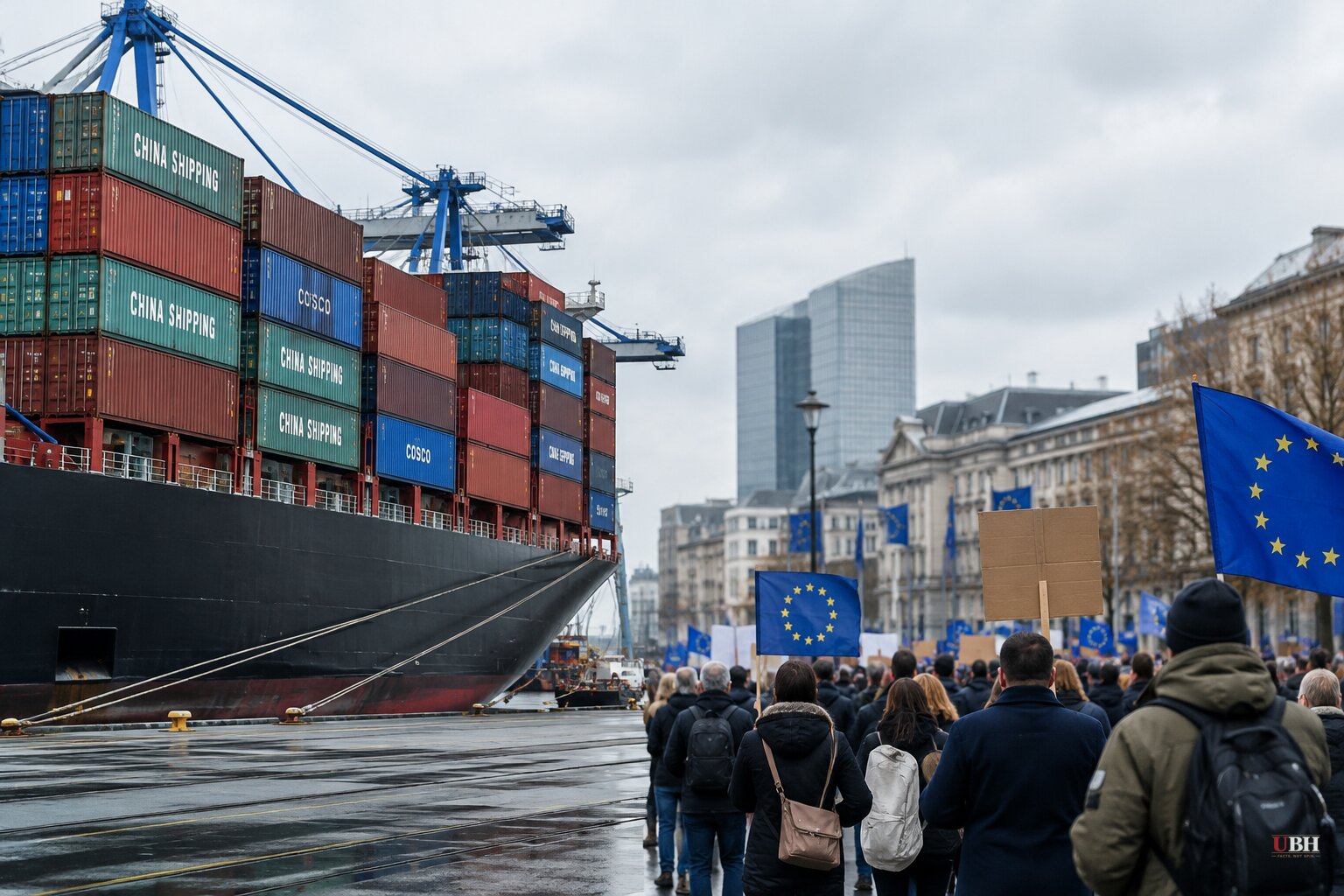
Europe is under strain on two fronts. Its trade deficit with China has grown sharply, and protests over the cost of living have turned violent in parts of the continent.
Nobody in the reporting links the two. They are separate developments, but they land in the same week.
The China trade gap
Columnist Milton Ezrati, writing in The Epoch Times, put figures on the shift. The EU's trade deficit with China rose from 66.14 billion euros in the first quarter of 2024 to 103.34 billion euros in the second quarter of 2026. That is a jump of more than 50 percent in roughly two years.
Ezrati says EU imports of Chinese goods rose 12.5 percent in 2025. He puts the gain at another 8 percent over the 12 months ended mid-2026.
He also says China lost about half of its North American sales to Trump administration tariffs during 2025 and has regained little since. In his reading, Beijing now needs European buyers more than it did, and Brussels has noticed.
German carmakers lose ground in China
The numbers from Europe's flagship exporters point the other way. Ezrati says Mercedes sales in China fell 30 percent year over year in the second quarter of 2026. BMW's fell 25 percent in the 12 months ended in the third quarter. Audi's fell 12 percent through the first quarter.
Those companies once grew fast in China. Between 2003 and 2022, Ezrati says, Mercedes sales there rose 24 percent a year, BMW's 20.2 percent and Audi's 12.6 percent.
Ezrati's argument is that European business no longer has the same incentive to lobby Brussels for a soft line on Beijing. Domestic Chinese competitors have eroded those once-profitable operations, and Chinese imports have hurt European producers at home. He calls this a significant turn in European trade policy, but says how it plays out is conjecture.
Unrest in France and Albania
The protests are a separate matter. UN human rights chief Volker Türk said this week that riots had erupted across Europe over rising living costs. He condemned those using protests for violence and vandalism and said they should be held individually accountable.
Türk also said he was concerned about reports of "unnecessary and excessive use of force against protesters, including children." He called for prompt, independent investigation of any allegations of unlawful force.
In Tirana, Albanian police have clashed with anti-government protesters for eight straight days, according to the Associated Press. Demonstrators are demanding Prime Minister Edi Rama resign. The AP says they have thrown rocks, flares and firebombs, and that police have answered with tear gas and water cannons.
The AP attributes the Albanian unrest to anger over fuel costs, the education system and a housing crisis. Rama called the protests "an attempt to overthrow the government and change those in power through the imposition of violence" and said that would "never be allowed."
In France, unrest has gripped the country for several days. Fox News reported that a man it describes as a far-left activist was arrested after a city hall was set on fire.
Trump's response
President Donald Trump pointed to France while campaigning in Greenville, North Carolina, for Republican Senate candidate Michael Whatley. He was responding to a heckler.
"You watch nutjobs like him in France ruining their country," Trump said. "We're not going to put up with it by the way."
Trump said that if a threat emerged in the U.S., "I hope you won't get angry if I treat them very, very rough." He framed that as a response to potential threats, not to peaceful protest.
Türk's statement sits at the other end of that spectrum. It asks that any police response stay "lawful, necessary and proportionate," and it calls for "inclusive and safe dialogue" between governments and protesters.
What is unresolved
The trade figures come from a single columnist's account, and no EU institution is quoted confirming them in this reporting. Brussels has not been shown linking its China posture to the street unrest, and the protesters' stated grievances are fuel, housing and schools, not China.
What remains open is whether the EU turns the leverage Ezrati describes into actual trade measures, and whether the Tirana demonstrators get any response beyond Rama's refusal to yield to them.
Sources used for this briefing
2 links from 2 independent newsrooms (syndicated copies of the same report count once)
These are the sources it draws on, linked so you can verify.


