
Unbiased headlines. Facts, not spin.
Unbiased Headlines is an independently owned news organization. We bring you the facts, not opinions, written fresh from 110+ named sources. Sources linked so you can verify it yourself.
 health
Major Story (7/10)
Event date: October 17, 2026 ·
EPA Data Finds PFOA or PFOS at 4 ppt or Higher in 1,700-Plus Water Systems, and Agency Rewrites 'Phased Out' Claim
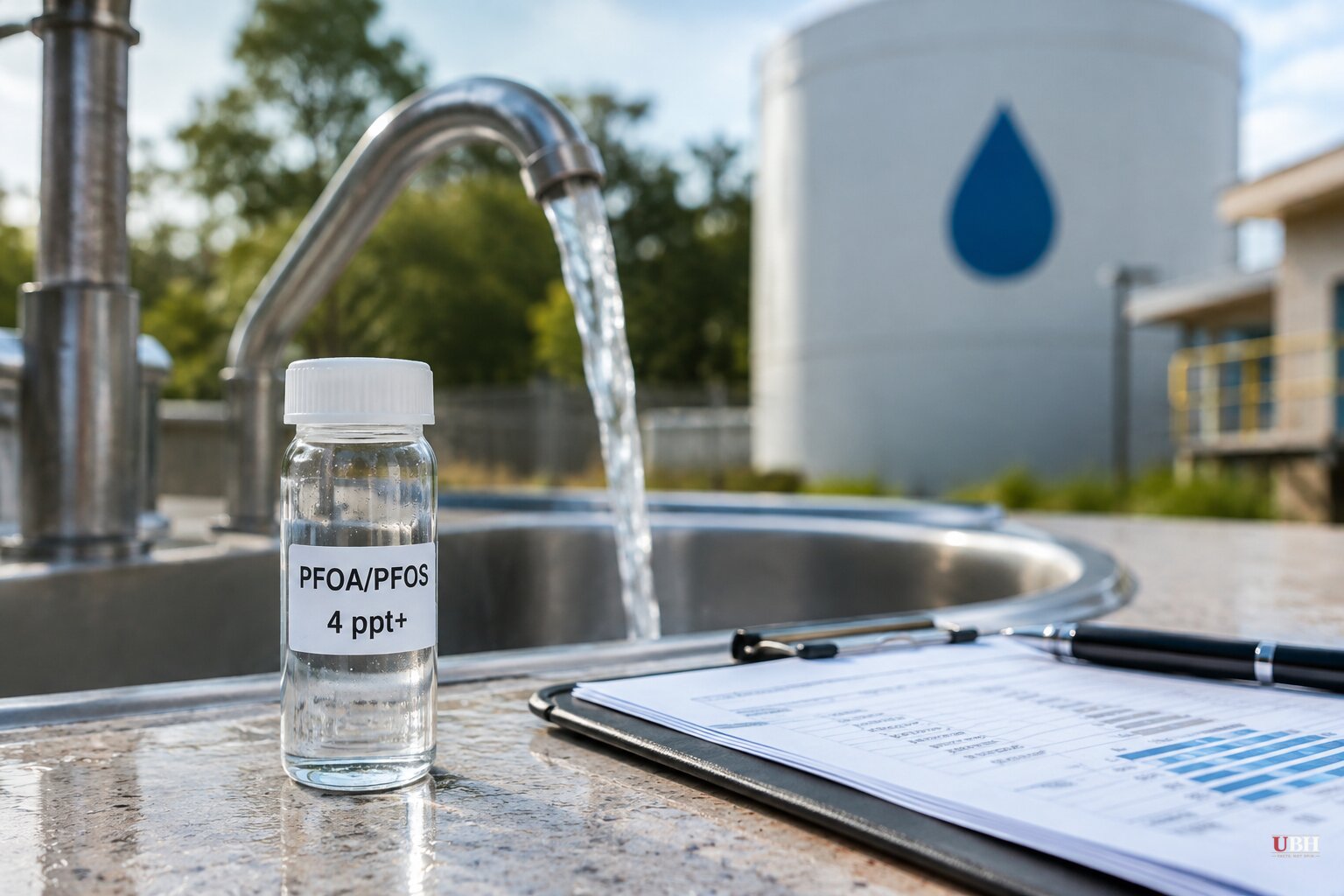
More than 1,700 U.S. public water systems recorded at least one PFOA or PFOS result at or above 4 parts per trillion, according to final federal monitoring data released in August. That number is the federal Maximum Contaminant Level for each chemical.
The figures come from the EPA's Fifth Unregulated Contaminant Monitoring Rule, known as UCMR 5. It required certain water systems to test for 29 PFAS between 2023 and 2025.
A caveat is important here. A single UCMR 5 reading at or above 4 ppt is not a violation. Compliance is determined through separate compliance monitoring and running annual averages. So the 1,700 figure counts systems with a high reading, not systems that broke the law.
What the chemicals are
PFOA and PFOS are man-made PFAS used since the mid-20th century in stain- and water-resistant coatings, food packaging and textiles. PFOS was also used in firefighting foams.
The International Agency for Research on Cancer classifies PFOA as carcinogenic to humans and PFOS as possibly carcinogenic. Studies have also linked the chemicals to liver damage, thyroid disease, high cholesterol and reproductive or developmental problems.
They break down extremely slowly. A detection today does not mean anyone is making the stuff today. Old contamination lingers.
EPA rewrites its own website
Last month, the EPA changed language on its website that had said the manufacture and import of PFOA "has also been phased out in the United States."
The watchdog group Public Employees for Environmental Responsibility (PEER) filed a complaint over that wording in October 2025 under the Information Quality Act. In a response this September, Douglas M. Troutman, the EPA's Assistant Administrator for Chemical Safety and Pollution Prevention, wrote: "In response to PEER's request, EPA is updating its websites."
The page now reads: "Quantities of PFOA may be produced, imported, and used by companies."
The agency took roughly a year to fix a public statement that its own update now treats as inaccurate. The EPA also did not announce the change. It surfaced because a complainant pushed.
More time for utilities
The EPA is also considering giving some public water systems more time to comply with the federal limits for the two chemicals. In May, the agency announced two proposals concerning the Biden-era PFAS rules. The outcome of those proposals is still open.
Critics, including environmental groups quoted by The New Lede, say the Trump administration's rollbacks of PFAS policy will worsen people's exposure. The administration's stated rationale for the timeline proposals is not laid out in the material at hand, and the EPA has not said how many systems would get extra time.
Cost is also a factor. Water utilities, many of them local and taxpayer-funded, bear the cost of treatment upgrades. Compliance deadlines are a real budget question, not just a political one. But the EPA's own position, as it has previously confirmed, is that there is essentially no safe level of PFOA or PFOS exposure.
Rivers and lakes
A separate report published Oct. 14 by the advocacy group Environment America Research & Policy Center looked at surface water, not tap water. Researchers analyzed federal, state and nonprofit data collected from 2022 to 2024 and found PFAS at 83% of 1,602 tested lakes, rivers and streams. They identified more than 114 different PFAS.
In Minnesota, PFAS turned up at all 91 testing sites, including dozens along the Mississippi River. The Mississippi was also contaminated at all 39 monitoring locations in Minnesota and Wisconsin, and at every site on and around Lake Ontario.
The highest concentration in Minnesota was near Hastings, downriver from 3M's Cottage Grove facility. 3M made PFAS there for decades beginning in the 1940s, and the chemicals were discontinued in the early 2000s. In 2018, the company agreed to pay Minnesota $850 million to settle a lawsuit alleging environmental contamination in the east Twin Cities metro. 3M stopped producing PFAS at the end of 2025.
The national high was in Brunswick, Maine, near an executive airport that had a PFAS firefighting foam spill in 2024. State testing of a nearby retention pond found PFOS at 1,040,000 ppt. The 4 ppt limit applies to drinking water, not to a retention pond, so that comparison shows scale rather than a violation.
John Rumpler, the report's co-author, noted surface water monitoring varies across the country. The report's authors say the findings are likely "just the tip of the iceberg" because many waterways have never been tested. Tony Spaniola, co-chair of the Great Lakes PFAS Action Network, said the report "dramatically understates the problem." Both are advocates with a stake in stricter rules.
A March analysis by the Environmental Working Group estimated that roughly 176 million Americans drink PFAS-polluted tap water.
The chemicals nobody routinely tests for
A study in the October issue of Environmental Science & Technology Letters points to another gap. New Jersey researchers tested tap water from across the state and a range of bottled drinks. They looked at ultra-short-chain PFAS, which are generally not part of routine U.S. drinking water monitoring.
One of them, trifluoroacetic acid (TFA), turned up in more than 91% of tap water samples and nearly 80% of bottled beverages. Sports drinks, electrolyte waters and other formulated beverages averaged 52 times more TFA than plain bottled water.
The researchers said TFA is not intentionally added. It may come from ingredients, manufacturing processes, or water sources polluted by pesticides or refrigerants. European chemical regulators recently recommended classifying TFA as toxic to reproduction.
No U.S. standard covers TFA. What remains unsettled is the EPA's pending decision on whether to give some utilities extra time on the PFOA and PFOS limits, which would set the compliance schedule for the systems that logged those 4 ppt readings.
Sources used for this briefing
6 links from 4 independent newsrooms (syndicated copies of the same report count once)
These are the sources it draws on, linked so you can verify.


