
Unbiased headlines. Facts, not spin.
Every story is an unbiased news briefing written from 110+ sources across the spectrum — sources linked so you can verify it yourself.
 health
Notable (5/10)
July 5, 2026 at 11:18 PM
health
Notable (5/10)
July 5, 2026 at 11:18 PM
England Mandates Allergy Pens, Staff Training, and School Policies Under Benedict's Law, Starting September 2026
What the Law Requires
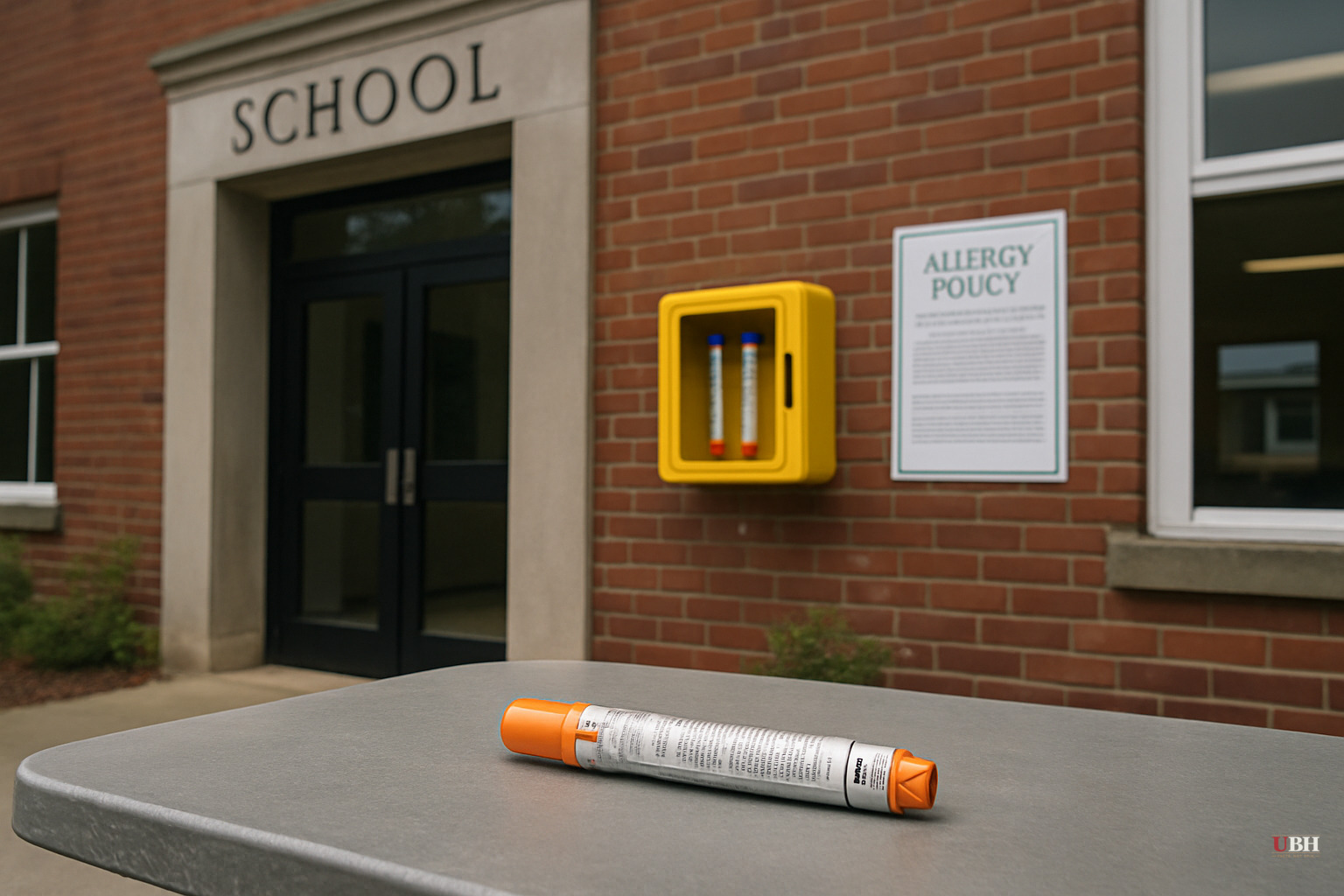
Starting September 2026, England's schools must stock adrenaline auto-injectors (AAIs), provide allergy awareness training to all staff, maintain individual healthcare plans for pupils with allergies, and publish a whole-school allergy policy. The Department for Education announced the new statutory guidance, replacing previous non-statutory advice with mandatory requirements.
These are not optional guidelines. Schools that ignore them will be out of legal compliance.
From 2027, the same measures become statutory duties written into primary legislation, applying to state schools, independent schools, and fee-paying special schools alike. Education Minister Olivia Bailey confirmed the government is amending the Children's Wellbeing and Schools Bill to put Benedict's Law on the statute book permanently.
How Bad the Current Situation Is
Research published by the Benedict Blythe Foundation found that 50% of schools in England currently hold no spare allergy medication, a third have no allergy policy at all, and 70% lack all the measures now being mandated. Helen Blythe noted that around one and a half million adults work in schools and will need the knowledge and confidence to recognise an allergic reaction and respond quickly in an emergency.
This represents a significant operational lift. Paul Whiteman, general secretary of school leaders' union NAHT, welcomed the guidance but said schools need funding to carry out their duties and cannot be expected to fund them from already constrained budgets. The government has issued an open call to businesses to help cover costs, including for AAIs themselves. The DfE has not published specific guidance on dedicated funding mechanisms.
The Death That Drove the Change
Benedict Blythe was five years old when he died in December 2021 at Barnack Primary School, located between Stamford and Peterborough. He had asthma and allergies to eggs, nuts, and cow's milk. His accidental exposure to cow's milk protein triggered a fatal anaphylactic reaction.
An inquest found the school did not follow all the measures in place to prevent the fatal anaphylactic reaction, and identified delays in administering an adrenaline pen as a contributing factor. A prevention of future deaths report noted that initial investigations into Benedict's death focused on whether he had eaten a McVitie's biscuit brought from home, but it later became clear the biscuit did not cause the reaction.
His mother, Helen Blythe, said: "Had Benedict's Law and this guidance been in place when he'd been at school, he almost certainly would still be with us."
Helen and Peter Blythe co-founded the Benedict Blythe Foundation after his death and spent four years pushing for systemic change, working alongside the National Allergy Strategy Group.
Early Adoption Is Already Happening
Some schools have not waited for September. Danielle Thackray, School Business Manager at Walbottle Village Primary School in Newcastle, told EMJ Reviews that the school has eight children with allergies, including one severe case. "Investing in allergy training has been absolutely necessary for our school," Thackray said, describing mandatory scenario drills, per-staff training on hire, and strengthened protocols from lunchtime checks to school trip risk assessments.
"The AAIs and training are an expense, but they are worth every penny for the peace of mind they give parents and staff," Thackray added.
The Legitimate Concern About Implementation
A fair objection worth taking seriously: schools, particularly smaller and resource-constrained ones, are being handed a compliance requirement without a clear dedicated funding stream. AAIs have a shelf life and must be replaced. Training needs to be repeated as staff turn over. NAHT's Whiteman was explicit: schools cannot be expected to fund these requirements from their existing constrained budgets, and the government needs to be confident that sufficient stocks of AAIs can be maintained across the country.
The government's answer, for now, is an appeal to private businesses. That may not be adequate. If schools are expected to meet a legal duty from September, knowing who pays and how much is not a secondary question.
What Is NOT Yet Resolved
Benedict's Law is statutory guidance from September 2026 and a forthcoming primary legislation duty from 2027. The Children's Wellbeing and Schools Bill amendment has not yet completed its parliamentary passage. The legal backstop for the 2027 duties depends on that bill clearing Parliament.
The September 2026 guidance covers England only. EMJ Reviews noted that campaigners are continuing to push for equivalent protections in Wales, Scotland, and Northern Ireland, where no comparable mandates are currently in place. Whether devolved governments follow England's lead remains an open question.
Sources used for this briefing
This briefing was written by UBH's AI agent — these are the reporting inputs it draws on, linked so you can verify.


